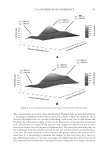
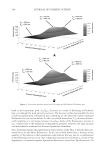
J. Cosmet. Sci., 62, 191–202 (March/April 2011) 191 Spectrofl uorescent characterization of changes in hair chemistry induced by environmental stresses ROGER L. McMULLEN, SUSAN CHEN, and DAVID J. MOORE, Materials Science Dept., Corporate R&D, International Specialty Products, Wayne, NJ. Synopsis Hair is frequently exposed to environmental stresses and chemical insults that result in damage to its internal structure and its outer cuticular components. Spectrofl uorescence is a useful tool to monitor the health of biological tissues as it can measure the level of tryptophan (Trp), which is representative of protein integrity. In addition to Trp fl uorescence, several other fl uorophores are also present in hair and are believed to be at- tributed to kynurenenine, N-formylkynurenine, and 3-hydroxykynurenine, which are known metabolic and degradation products of Trp that are affected by environmental stresses normally experienced by hair. In this work, we were able to construct an endogenous fi ngerprint of fl uorescent compounds present in hair by em- ploying a range of excitation wavelengths from 270 nm to 450 nm with a resolution of 2 nm. As a result, we generated surface plots of fl uorescence emission as a function of excitation and emission wavelengths (excita- tion-emission matrices). Thus, we were able to profi le the levels of various structural molecules in hair before and after exposure to UV irradiation and thermal straightening irons as well as to chemical treatment such as bleaching and straightening. INTRODUCTION Human hair is constantly exposed to environmental insults that damage the fi ber and reduce its biological integrity. In addition to natural stresses, such as UV irradiation, hair is often subjected to other chemical and physical treatments. For example, hair may be damaged by mechanical grooming procedures or thermal treatments carried out with hot irons. Chemicals treatments, such as permanent waving, hair straightening with relaxers, and bleaching of hair, are also very damaging to hair. Typically, permanent waving is ac- complished by treating the hair fi rst with a reducing agent (e.g., mercaptoethanol) to break disulfi de bonds, then once hair is manipulated in the desired formation, it is treated with H2O2 in order to reform the disulfi de links (1). Historically, hair straightening was achieved with lye relaxers (containing NaOH), which are very damaging to hair’s mor- phological and chemical structure (2). More recently, slightly less basic reagents have been introduced as straightening agents however, lye relaxers are still commonly em- ployed. Hair bleaching, nowadays still a very common procedure, employs H2O2 used in conjunction with accelators (salts of persulfates), which results in hair surface damage and destruction of internal components of hair, including melanin and proteins (3,4). The subject of photodegradation of hair has recently received a great deal of attention in the
Purchased for the exclusive use of nofirst nolast (unknown)
From: SCC Media Library & Resource Center (library.scconline.org)