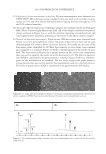
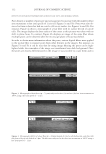
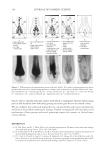
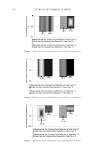
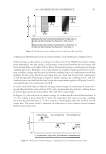
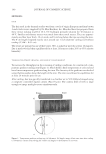
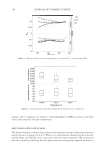
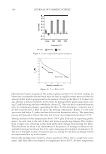
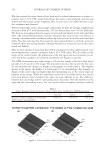
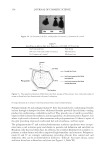
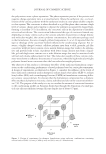
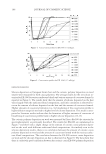
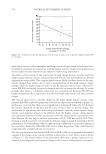
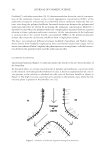
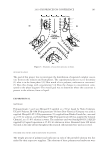
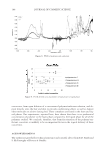
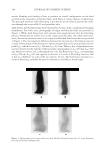
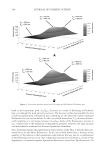
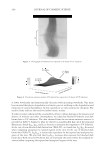
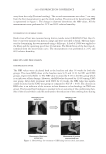
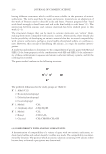
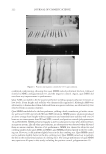
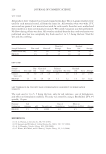
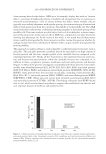
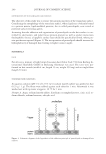
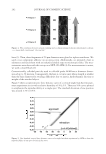
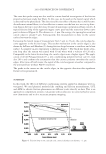
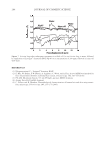
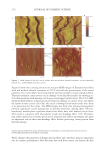
JOURNAL OF COSMETIC SCIENCE 264 REFERENCES (1) Polyquaternium-87 = Luviquat® Sensation, BASF. (2) E. Max, W. Häfner, F. W. Bartels, A. Sugiharto, C. Wood, and A. Fery, A novel AFM based method for force measurements between individual hair strands, Ultramicroscopy, 110, 320–324 (2010). (3) P.A.L.M. Microbeam System, 355 nm UV-light, gas laser, ZEISS, Germany. (4) Atomic Force F&E GmbH, Germany. (5) C. LaTorre and B. Bhushan, Nanotribological characterization of human hair and skin using atomic force microscopy, Ultramicroscopy, 105, 155–175 (2005). Figure 7. Friction loops after subsequent treatments in a fl uid cell: In situ friction loop in water, followed by application of Luviquat® Sensation (INCI PQ-87) at a concentration of 200 ppm, followed by rinse-off with water.

J. Cosmet. Sci., 62, 265–282 (March/April 2011) 265 The effect of various cosmetic pretreatments on protecting hair from thermal damage by hot fl at ironing Y. ZHOU, R. RIGOLETTO, D. KOELMEL, G. ZHANG, T.W. GILLECE, L. FOLTIS, D. J. MOORE, X. QU, and C. SUN, International Specialty Products, Wayne NJ (Y.Z., R.R., D.K., G.Z., T.W.G., L.F.), and ISP Shanghai Global R&D, Shanghai, China (X.Q., C.S.). Synopsis Hot fl at irons are used to create straight hair styles. As these devices operate at temperatures over 200 °C they can cause signifi cant damage to hair keratin. In this study, hair thermal damage and the effect of various polymeric pretreatments were investigated using FTIR imaging spectroscopy, DSC, dynamic vapor sorption (DVS), AFM, SEM, and thermal image analysis. FTIR imaging spectroscopy of hair cross sections provides spatially resolved molecular information such as protein distribution and structure. This approach was used to monitor thermally induced modifi cation of hair protein, including the conversion of α-helix to β-sheet and protein degradation. DSC measurements of thermally treated hair also demonstrated degradation of hair keratin. DVS of thermally treated hair shows the reduced water regain and lower water retention, compared to the non-thermally treated hair, which might be attributed to the protein conformation changes due to heat damage. The protection of native protein structure associated with selected polymer pretreatments leads to improved moisture restoration and water retention of hair. This contributes to heat control on repeated hot fl at ironing. Thermally stressing hair led to signifi cantly increased hair breakage when subjected to combing. These studies indicate that hair breakage can be reduced signifi cantly when hair is pretreated with selected polymers such as VP/acrylates/lauryl methacrylate copolymer, polyquaternium-55, and a polyelectrolyte complex of PVM/MA copolymer and polyquaternium-28. In addition, polymeric pretreatments provide thermal protection against thermal degradation of keratin in the cortex as well as hair surface damage. The morphological improvement in cuticle integrity and smoothness with the polymer pretreatment plays an important role in their anti-breakage effect. Insights into structure-property relationships necessary to pro- vide thermal protection to hair are presented. INTRODUCTION Hair damage from thermal treatment with styling appliances such as hot fl at irons, blow dryers and curling irons has become an increasing concern in hair care. This is especially true with hot fl at irons that can exceed temperatures of 200°C. Because of the growing popularity of using high temperature thermal styling appliances, there is a need for ther- mal protective ingredients/products and test methods to show their effi cacy. To meet this challenge, understanding and assessing hair damage from thermal treatment is needed. In recent decades, thermal damage of hair by curling irons has been discussed by several publications (1–3) that have studied various effects on hair thermal damage, such as
Purchased for the exclusive use of nofirst nolast (unknown)
From: SCC Media Library & Resource Center (library.scconline.org)