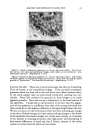
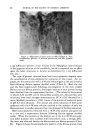
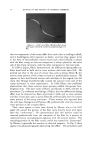
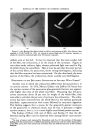
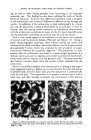
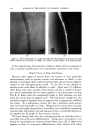
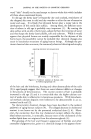
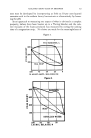
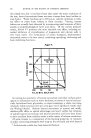
FILM PROPERTIES AND COMPOUND FORMATION IN THE SODIUM LAURYL SULFATE-LAURYL ALCOHOL-WATER SYSTEM* By ABRaHaM WtLSON Textile Resins Research, dinerican Cyanamid Co. Bound Brook, N. •. WE ARE PRESENTING here essentially a review of previously pub- lished work and in particular some quantitative aspects of simple experi- ments of considerable significance with respect to the evaluation of foam properties by single film techniques (1). The effect of long chain polar additives upon the rate of drainage of detergent films is directly related to their effect on the quality of the foam which can be produced from the same system. The temperature at which a given slow draining foam will sud- denly change to a fast draining one is identical to that at which the slow draining single film, prepared from the same solution, becomes fast drain- ing. Furthermore, the film drainage experiment requires only a test tube into which a rectangular glass frame has been sealed (Fig. 1), and ordinary laboratory equipment such as a suitable container for varying the tem- perature. The film drainage tube itself may be of any convenient size and has been scaled down to hold as little as 1 mi. of solution. The method of observation is as follows: Let us assume that we have two film drainage tubes, each half-full, one giving a slow draining and the other a fast draining film. By rotating the tubes 90 ø to a horizontal plane, with the frame also horizontal, and then slowly returning the tube to the vertical position, a film has been formed on each frame. Now if the tubes are placed in such a way that the observer can see the reflections from the film surfaces, the slow draining film will simply reflect the light source, while the fast draining film will exhibit rapidly descending horizontal bands of interference colors. These bands are of course directly related to the thickness of the film, and their rapid descent is indicative of the rate with which liquid is draining from the film. The thinning of the slow draining film is a much slower process, and may take many hours to drain completely to a "black film" whereas the fast draining film will drain to the same con- dition in a matter of seconds, hence "fast draining." * Presented at the May 13, 1955, Meeting, New York City. 392

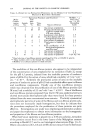
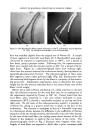
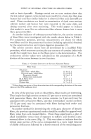
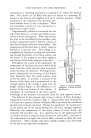
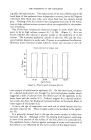
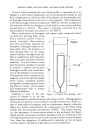
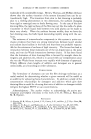
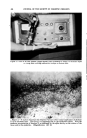
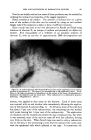
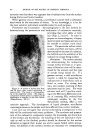
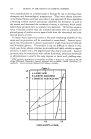
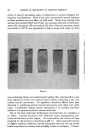
SODIUM LAURYL SULFATE-LAURYL ALCOHOL-WATER SYSTEMS 393 If now a tube containing the slow draining film is immersed up to its stopper in a bath whose temperature can be systematically raised, we will find a temperature at which the film will suddenly and dramatically alter its drainage characteristics from slow to fast draining. This temperature is the film drainage transition temperature (FDTT), which' is a property of the structure of both the detergent and the additive, their ratios and their concentrations in solution. This paper is primarily concerned with the relationships of detergen• and additive to the FDTT. Many combinations of detergents and organic polar compounds which can form slow draining films, along with a tentative outline of the re- quired structural characteristics, have been previously reported (2). Examples of detergent-additive sys- tems which favor the formation of slow draining films are the soaps, alcohol sulfates, monoglyceride sul- fates in combination with long chain fatty acids, fatty alcohols and similar materials. It is to be borne in mind that the amount of additive required to produce a solution having slow drainage is usually only a small frac- tion of the detergent concentration. Consequently many commercial de- tergents, such as the alcohol sulfates which contain unsulfated alcohols, are capable of producing slow drain- ing films at certain concentrations and temperatures with no further addition of additive. Common to most of the sub- stances of interest to us are two Figure 1.--Typical film drainage tube." physical properties, micelle formation and surface activity. The aggregation of molecules in solution to form micelles is usually observed as a break in a plot of some physical property such as conductance, density, refractive index, etc., versus concentration, the concentration at the break being termed the critical micelle concentration (CMC). The surface activity, i.e., the adsorption of surface-active solute at the air-liquid, the liquid- liquid, and the solid-liquid interfaces, manifests itself as a reduction in the corresponding interfacial tension at each interface relative to that of water. Very often the adsorption of surface-active molecules at the air-liquid interface leads to the ability of the solution to form stable films.
Purchased for the exclusive use of nofirst nolast (unknown)
From: SCC Media Library & Resource Center (library.scconline.org)