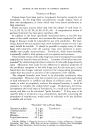
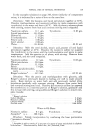
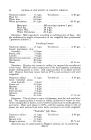
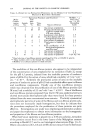
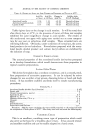
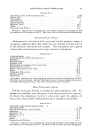
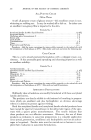
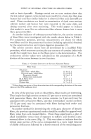
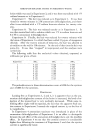
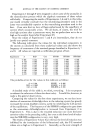
390 JOURNAL OF THE SOCIETY OF COSMETIC CHEMISTS Experiments 5 through 9 were designed to show some of the anomalies in the neutralization process which the algebraic treatment of these values will clarify. Comparing the results of Experiments 5, 6 and 9, in this table, one would certainly conclude that the neutralizing procedure used in the latter was considerably superior to the neutralizing procedure used in the first. (I am sure that we have all been embarrassed by the superfluity of cystine which occasionally arises. We all share, of course, the wish for nice high cystines after a permanent wave, but we prefer them not to be as high as the analyst found after Experiment 9 !) Since the values of Experiments 7 and 8 are intermediate, they do not justify any special comment. The following table gives the values for the individual components in the system as calculated from these analytical values and also shows the frequency of occurrence of the terminal groups described in Equations 6, 7 and 8. All values are reported as millimoles per gram of hair. Experiment A B-D C-E SH-HS SH-RSS SSR-RSS 1 0.491 0.202 0.022 0.182 0.040 0.002 2 0.574 0.089 0.052 0.056 0.066 0.019 3 0.658 0.023 0.034 0.009 0.028 0.020 4 0.634 0.064 0.018 0.050 0.028 0.004 5 0.692 0.023 0.006 0.023 0.000 0.000 6 0.674 0.006 0.035 0.001 0.010 0.030 7 0.640 0.009 0.067 0.001 0.015 0.059 8 0.681 0.016 0.019 0.007 0.017 0.010 9 0.623 0 005 0.087 0.000 0.010 0.082 The probable errors for the values in this table are as follows: A •- 0.006 SH-HS q- 0.006 B-D q- 0.0003 SH-RSS q- 0.010 C-E q- 0.006 SSR-RSS q- 0.006 A detailed study of this table is, we think, rewarding. I do not propose to exhaust the substance of these data here today. I would like, however, to make a few general observations. Comparing the values for the first three experiments, we see that intro- duction of ammonium dithiodiglycolate to the reducing system has greatly increased the mixed disulfide content, surely by inhibiting the C-D portion of the equilibrium. The frequency of the SH-RSS configuration goes down as the ammonium dithiodiglycolate is increased from Experiment 2 to Experiment 3. This is due to the retarded reduction rate (note the lower cysteine values in the preceding table), but even at this lower level of reduc- tion the SSR-RSS configuration is very, very high. The results of Experiment 4 show that whereas the level of reduction was inhibited by the introduction of the bi-functional salt, the C-E terminal values are as high as in Experiment 1. Generally, as the ionic strength of

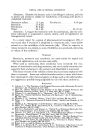
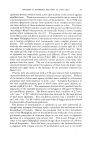
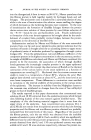
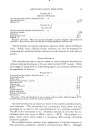
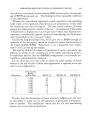
MERCAPTAN-DISULFIDE SYSTEM IN PERMANENT WAVING 391 the solution is increased, maintaining the RSH concentration, the percent- age of RSSW groups goes up. This finding has been repeatedly confirmed in our experiments. Whereas the neutralizing experiment results reported in the preceding table could not be explained, when the data are presented as in this table the conclusions are clear and logical. The true cystine content (A) never exceeds the original cystine content of the hair. A comparison of the results of Experiment 5, Experiment 6 and Experiment 9 shows that Experiment 5 represents a considerably superior method of neutralizing, and the Experi- ment 9 procedure is very, very poor indeed. Excessively long processing times, which give rise to RSSR through air oxidation of the mercaptan, should be avoided to reduce the formation of the mixed disulfide WSSR. Experiment 7, as a departure from experi- ments 1 and 5, points up this danger. The equality of the C-E values in Experiments 3 and 6 is extremely sig- nificant, we think, in the consideration of the whole neutralizing process. It emphasizes the fact that the SSR-RSS configuration is not directly con- vertible to cystine bonds by oxidation. Let me show you one more table in which the total number of bonds broken at the end of each of these nine experiments is reported as the per cent in each configuration. Total Cystines Broken Experiment (mM/g. Hair) SH-HS, % SH-RSS, % SSR-RSS, % 1 0.224 81 18 1 2 0.141 40 47 13 3 0.057 16 48 36 4 0.082 61 34 5 5 0.023 100 0 0 6 0.04l 2 24 74 7 0.075 1 20 79 8 0.186 21 49 30 9 0.092 0 11 89 The fact that the distribution of these terminal configurations can vary so remarkably is surely one for all researchers in permanent waving proc- esses to ponder. The implications which this has for the neutralizing process are, in our opinion, profound.
Purchased for the exclusive use of nofirst nolast (unknown)
From: SCC Media Library & Resource Center (library.scconline.org)