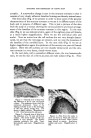
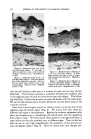
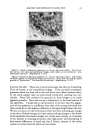
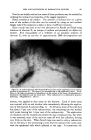
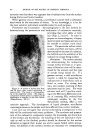
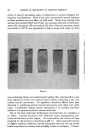
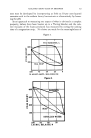
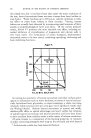
312 JOURNAL OF THE SOCIETY OF COSMETIC CHEMISTS Now it is very significant in my opinion that there are these marked changes in the epidermis in the human skin with advancing age. It is very significant because the epidermis generally has been relegated to a some- what minor role in the skin changes. A great deal of emphasis has been based upon the condition of the underlying dermis and the condition of its fibers. Nex/ertheless, we have seen evidence within recent years of the great pliability of the epidermis. Goldzieher (12, 13) has made studies on the local action of hormones, particularly of the steroid hormones, upon the epidermis and has found that it is possible to change rather radically the microscopic appearance of the epidermis of older people. In our labora- tory we have made studies on experimental animals using particularly the female or estrogenic hormones and have obtained striking changes in the epidermis, including a considerable amount of cell proliferation. It seems to me that the structure of the epidermis, so different in the old from that seen in the young, may be of great importance for the general character of the skin and it is encouraging to know that such a tissue is so near to the surface as to be readily subject to treatment of various types. REFERENCES (1) Andrew, W., "Age Changes in the Skin ooe Wistar Institute Rats with Particular Reoeer- ence to the Epidermis,"/Ira. y./Inat., 89, 283 (1951). (2) Andrew, W., and Andrew, N. V., "Lymphocytes in Normal Epidermis ooe Young, Older Middle-aged and Senile Rats," 5 e. Gerontol., 9, 412 (1954). (3) Ceresa, F., "Trasformazioni del tegumento dell' uomo durante la vita fetale e post- natale. Metamorfosi senili,"/Irch. Ital./Inat. Embriol., 36, 101 (1937). (4) Cowdry, E. V., and Andrew, W., "Some Cytochemical and Cytologic Features of Senile Keratosis," 5 e. GerontoL, 5, 97 (1950). (5) Cowdry, E. V., Copper, Z. K., and Smith, W., "Program of Research on Aging of the Skin," 5 e. Gerontol., 2, 31 (1947). (6) Dick, J. C., "Observations on the Elastic Tissue of the Skin with a Note on the Reticular Layer at the Junction of the Dermis and Epidermis," 7-/inat., 81, 201 (1947). (7) Duran-Reynals, F., "Tissue Permeability and the Spreading Factors in Infection," Bact. Rev., 6, 197 (1942). (8) Ejiri, J., "Studien fiber die Histologie der menschlichen Haut. II Mitteilung. •ber die Alter--und GeschlechtoVerschiedenheiten der elastischen Fasern der Haut," yap. 7. Dermat. u. Urol., 40, 216 (1936). (9) Ejiri, J., "Studien fiber die Histologie der menschlichen Haut. III Mitteilung. •ber die regionaren und Altersunterschiede der verschiedenen Hautelemente mit besondere' Berucksichtigung der elastichen Fasern," •eap. •e. Dermat. u. Urol., 41, 8 (1937). (10) Ejiri, J., "Studien fiber die Histologie der menschlichen Haut. IV Mitteilung. (2ber das Wesen der Altersveranderungen der Haut," 5Cap. 7. Dermat. u. Urol., 41, 64 (1937). (11) Evans, R., Cowdry, E. V., and Neilson, P. E., "Aging in Human Skin. I. Influence of Derreal Shrinkage on Appearance of the Epidermis in Young and Old Fixed Tissue," /inat. Record, 86, 545 (1943). (12) Goldzieher, J. W., "Studies on Aging: Correlation of Skin Morphology with Age and Hormone Excretion," 7. GerontoL, 7, 47 (1952). (13) Goldzieher, J. W., "Local Action of Steroids on Senile Human Skin,"/Irch. Derm, atol. & Syphilol., 66, 304 (1952). (14) Hill, R., and Montgomery, H., "Regional Changes and Changes Caused by Age in the Normal Skin," 5 e. Investigative DermatoL, 3, 231 (1940). (15) Jordan, P., "Alter und Geschlecht in der Biologie der Haut. I. Systematische histo- logische Untersuchung normaler Haut (vorlaufige Mitteilung)," Dermatol. 14/ochenschr., 87, 1709 (1929). (16) Kierland, R. R., and O'Leary, P. A., "The Aging Skin," 5 e./Im. Geriat. $oc., 1, 679 (1953). (17) Kvorning, S. A., and Kirk, E., "Correlation Between Appearance of Skin and Skin Lipid Secretion in Middle-aged and Old Individuals," 7- GerontoL, 4, 113 (1949).

TOPICAL USES OF SEVERAl, ANTIBIOTICS 313 (18) (19) (20) (21) (22) (23) (24) (25) (26) (27) (28) (29) (30) McCreight, C. E., "Experimental Studies on Some Cell Types in the Epidermis of the Mouse," .4nat. Record, 121, 338 (1955). Ma, C. K., and Cowdry, E. V., "Aging of Elastic Tissue in Human Skin," y. Geront., 5, 203 (1950). Pease, D.C., "Electron Microscopy of Human Skin," .rim. •..4nat., 89, 469 (1951). Percival, C. H., "The Skin in Old Age," Practitioner, 172, 510 (1954). Strauss, J., and Necheles, H., "Variation, in Dermal Absorption with Age," 5'. Lab. and Clin. Med., $$, 612 (1948). Strobel, H., "Die Gewebsveranderungen der Haut im Verlauf des Lebens," glrch. Der- matol. u Syphilis, 186, 636 (1948). Thompson, R. C., "Dermatologic Problems of Geriatric Patients," 7. Tenn. Med..4ssoc., 46, 316 (1953). Thuringer, J. M., and Cooper, Z. K., "The Mitotic Index of the Human Epidermis, the Site of Maximum Cell Proliferation, and the Development of the Epidermal Pattern," .4nat. Record, 106, 255 (1950). Traub, E. F., and Spoor, H. J., "Aging Skin with Particular Reference to Small Growths Appearing Late in Life," 7..4m. Geriat. Soc., 1, 805 (1953). Tunbridge, R. E., Tattersall, R. N., Astbury, D. A., and Reed, W. T., Royal Clinical Society, 11, 315 (1952). Cited from "Annotations"--Lancet, 5, 283 (1953). Unna, P. G., "The Histopathology of the Diseases of the Skin," New York, Macmillan and Company (1896), pp. 976-984. Wells, G. C., "Senile Changes in the Skin of Man," •..4m. Geriat. Soc., 2, 535 (1954). Zahon, S. J., Goldberg, A. L., and Forman, J., "Geriatric Dermatoses'. A Survey of the Skin of the Aged," Illinois Med. 5:., 101, 37 (1952). TOPICAL USES OF SEVERAL ANTIBIOTICS: VEHICLES EMPLOYED* By WM. BURDELL BAKER /lntibiotic Division, S. B. Penick & Co., New York 8, N.Y. ANTIBIOTICS such as bacitracin, neomycin and tyrothricin are used mainly for topical and other local applications and are also used orally. The major objective of this particular study is to review salient features of these antibiotics and to present the status of some of the vehicles or bases that have been employed with them. Also, some vehicle formulas similar to those which have been employed for other chemical agents and drugs, such as sulfonamides, are suggested as being adaptable for use with these antibiotics. Various literature reports dealing generally with the above antibiotics have included the subject of bases. Some investigators have given logical reasons for preferring grease bases for topical application of medicaments, while others have favored aqueous bases where possible. Still others ap- parently do not think the nature of the base important because, in discuss- ing applications and results, they mention the vehicle used, but do not state the formula. * Presented at the May 13, 1955, Meeting, New York City.
Purchased for the exclusive use of nofirst nolast (unknown)
From: SCC Media Library & Resource Center (library.scconline.org)