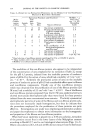
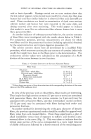
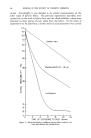
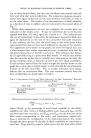
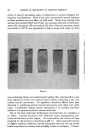
304 JOURNAL OF THE SOCIETY OF COSMETIC CHEMISTS There was not any correlation between the degree of wrinkling or furrow- ing and the amount of secretion. The positive correlation, then, was between the presence of distinct and enlarged skin pores and the presence of a higher amount of lipid secretion. There was also a good degree of correlation between skin thickness and lipid secretion in the women but not in the men. We are interested in this paper primarily in the normal anatomy and his- tology of skin. A nnmber of recent articles, besides attempting to sum- marize the normal characteristics, describe the disease conditions most common for the aging skin (30, 16, 24, 21). PERSONAL RESEARCH ON AGING OF THE SKIN In planning our investigations on age changes in the skin it seemed wise to try to use both animal and human material. Certainly there is such a very large amount of intrinsic interest that attaches itself to the study of human tissues that we felt determined to make such an investigative study. On the other hand, there are so many factors involved in the variations in different tissues of human beings such as pathological conditions, race and other things that it seemed very wise to attempt also to study animal skin and particularly skin of pedigreed animals. We therefore made an arrange- ment with the Wistar Institute whereby it was possible to obtain specimens of skin from different parts of the body of the pedigreed Wistar Institute rats. These include specimens from the back in the region between the scapulae, from the abdomen, near the mid-line, from the ear and from the sole of the forepaw. Our human material consists now of almost 200 individuals, minute samples having been taken from various regions of the body at the time of surgical operation. The skin is so stretchable and so easily regenerated that the taking of such minute specimens does not inconvenience the patient in any way. In this manner it has been pos- sible to obtain representative sections of skin from people of many different ages and skin which is essentially normal in all respects. Careful records are kept of the type of surgical operation involved and, of course, of the general record of the patient so that the material on these individuals is always accessible through our hospital files. However, in general, the operations are such that the condition of the patient is essentially normal except for the particular pathology such as appendicitis, abdominal preg- nancy or some other such condition in which it is not expected that the con- dition of the skin will be other than normal. We now have made three individual studies on the skin of the Wistar Institute rats. The first was concerned with the general characteristics of the dermis and the epidermis and the second with the cell types in the epidermis of the back while the third concerns the cell types at different ages in the epidermis of the abdo- men.

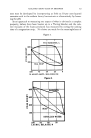
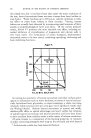
ANATOMY AND HISTOLOGY OF AGING SKIN 305 Let us turn, then, first, to the general study on the dermis and epidermis of the rat skin. We will remember that in regard to the dermis there was a rather confusing series of findings but that there was a considerable body of opinion that there are changes in the elastic connective tissue fibers and probably also changes in the white or collagenous fibers in old age. We found in our very young animals, the twenty-one-day-old rats, that there was a richly cellular dermis, large numbers of fibroblasts and of wandering cells. In these animals the fibrous feltwork generally appears rather loose and the fibers delicate. The elastic tissue was in the form of a widely open network. In the deeper parts of the dermis the fibers are coarse and tend to run parallel to the surface while in the more superficial part they are finer and often run perpendicularly upward. Dense networks are formed about the hair follicles and about the sebaceous glands and here the elastic fibers are relatively heavy. The dermis of the three-hundred-day-old (middle-aged) animals pre- sents a rather marked contrast to that of the younger immature animals in the small number of cells in all of the regions studied. The majority of the cells are pressed closely to the fibers, flattened and with deeply staining nuclei. Very few cells are seen as compared with the younger animals. The collagenous fibers here are coarser than in any of the younger speci- mens and the tissue has a denser appearance. The elastic connective tis- sue showed no change in general from that seen in the very young animals. Of particular interest of course is the appearance of the dermis in the senile rats. Here we find the degree of cellularity or the number of cells per given volume to be rather variable but in general to be much less than in the'very young animal but not to differ greatly from the dermis of the middle-aged animals. There is a larger number of wandering cells, lymphocytes and phagocytic cells in the dermis in the senile animals. The appearance of the collagenous fibers does not differ very greatly from that of the middle-aged animals. No visible evidence of real degeneration or clumping of the fibers was seen except in one 1000-day-old animal where there was a definite basophilic degeneration of fibers. Elastic connective tissue showed remarkably little difference from that in the middle-aged animals. The pattern of the elastic tissue appeared very similar to that seen in very young animals and there is no definite degeneration or clump- ing of elastic fibers seen. When we turn now, however, to the appearance of the epidermis we do find a more marked difference among the different age groups. In the young and the middle-aged animals in general the cells, particularly the nuclei of the cells, have a rather crowded aspect. These nuclei are large and vesicular with relatively little cytoplasm visible between them. This is particularly well seen in the back, the abdomen and on the ear and some- what less clearly on the forepaw.
Purchased for the exclusive use of nofirst nolast (unknown)
From: SCC Media Library & Resource Center (library.scconline.org)