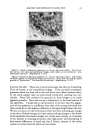
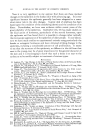
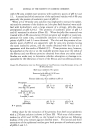
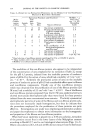
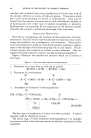
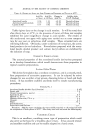
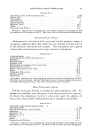
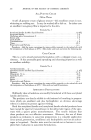
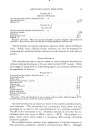
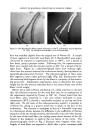
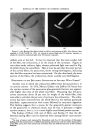
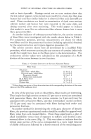
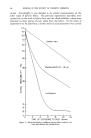
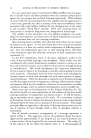
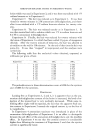
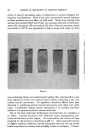
306 JOURNAL OF THE SOCIETY OF COSMETIC CHEMISTS In the young and the middle-aged animals there are present only two layers in the epidermis, that is, a stratum germinativum, a layer of living cells, and a stratum corneum, a layer of dead cells. When we compare the senile animals with younger ones we find that there is invariably present in old age another layer between the stratum germinativum and the stra- tum corneum. This is the stratum granulosum, a layer in which the cells contain many large deeply staining granules. Apparently this layer, in this group of animals at least, did not make its appearance until some time after three-hundred days of age. In the young and middle-aged animals the layer of dead cells or stratum corneum is invariably made up of plate-like structures or lamellae which seem to be very loosely cemented or fastened together. In the senile animals, on the other hand, the stratum corneum seems to be made up of lamellae which are very closely adherent and which are difficult to separate from one another. This difference is accentuated also by the fact that the stratum corneum in the senile animals takes a much more definitely eosino- philic stain than does the stratum corneum in the younger rats. The general effect is to give quite a different aspect to the senile epidermis from that seen in the younger animals. We attempted to make studies on the relative thickness of the epidermis in these animals at different ages and we present a table concerning this relative thickness. It will be seen from the figures that are given that it would not be at all proper to compare epidermis from animals of different ages if material from different regions of the body were to be used. There- fore, the only pertinent comparisons must be made between the back of young and old animals, between the abdomen of young and old animals, etc., for the various regions. When this is done, it is found that there is no significant decrease in thickness of the epidermis in senility for the back, for the abdomen nor for the ear. In fact, although variations are great, TABLE 1--T•IcKNESS Or T•E EPIDERMIS IN YOUNG, MIDDLE-AoED AND SENILE RATS (For each group the probable error is given with the mean the coefficient of variation and the range among the individual rats) Back Abdomen Ear Group I (young, imma- Thickness in u 11.38 q- 0.34 38.3 q- 1.4 18.3 q- 1.13 ture) Coefficient of 10.0 12.5 20.8 variation Range 9.9-12.8 32.7-46.2 13.5-22.0 Group II (middle-aged) Thickness in t• 13.3 q- 1.17 22.2 q- 1.35 10.8 q- 0.67 Coefficient of 41.4 28.6 19.6 variation Range 8.5-17.8 10.7-32.7 7.2-13.5 Group lII (senile) Thickness in u 16.9 q- 1.71 26.1 q- 1.63 15.2 q- 0.80 Coefficient of 47.4 29.2 24.5 variation Range 7.9-31.2 19.9-32.0 12.8-18.5

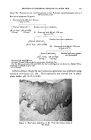
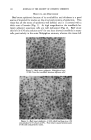
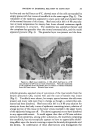
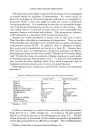
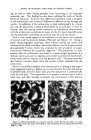
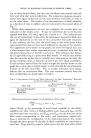
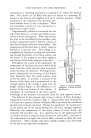
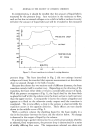
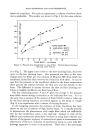
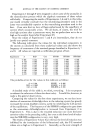
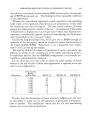
ANATOMY AND HISTOLOGY OF AGING SKIN 307 there is some indication of an increase in thickness of the epidermis in these regions. There is also apparently a correlation between the thickness of the epidermis in any one age group and the degree of development of the stratum granulosum, such that it is best developed in those animals where the epidermis is thickest. Therefore, from our studies on the rat we were not able to see anything which we could call atrophy of the epidermis as such. We did find pockets and groups of somewhat abnormal cell types at certain places and some of these may well represent the beginnings of pre- cancerous lesions. We turn now to the human material. In the human skin which we have examined up to the present time there seem to be certain features of the aging process which are similar to those found in our laboratory animal material and others which are different. In the dermis, for instance, we find the greater degree of cellularity, greater number of cells, particularly in the areas close beneath the epidermis, to be present in the younger individuals just as among the animals and a relative paucity of cells in older persons. The elastic tissue so far as we have studied it appears to be less in amount in senile human beings than in younger, but we do not have means at pres- ent for obtaining good quantitative data on this subject. It is hoped that such a method will be forthcoming. It is to the epidermis, however, that we have paid most attention and it is here that the findings are of most interest because many of them have not been described by other authors. First, we do readily confirm the presence of the abundant rete pegs or shelf-like extensions of the epidermis down into the dermis in the younger individuals. In our senile persons, on the other hand, these rete pegs are actually ironed out so as to be in many cases entirely obliterated, leaving a very smooth and also a very sharp line of demarcation between the epidermis and the dermis. In spite of this difference in the epidermis of the young and of the old individuals, I would hesitate to speak of the epidermis of the senile individ- ual as being in an atrophic condition or as having atrophied. It is still a good many cell layers thick and the cells themselves seem to be in good condition. There are, however, very interesting differences between the epidermis as such of the young and of the old individuals. It will be remembered that the epidermis is generally divided into two or three layers. The two chief layers are the stratum germinativum, composed of living cells some of which usually are found in division, and the stratum corneum, formed of dead cells which are scale-like and which "scuff off" and are lost, being carried away from the body. Interposed between these two layers there frequently is a narrower granular layer, a stratum granulosum. The
Purchased for the exclusive use of nofirst nolast (unknown)
From: SCC Media Library & Resource Center (library.scconline.org)