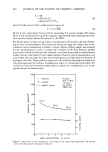
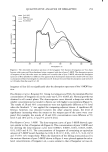
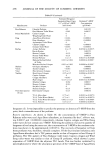
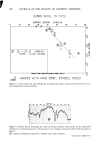
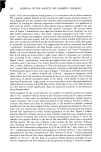
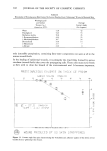
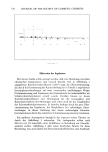
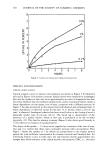
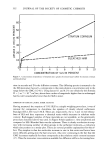
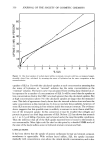
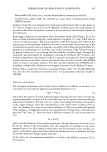
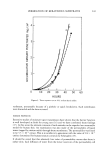
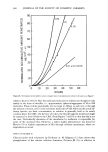
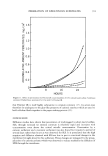
348 JOURNAL OF THE SOCIETY OF COSMETIC CHEMISTS 90 80 z ,,, 70 z • 60 o o 50 - 40 ro 30 N 20 • 10 o z lO% O.Ol and 0.001% 0 I I I 0 10 20 30 40 50 60 HOURS Figure 8. Normalized permeability curves at longer times. Calculation procedure is the same as in Figure 7 which is about 0.24% for SLS, the surfactant molecules in solution are thought to exist mainly in the form of micelies, i.e., approximately spherical aggregates of 50 to 100 molecules. These entities presumably are too large to diffuse as such into or through the stratum corneum, and it is the monomer molecules of SLS which are the actual dif- fusing species yet their concentration in solution is generally held to be nearly constant above the CMC. On the face of it then, the flux through the membrane might be expected to level off above the CMC. From Figures 7 and 8 it is clear that this is not the case. Undoubtedly alteration of the membrane by surfactant is responsible for some of the increased flux. However, a rather similar phenomenon was found by Mysels (19) in dialysis experiments of SLS through cellulose membranes, where no degradation occurred. EFFECT OF POLYMER JR Clinical studies with volunteers by Professor A.M. Kligman (11) have shown that preapplication of the cationic cellulose derivative, Polymer JR (13), is effective in

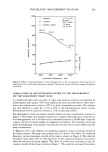
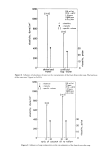
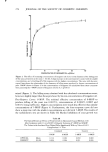
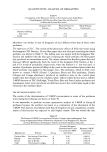
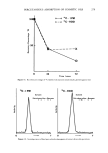
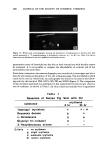
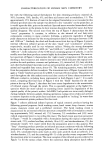
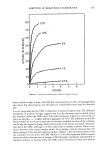
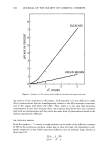
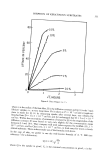
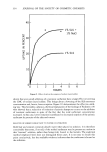
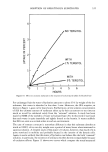
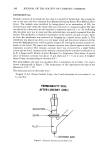
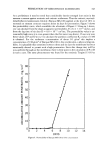
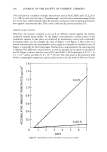
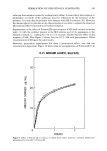
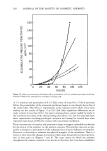
PERMEATION OF KERATINOUS SUBSTRATES 349 reducing skin irritation caused by sodium lauryl sulfate. It seems likely that sorption or permeation (or both) of the surfactant must be influenced by the presence of the polymer. It is true that the polymer does interact with SLS in solution (20). However the amount placed on the skin in the clinical studies is too little to explain the observed phenomena either by interaction or by film formation. Experiments on the effect of Polymer JR upon sorption of SLS were carried out in tWO ways: (1) with the polymer present in the SLS solution and (2) by application to the stratum corneum, i.e., soaking for 1 hr in a 1% solution. Neither had any effect on the sorption of SLS. Thus Figure 9 shows data for 0.1% SLS with pretreatment. Other concentrations of SLS gave the same results. However, permeation experiments did show a pronounced effect, one that was concentration-dependent. Figure 10 shows data for preapplication of Polymer JR (1• hr 0.1% SODIUM LAURYL SULFATE 30 o z o I I o I 2 HOURS Figure 9. Effect of Polymer JR on sorption of sodium lauryl sulfate. Solid line: untreated. Dashed line: pretreatment for 1 hr with 1% Polymer JR
Purchased for the exclusive use of nofirst nolast (unknown)
From: SCC Media Library & Resource Center (library.scconline.org)