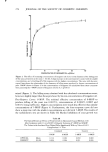
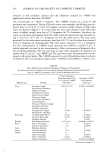
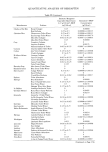
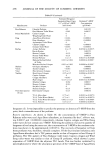
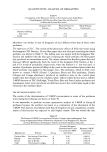
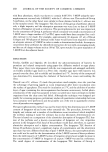
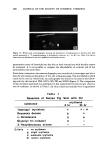
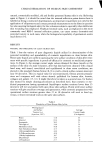
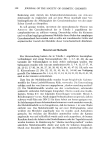
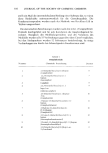
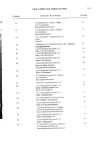
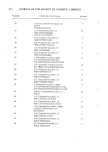
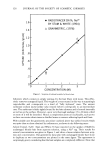
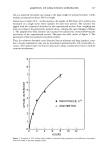
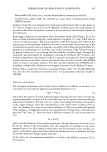
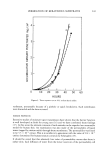
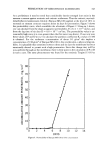
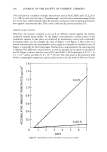
QUANTITATIVE ANALYSIS OF BERGAPTEN 259 Table ¾ A Comparison of the Phototoxic Activity of Yves Saint Laurent Toilet Water Using Bergapten TLC'Fraction, Filter Paper Disc and Silica Gel to Which the Perfume Was Added Bergapten TLC Whole Perfume On Whole Perfume Fraction Filter Paper Disc On Silica Gel Diameter of Killing Zone (mm) 26.8 25.2 23.6 S.E.M. 0.37 0.20 0.40 aftershave was similar to that of bergamot oil and different from that of three other perfumes. The importance of TLC. The results of the phototoxic effects of YSL toilet water using the bergapten TLC fraction, 10 mm filter paper discs and silica gel containing the whole perfume, are shown in Table V. The killing zone was largest with the bergapten TLC fraction and smallest with the silica gel containing the whole perfume the filter paper disc produced an intermediate result. The values obtained for the filter paper discs and silica gel differed significantly from the result of the bergapten TLC fraction at the 1 and 0.1% levels of probability respectively, when the Student's "t" test was used. A number of perfumes produced killing of the yeast in the nonirradiated plates when the whole perfume was applied to filter paper discs. The perfumes, which on TLC were shown to contain 5-MOP (Chanel 5, Quelques Fleurs and F•te perfumes, Charlie Cologne and Cougar aftershave), produced an inhibitory zone in the control plate smaller than that obtained in the irradiated plate. Others which did not show a definite 5-MOP fraction on TLC (Bellodgia, Youth Dew, Ritz and Estee Lauder perfumes and Aquamarine toilet water) produced an inhibition zone in the control plate equal to that obtained in the irradiated plate. THE SPECTROPHOTOMETRIC TEST The results of the determination of 5-MOP concentration in some of the perfumes tested using this technique are shown in Table VI. It was impossible to perform accurate quantitative analysis of 5-MOP in Group B perfumes because the method was based on a comparison of the absorption of the 5-MOP TLC fraction of perfumes with that of bergamot oil and a significant contami- nation of this fraction was expected to yield higher results. This was indeed the case Table VI The Estimated 5-MOP Concentration in Perfumes Using the Spectrophotometric Test. Group A Represents Perfumes Which Have a Relatively Clear Bergapten TLC Fraction. In Group B Perfumes, the Bergapten TLC Fraction Shows Significant Impurities Manufacturer Perfume Group Estimated Bergamot Equivalent Based Upon 0.27 g/100 ml 5-MOP (ml/100 ml) Estimated 5-MOP Concentration (g/100 ml) Christian Dior Faberge' Rochas Vidal Eau Sauvage Toilet Water A Brut Aftershave B Eau de Rochas A Pino Sylvestre Cologne A 0.90 2.70 1.00 O.9O O.O0243 0.00729 0.00270 0.00243

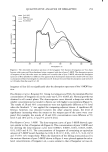
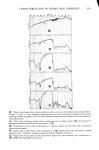
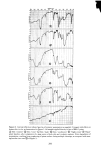
260 JOURNAL OF THE SOCIETY OF COSMETIC CHEMISTS with Brut aftershave, which was shown to contain 0.00729% 5-MOP using the spec- trophotometric test and only 0.00068% with the C. albicans test. The results of Group A perfumes, on the other hand, were similar to those obtained with the C. albicans test in the samples tested. The bergapten TLC fraction of this group of perfumes showed only a slight impurity and the absorption spectrum was very close to that of 5-MOP fraction of bergamot oil used as reference. The spectrophotometric test was impractical for the assessment of Group A perfumes which contained very small concentrations of 5-MOP since a large number of 25/zl TLC spots would have been required for a reli- able estimate to be made. For example, approximately 60 aliquots (25 /zl) of Ritual Cologne and 500 aliquots of Intimate toilet water would have been required to obtain an adequate amount of 5-MOP in order to make a determination feasible. Attempts to concentrate these perfumes by chloroform extraction did not yield encouraging results and the use of a larger volume such as 100/zl TLC spots resulted in a poor separation of 5-MOP from the adjacent bands. DISCUSSION Fowlks, Griffith and Oginsky (8) described the photosensitization of bacteria by psoralens and related compounds using paper-disc diffusion method on agar plates. Filter paper discs were impregnated with the test compounds and arranged uniformly on freshly solidified agar layer in a Petri dish. Another agar layer with bacteria was poured over the discs, left to solidify and incubated at 37øC. Activity of the compound was determined by measuring the diameter of bacteria-free zones surrounding the discs. Daniels' use of C. albicans (5) made this procedure much simpler, since the yeast has the advantage of growing rapidly at room temperature after direct inoculation onto the surface of agar plates. The need for incubation at 37øC and the addition of another layer of agar containing the microorganisms thus became unnecessary. Lethal photo- sensitization of the yeast was assumed to have occurred since many attempts to replate organisms from the clear zone had failed. Although the technique was designed pri- marily for screening purposes, preliminary studies of quantitative relationship between furocoumarins were performed and the possible use of the test in quantitative estima- tions ofpsoralens was suggested. The spectrophotometric method was used by Cieri (6) for the determination of 5-MOP content of bergamot oil and some other essential oils. The procedure, however, was lengthy and tedious and a number of modifications were introduced which simplified the method, making it easier for ordinary day-to-day laboratory determinations (2). The test is based on a comparison of the ultraviolet absorption of bergapten TLC frac- tion of the perfume and a known concentration of bergamot oil. Any impurities present in the bergapten TLC band of the perfume would lead, therefore, to a greater ultraviolet absorption and a higher concentration. The bergapten TLC fraction of Group B perfumes showed a significant degree of contamination and the absorption spectrum was very different from that of pure 5-MOP. Hence, the spectrophotometric test could not be used for the determination of the 5-MOP content of these perfumes. Even the mild impurity of 5-MOP fraction of bergamot oil produced a slight increase in the concentration of 5-MOP in bergamot oil as pure 5-MOP was used as a reference. The small degree of contamination of the bergapten TLC fraction of Group A
Purchased for the exclusive use of nofirst nolast (unknown)
From: SCC Media Library & Resource Center (library.scconline.org)