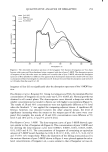
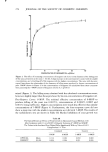
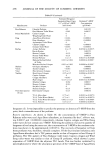
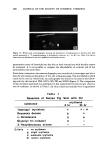
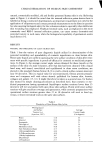
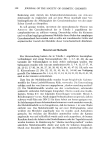
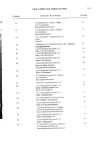
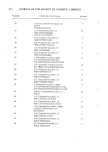
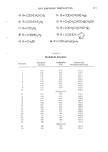
QUANTITATIVE ANALYSIS OF BERGAPTEN 249 Table I The Concentration of Bergamot Oil (Coty), 5-MOP and 8-MOP Applied to Each Sabouraud's Dextrose Agar Plate Bergamot Oil 5-MOP 8-MOP ml/100 ml g/100 ml g/100 ml Plate No. 1 0.125 0.00025 0.00025 0.25 0.0005 0.0005 0.5 0.001 0.001 2 1 0.0025 0.0025 2.5 0.005 0.005 3 5 0.01 0.01 4 10 0.025 0.025 5 20 0.05 0.05 6 40 0.1 -- 7 -- -- 0.1 with the plate covers on, was irradiated for two days with UVA from two fluorescent tubes (Philips Blacklight TW 20 W/08, wave-length range 300-355-400nm), placed 7 cm apart and 20 cm above the plates. The experiment was repeated six times and the diameter of the killing zone was measured, the minimum measurable zone being the diameter of the silica gel spot. In comparing the efficacy of various photoactive psoralens, using this test, it was necessary to ensure that any difference in phototoxic effects based on the size of the killing zone is not due to a relative diffusion of the psoralens in the agar layer. A tur- bidimetric test using Sabouraud's liquid medium was devised. 2 In this test, 3 ml of the medium were delivered to 35 x 10 mm sterile tissue culture petri dishes (Flow Labora- tories). The inoculom consisted of a suspension of C. albicans prepared by transferring 2 to 3 dabs from a two-day slant culture on a sterile cotton swab to 6 ml sterile water, to obtain an optical density of the suspension of approximately 1.2 at 600 nm. A volume of 0.1 ml was added to each of the petri dishes and a total of 20 dishes were prepared. Fresh solutions of 0.005% 5-MOP and 8-MOP in ethanol (w/v) were made and 0. ! ml of each added separately to each culture followed by gentle swirling to mix the contents. Five petri dishes containing 5-MOP and another five containing 8-MOP were exposed for 24 hr to UVA as previously described. Duplicates were covered with light- excluding material as controls. With the use of a glass rod, the contents of each culture plate were then mixed and any yeast growth on the walls of the petri dish brought into suspension. The optical density was then recorded at 600 nm. THE 5-MOP CONTENT OF PERFUMES As the presence of 5-MOP in perfumes is a result of the addition of 5-MOP containing bergamot oil, it was considered important in the assessment of 5-MOP concentration in perfumes to use bergamot oil of known concentration of 5-MOP as reference instead of pure 5-MOP. Aliquots of 5/xl of the perfumes and 5/xl of each 0.25, 0.5 and 1% bergamot oil Coty (contains 0.27 g/100 ml 5-MOP) in ethanol were 2Pancreatic digest of casein (Oxoid L 42) 5 g, Peptic digest of fresh meat (Oxoid L 49) 5 g, Dextrose 20 g per litre pH approximately 5.7.

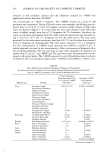
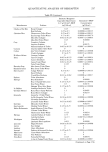
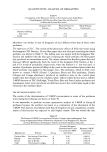
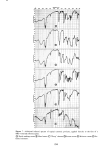
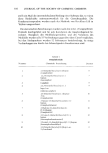
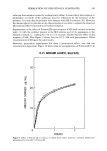
250 JOURNAL OF THE SOCIETY OF COSMETIC CHEMISTS Table II The Relationship of the Volume of Bergamot Oil (Coty) and Perfume Used in Each Agar Plate to the Concentration of Bergamot Oil Present in the Perfume Concentration of Bergamot Oil ml/100 ml Volume of Bergamot Oil and Perfumes Applied Plate No. 1 1 0.5 5 0.25 2 0.125 0.062 25 3 0.031 0.016 100 chromatogrammed as before. The silica gel containing the 5-MOP fractions was scraped from the TLC sheet and added in duplicates to agar plates innoculated with C. albicans. One plate was irradiated as before and the control was kept in the dark. The diameters of the killing zones were compared and the concentration of bergamot oil producing an inhibition zone equal to that of the perfume was recorded as the concentration of bergamot oil present in that perfume. When the zone of inhibition was greater than that of 1% bergamot oil, dilutions of the perfume in ethanol were pre- pared and the procedure repeated as above. On the other hand, when a zone smaller than that produced by 0.25 % bergamot oil was obtained, 25 •1 or more of the perfume and 0.016, 0.031, 0.062 and 0.125% bergamot oil were used. A rough guide to the amount and concentration of bergamot oil applied to each plate is shown in Table II. For a more precise measurement of bergamot oil concentrations in some perfumes, further dilutions of bergamot oil such as 0.75, 1.5 and 2.5 % were also used. The concentration of 5-MOP in each perfume was then calculated as follows: 0.27 Concentration of 5-MOP (w/v) = Concentration of bergamot oil x -- 100 RECOVERY EXPERIMENTS The concentration of 5-MOP in Agua Brava aftershave and Paco Rabanne toilet water (for males), Caprice Cologne and Wind Song toilet water (for females) was determined as outlined above. A volume of 0.25 ml of 10% begamot oil (Coty) was mixed with 4.75 ml of each perfume, to give an additional concentration of 0.00135% and the 5~MOP content of the resultant solutions of perfumes was reassessed. In addition, the absorption spectrum of the bergapten TLC fraction of the prepared solutions was recorded and compared with that of the bergapten TLC fraction of bergamot oil. THE IMPORTANCE OF TLC IN THE QUANTITATIVE ESTIMATIONS OF 5-MOP In the original phototoxicity test (Daniels, 1965), the substances were applied to seeded agar plates as pure crystals, fresh plant materials or as dried concentrates in filter paper discs. The value of TLC in this study was therefore assessed by comparing the phototoxic effects of bergapten TLC fraction of perfumes with those of the whole
Purchased for the exclusive use of nofirst nolast (unknown)
From: SCC Media Library & Resource Center (library.scconline.org)