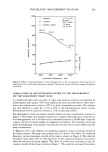
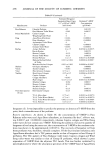
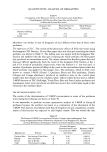
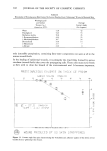
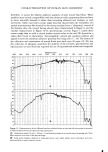
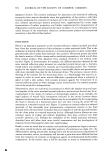
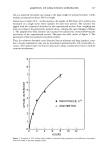
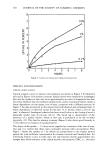
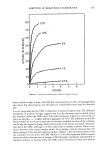
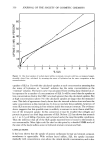
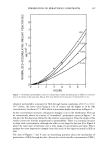
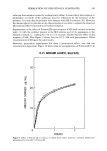
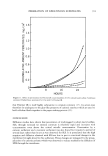
ViSCOELASTIC MEASUREMENT ON FOAM 243 1200 lOOO 800 600 400 200 o : elasticity 5 % wt/wt 70 ppm ß : viscosity 70Oc_•40oc [ ]: specific volume 1.5 hours 5.4 cc/min (24.4] 30 5000 7500 10000 12500 rotational frequency, rpm Figure 6. Effect of rotational frequency of the foam-generator on the viscoelasticity of the soap foam ob- tained from a 5 % (wt/wt) toilet soap aqueous solution. The specific volume of the foam sample is designated in brackets APPLICATION OF THE DEVELOPED SYSTEM TO THE MEASUREMENT ON THE FOAM FROM TOILET SOAP A commercial toilet soap was used. A toilet soap aqueous solution was prepared by dissolving the toilet soap at 70øC in the artificial tap water described above. After disso- lution, the solution was cooled to 40øC in a bath containing iced water. The solution was then allowed to stand for 1.5 hr at 40øC in the foam-generator before testing. Measurements were conducted at about 2.5 Hz on the foam at 40øC. The dependence of the viscoelastic toodull of foam on soap concentration is shown in Figure 5. The foams were prepared under such condition that a flow rate of solution to the foam-generator is 6.2 cma/min and a rotational frequency is 10,000 rpm. A specific volume (cma/g) of a foam sample is designated in brackets. The elasticity decreased with increasing soap concentration, whereas the viscosity was not much affected by the soap concentration. In Figures 6 and 7, the influence of a foaming condition on the viscoelastic moduli of the foam is shown. The soap concentration was 5% (wt/wt). The effect of a rotational frequency on the viscoelastic toodull of the foam is shown in Figure 6. The elasticity decreased from about 850 to 500 dynes/cm 2 as the rotational frequency increased, while the viscosity increased slightly. The effect of a flow rate of solution on the vis- coelastic moduli of the foam is shown in Figure 7. The elasticity increased from about

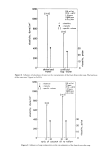
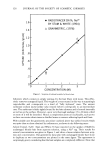
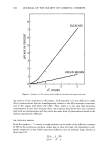
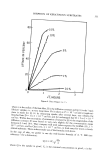
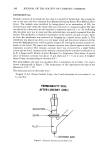
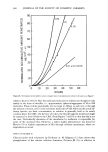
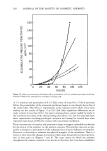
244 JOURNAL OF THE SOCIETY OF COSMETIC CHEMISTS 1200 o : elasticity 5 % wt/wt 70 ppm ß : viscosity 70Oc.__40oc I• ]: specific volume 1.5 hours 1000 - 10•000 rpm l•18.3] I• 16.1 ] ....,._.• 8oo u l•14.6] / " J•10.6] • 600 J• 10.0 '• 400 - 30 o 200 0 • • I • • 0 3.8 4.6 5.4 6.2 7.0 flow rate, cc/min Figure 7. Effect of flow rate of the soap solution (to the foam-generator) on the viscoelasticity of the soap foam obtained from a 5 % (wt/wt) toilet soap aqueous solution. The specific volume of the foam is designated in brackets 500 to 800 dynes/cm 2 with increasing flow rate, while the viscocity scarcely depended on the flow rate. On the other hand, a close relationship is probable between elasticity of foam and its specific volume, as is evident from Figures 5, 6 and 7. The comparison of the viscoelastic moduli of the foam prepared by using deionized water with those of the foam prepared by using the aforementioned water is shown in Figure 8. The elasticity of the foam was much larger with the deionized water than that with the artificial tap water. Figure 9 shows the influence of a soap composition on the viscoelastic moduli of the foam. The elasticity of the foam prepared from soap manufactured by mixing coconut oil with tallow in the ratio of 20 to 80 was larger than that of the foam from soap in which the ratio of coconut oil to tallow was 15 to 85. CONCLUSION The storage shear modulus increased from about 500 to 850 dynes/cm 2 as the specific volume of the foam increased from about 10 to 25 cma/g. On the other hand, the dy-
Purchased for the exclusive use of nofirst nolast (unknown)
From: SCC Media Library & Resource Center (library.scconline.org)