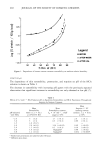
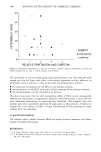
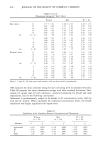
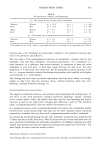
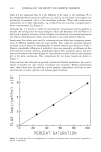
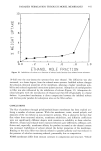
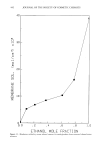
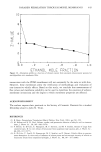
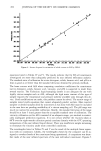
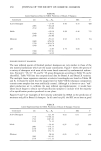
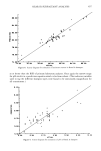
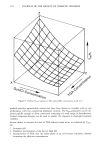
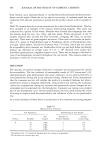
406 JOURNAL OF THE SOCIETY OF COSMETIC CHEMISTS 50- 40- 30- 20- 10- [] ß ß [] ß [] [] ß ß ß [] [] ß I I I 1 1 2 3 4 RELATIVE PENETRATION AND SORPTION Legend ß PENETRATION [] $ORPTION Figure 3. Epidermis extensibility as a function of stratum corneum's relative permeability constant and relative sorption for 0.2 mol 1-• HCA solution with additives. The mechanism of action of these plasticisation potentiators is not clear from the work carried out thus far. Since their effect is not simply dependent on their influence on penetration rates or sorption, it may be that they are altering one or more of: ß the molecular environment of the HCA in the stratum corneum. ß the distribution of the HCA within the cellular structure of the stratum corneum. ß the thermodynamic activity of the HCA in solution. The above data show that the skin extensibility effect of HCA can be substantially enhanced by the presence of appropriate additives, while HCA alone is more effective than traditional moisturisers in improving skin flexibility. This suggests that such systems may have considerable potential for application to skin products. Evidence to support the in vivo efficacy of HCA is being collected and will be published by other workers from this laboratory. ACKNOWLEDGEMENTS The authors wish to thank Christine Black for expert technical assistance and Dieno George for helpful discussions. REFERENCES (1) B. Idson, Dry skin, Drug Cosmet. Ind., 104, 44-47 and 161-162 (June 1969). (2) I. H. Blank, Factors which influence the water content of the stratum corneum, J. Invest. Dermatol., 18, 433-440 (1952).

SKIN PLASTICISATION BY 2-HYDROXYOCTANOIC ACID 407 (3) J. Wepierre and M. Adrangui, Factors in the occlusivity of aqueous emulsions, J. Soc. Cosmet. Chem., 33, 157-167 (1982). (4) J. D. Middleton, Sodium lactate as a moisturiser, Cosmet. Toilet., 93, 85-86 (March 1978). (5) M. Takahashi, K. Kawasaki, M. Tanaka, S. Ohta, and Y. Tsuda, "The Mechanism of Stratum Corneum Plasticisation With Water," in Bioe,gi,eeri,g a,d the Ski,, R. Marks and P. A. Payne, Eds. (MTP Press Limited, Lancaster, 1981), pp. 67-73. (6) M. Takahashi, Y. Machida, and Y. Tsuda, The influence of hydroxy acids on the rheological proper- ties of stratum corneum,J. Soc. Cosmet. Chem., 36, 177-187 (1985). (7) S. G. Alderson, M. D. Barratt, and J. G. Black, Effect of 2-hydroxyacids on guinea-pig footpad stratum corneum: Mechanical properties and binding studies, I,t. J. Cosmet. Sci., 6, 9 l-100 (1984). (8) J. D. Middleton, The mechanism of water binding in stratum corneum, Br. J. Derre., 80, 437-450 (1968). (9) J. Ferguson and P. Agache, Influence of site, storage and trypsin treatment in the mechanical proper- ties of stratum corneum,J. I,vest. Dermato/., 68(4), 256 (1977). (t0) M. Nicollier, P. Agache, J. L. Kienzler, R. Laurent, R. Gibley, N. Cardot, andJ. C. Henry, Action of trypsin on human plantar stratum corneum, Arch. Dermato/. Res., 268, 53-64 (1980). (t 1) P. A. Bowser and R. J. White, Isolation, barrier properties and lipid analysis of stratum compactum, a discrete region of the stratum corneum, Br. J. Derre., 112, t-14 (1985). (12) R. J. Scheuplein, Mechanism of percutaneous absorption. I: Routes of penetration and the influence of solubility, J. I,vest. Dermato/., 45, 334-346 (1965). (13) A. C. Park and C. B. Baddid, Rheology of stratum corneum--II: A physico-chemical investigation of factors influencing the water content of the corneum, J. Soc. Cosmet. Chem., 23, 13-21 (1972). (14) S. K. Chandrasekaran and J. E. Shaw, Factors influencing the percutaneous absorption of drugs, Curr. Prob/. Dermato/., 7, 142-155 (1978).
Purchased for the exclusive use of nofirst nolast (unknown)
From: SCC Media Library & Resource Center (library.scconline.org)