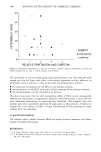
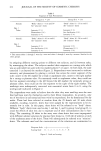
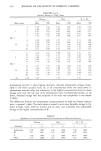
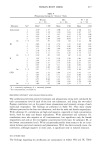
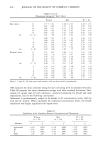
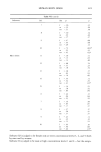
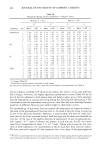
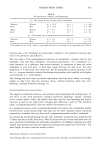
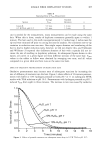
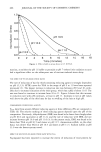
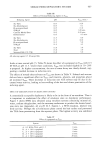
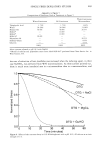
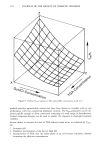
HUMAN BODY ODOR 427 finding that women reject the more intensive body odors, or body-like odors, more strongly than do men confirms Schleidt's observations (5). SEX ATTRIBUTION Perhaps the most surprising finding of the study is the fact that a significant majority both of male and of female respondents attributed the shirts that had been treated with androstenol to female wearers, at all concentration levels tested. This is unexpected in view of the fact that androstenol and the closely related andros- tenone occur in human plasma (10) and in axillary sweat (11) at far higher concentra- tions in men than in women and would, therefore, be expected to be associated with male body odor. Actually, the results of the behavioral experiments thus far reported in no way conflict with the notion that androstenol is predominantly perceived as female. In the dentist's chair experiment (12), one would expect the observed pattern of response (selection by women, avoidance by men) if the chair had smelled of some feminine perfume. In the rating of photographs (13), it was the females, not the males, that were judged more attractive and sexy in the presence of androstenol. Our finding does, however, throw additional doubt (if such were needed) on the claims of mail-order sex aid houses that men's lotions containing androstenol are sexual attractants to women. Another novel finding was the concentration dependence of sex attribution, found both for substance II and for substance III. Although novel, this finding was not unexpected in view of the earlier reported tendency to associate stronger body odors with men and fainter odors with women. As to the sex attribution of cyclopentadecanolide, we cannot rule out the possibility that the predominantly female attribution of shirts treated with this substance was due to an association with women's perfumes rather than with female bodies. The predominantly correct sex assignment of the shirts worn by women and by men impressively replicates the findings of Schleidt eta/. (5), as do the tendencies to at- tribute stronger and less pleasant odors to men and fainter and more pleasant odors to women. It is fascinating to observe how two patterns that are commonplace in the field of general aesthetics are also reflected in the olfactory field: (1) the "beauty and the beast" pattern, i.e., the notion that (young) women are more esthetically pleasing than men, (2) the greater prevalence among women of the tendency to judge by esthetic criteria: the differences in intensity are perceived equally by men and women,* but the women associate them more strongly with "pleasing" or "not pleasing." SUMMARY In the present study, it was shown that when the synthetic body odor analogues II and III are presented to human subjects under conditions where they might be taken for * Equal ability to perceive differences does not necessarily mean equal awareness of them in daily life. The design of the experiment inevitably induced high odor awareness among all respondents there is consider- able evidence that normally odor awareness is higher among women than among men.

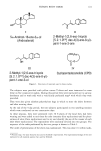
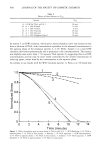
428 JOURNAL OF THE SOCIETY OF COSMETIC CHEMISTS human body odors, reactions to these chemicals 'are similar to those to natural body odors in a number of respects: 1. They are predominantly attributed to the one or the other sex. 2. Perceived intensity and pleasantness rating are negatively correlated. 3. When the materials are perceived as relatively strong or as relatively unpleasant, they tend to be attributed to male wearers. 4. At low concentration, the average pleasantness rating is comparable to that of nat- ural body odor (this is not true for the less pleasant substance II). For the synthetic musk, cyclopentadecanolide (IV), observations 2 and 3 do not hold. Furthermore, these synthetic odorants including cyclopentadecanolide were similar to the natural human body odorant, androstenol, in the following respects: 1. Low olfactory threshold. 2. Low slope of the psychophysical function. A surprising and important finding was the attribution of androstenol to females rather than to males, at all concentration levels, both by male and female respondents. The responses to the shirts that had actually been worn by test subjects confirmed M. Schleidt's findings in all respects: 1. Correct sex attribution by a significant majority of the respondents. 2. A significant tendency to attribute stronger smelling shirts to male wearers. 3. Stronger rejection of high intensity odors by female respondents. REFERENCES (la) A. Comfort, Dragoco Report, 19(11), 226-233 (1972). A. Comfort in Pheromones, M. C. Birch, Ed. (North Holland Publ., Amsterdam 1974), pp 386-396. (lb) I. Bloch, Odorants Sex/•alis (Panurge Press, New York, 1934). (2) For reviews of this work, cf. Richard L. Dory, Chemical Senses, 6(4), 351-376 (1981) J. N. Labows, K.J. McGinley, and A.M. Kligman, J. Soc. Cosmet. Chem., 34, 193-202 0uly 1982) D. B. Gower, M. R. Hancock, and L. H. Bannister in Biochemistry of Taste and Olfaction, R. H. Cagan and M. R. Kate, Eds. (Academic Press, New York, 1981), pp 7-31. (3) P. Jellinek, Die psychologischen Grundlagen der Parfiimerie (Dr. A. Hi•thig Verlag, Heidelberg, 1951). (4a) E. Paukner, J. Soc. Cosmet. Chem., 16, 515 (1965). (4b) W. Steiner, E.-F. Hanisch, and D. Schwarz, Parr. undKosm., 58, 189-196 (1977). (5) M. Schleidt, Ethology Sociobiol., 1, 225-231 (1981) and M. Schleidt, B. Hold, and G. Artill, J. Chem. Ecol., 7, 19-31 (1981). (6) J. S. Jellinek, Dragoco Report, 34(2), (1987). (7) A. R. Jonckheere and G. H. Bower, Brit. J. Math. and Social Psychol., 20(2), 163-186 (1967). (8) J. E. Amoore, P. Pelosi and J. L. Forrester, Chem. Senses and Flavor, 2, 401-425 (1977). (9) J. S. Jellinek, Dragoco Report, 26(2), 85-87 (1979). (10) D.C. Bicknell and D. B. Gower, J. SteroidBiochem., 7, 451-455 (1976). (11) S. Bird and D. B. Gower, J. Endocrinol., 85, 8P-9P (1980). (12) M.D. Kirk-Smith, D. A. Booth, in Olfaction and Taste VII, H. v. d. Starre, Ed. (IRL Press, London 1980), pp 397-404. (13) M.D. Kirk-Smith, D. A. Booth, D. Carroll, and P. Davies, Res. Commun. in Psychol., Psychiatry and Behavior, 3(4), 379-384 (1978).
Purchased for the exclusive use of nofirst nolast (unknown)
From: SCC Media Library & Resource Center (library.scconline.org)