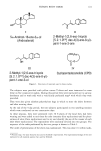
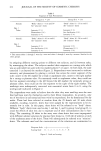
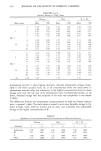
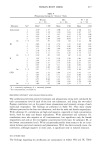
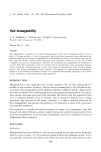
j. Sac. Cosmet. Chem., 37, 429-444 (November/December 1986) Influence of solvents on paraben permeation through idealized skin model membranes j. N. TWIST and J. L. ZATZ, Rutgers University College of Pharmacy, P.O. Box 789, Piscataway, NJ 08854. Received June 23, 1986. Presented at the Annual Meeting of the Society of Cosmetic Chemists, New York, December 4-5, 1986. Synopsis The effect of various solvents on permeation of methyl- ethyl- propyl-, and butylparaben through polydi- methylsiloxane membranes, a model for skin, has been investigated. Flux of a given paraben from saturated solution should theoretically be the same, independent of solvent, in the absence of membrane-solvent interaction. This was experimentally observed for water, various glycols, and glycol-water mixtures, de- spite enormous differences in paraben solubility in these vehicles. However, there was significant increase in flux from solutions containing various concentrations of ethanol. The nature of the solvent-membrane interaction was investigated through studies on solvent uptake, paraben partitioning, and diffusivity within the membrane. The results indicated that an increase in partition coefficient was the major effect responsible for the enhanced flux. Adsorption to silica filler was quantitated and found to parallel solute polarity. The variables investigated here are also expected to determine solvent interaction with skin. INTRODUCTION Experiments attempting to determine the effect of solvents on percutaneous absorption are often difficult to interpret due to the highly complex nature of the stratum corneum and its interaction with the vehicle. It is advantageous to test new permeation tech- niques or mathematical models intended for applications for skin transport by per- forming preliminary studies utilizing less complex membranes. Synthetic membranes offer advantages concerning the physical-chemical properties of the diffusional barrier, such as perm-selectivity, high diffusivity, thickness control, and less stringent storage and handling requirements. Polydimethylsiloxane (PDMS) is a non-polar, non-porous elastomer which is amorphous at ambient temperature. Permeation through PDMS membranes consists of initial dissolution of the solute into, and then diffusion through, the polymer matrix (1). Silica filler (20-30% w/w) is usually included to enhance the physical strength of cast sheets of the polymer and behaves as an inert dispersed phase. These properties make it an ideal model for drug transport across biologic membranes including skin. Nakano and Patel (2) studied the release of salicylic acid from several ointment bases using silicone rubber membranes as a model for skin. Their in vitro release results exhibited a perfect rank order correlation to published in viva data for the same systems. Experiments measuring the uptake of the solute into the ointment bases revealed a high affinity (complexation) between the solute and polyethylene glycol ointment. 429

430 JOURNAL OF THE SOCIETY OF COSMETIC CHEMISTS Bottari et al. (3) determined diffusion coefficients and vehicle solubilities for aqueous gel suspensions from release experiments employing PDMS membranes. They devel- oped a vehicle-membrane diffusion model valid when the amount of drug in the vehicle did not greatly exceed its solubility. Di Colo eta/. (4) investigated the effect on solu- bility and viscosity of benzocaine gels with the addition of high percentages of low molecular weight polyols. The systems studied were under vehicle-membrane control. The membranes were inert with respect to the solvents used and were used to determine the effect of added excipients on the release rate from the vehicle. Yalkowsky and Flynn (5) found that binary mixtures of p-aminoacetophenone at satura- tion yielded a constant permeation rate through PDMS membranes. Flux from these solutions was dependent upon the thermodynamic activity in the vehicle. Flux was under boundary layer control when very thin (0.005 mm) membranes and a very non- polar solute (hexyl p-aminobenzoate) were evaluated. Flux was found to be proportional to donor solute solubility. Tanaka eta/. (6) determined the effect of evaporation of volatile vehicle components on the release of hydrocortisone butyrate propionate from a cream and several gels. Differ- ences in release into silicone rubber receptor slabs were attributed to changes in solute activity in the vehicle. As the volatile component evaporated, the solubility in the remaining base increased causing a reduction in solute activity. The release patterns for the open systems correlated with in vivo vasoconstrictor assays. Behl eta/. (7) used PDMS membranes to assess concentration effects of methanol-phenol solutions. Hairless mouse skin exhibited enhancement in permeation of methanol as the phenol concentration was increased. At high concentrations, phenol (6%) accelerated its own permeability through the mouse skin. These effects were not observed with the synthetic membrane, eliminating the possibility of enhancement via a complexation mechanism. It was concluded that phenol reduces the barrier properties of the stratum corneum. Zatz and Dalvi (8) examined the effect of propylene glycol and polyethylene glycol 400 on benzocaine permeation through hairless mouse skin. Permeation experiments using an inert polypropylene membrane allowed the separation of vehicle-solute effects which do not involve the membrane (non-interactive effects) from vehicle-skin (interactive) effects. The objectives of this study were to determine the permeability of a series of parabens through polydimethylsiloxane membranes using a wide selection of solvents and solvent combinations to evaluate any effect of solvents on these membranes to characterize the behavior on the basis of partitioning, binding, and diffusivity and to employ a model to describe experimental results. EXPERIMENTAL MATERIALS The solutes utilized were methylparaben (methyl-p-hydroxybenzoate, Fisher Scientific Company, Fairlawn, NJ), ethylparaben (ethyl-p-hydroxybenzoate, Aldrich Chemical Company, Milwaukee, WI), propylparaben (propyl-p-hydroxybenzoate), and butylpar- aben (butyl-p-hydroxybenzoate, Eastman Kodak Company, Rochester, NY). The par-
Purchased for the exclusive use of nofirst nolast (unknown)
From: SCC Media Library & Resource Center (library.scconline.org)