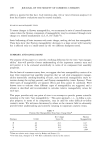
488 JOURNAL OF THE SOCIETY OF COSMETIC CHEMISTS (6) M. Chan and H. Prince, A rapid screening test for ranking preservative efficacy, Drug and Cosmetic Industry, 34- 37 (December 1981). (7) J. J. O'Neill, C. A. Mead, and E. J. Scibienski, An accelerated preservation test. Presentation at SCC Annual Meeting NYC, 12/11/81. (8) R. Bhadauria and D. G. Ahearn, Loss of effectiveness of preservative systems of mascaras with age, Applied & Environmental Microbiology, 39, 665-667 (1980). (9) L. A. Wilson, A. J. Julian, and D. G. Ahearn, The survival and growth of microorganisms in mas- cara during use, American Journal of Opthalmology, 79, 596 (1975). (10) L. A. Wilson and D. G. Ahearn, Pseudomonas induced corneal ulcers associated with contaminated eye mascaras, American Journal of Opthalmology, 84, 112-119 (1977).

j. Soc. Cosmet. Chem., 37, 489-499 (November/December 1986) Hair manageability C. R. ROBBINS, C. REICH, and J. CLARKE, Colgate Palmolive Research Center, Piscataway, NJ 08854. Received May 23, 1986. Synopsis Hair manageability is defined as the "ease of arranging hair in place and its temporary ability to stay in place" (1) during styling, i.e., ease of styling hair. Survey data from consumers indicate that three hair assembly properties are relevant to manageability: combing/brushing of hair, style retention while styling hair, and static flyaway. Results further show that many consumers consider two or only one of these components as relevant to manageability. Therefore, we recommend that manageability be considered in terms of these three components which we call three types of manageability: style arrangement manage- ability (essentially combing/brushing of hair), style retention manageability (style retention during styling), and flyaway manageability (static flyaway). This approach to understanding manageability permits it to be measured or evaluated in terms of its component hair assembly properties, each of which may be considered in terms of fundamental fiber properties. INTRODUCTION Manageability, a very important term in hair cosmetics, has not been adequately de- scribed in the scientific literature. Recent surveys (summarized in the Discussion sec- tion) show that manageability offers different benefits to different people. These survey data help to explain why a working definition that permits measurement of this impor- tant cosmetic term has never been fully described. We believe that this important term as it is currently defined (1) is so inclusive that it cannot be measured by a single procedure. The objective of this paper, therefore, is to offer a working definition for hair manageability that permits this property to be measured in terms of its constituent hair assembly properties. This approach, to consider an inclusive property in terms of its components, may also be used with other difficult-to-define cosmetic terms and could ultimately permit them to be better understood, to be evaluated scientifically, and to be considered in terms of fundamental fiber properties. DISCUSSION DEFINITION Manageability has been defined as "the ease of arranging hair in place and its temporary ability to stay in place" (1). It is observed during styling and reshaping of hair, but is not generally concerned with longer term effects as is the case for style retention. Hair 489
Purchased for the exclusive use of nofirst nolast (unknown)
From: SCC Media Library & Resource Center (library.scconline.org)