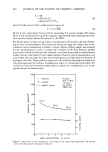
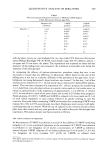
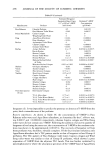
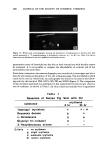
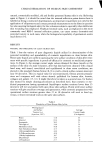
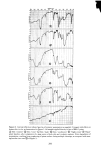
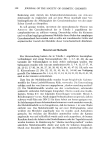
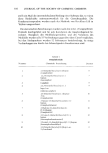
250 JOURNAL OF THE SOCIETY OF COSMETIC CHEMISTS Table II The Relationship of the Volume of Bergamot Oil (Coty) and Perfume Used in Each Agar Plate to the Concentration of Bergamot Oil Present in the Perfume Concentration of Bergamot Oil ml/100 ml Volume of Bergamot Oil and Perfumes Applied Plate No. 1 1 0.5 5 0.25 2 0.125 0.062 25 3 0.031 0.016 100 chromatogrammed as before. The silica gel containing the 5-MOP fractions was scraped from the TLC sheet and added in duplicates to agar plates innoculated with C. albicans. One plate was irradiated as before and the control was kept in the dark. The diameters of the killing zones were compared and the concentration of bergamot oil producing an inhibition zone equal to that of the perfume was recorded as the concentration of bergamot oil present in that perfume. When the zone of inhibition was greater than that of 1% bergamot oil, dilutions of the perfume in ethanol were pre- pared and the procedure repeated as above. On the other hand, when a zone smaller than that produced by 0.25 % bergamot oil was obtained, 25 •1 or more of the perfume and 0.016, 0.031, 0.062 and 0.125% bergamot oil were used. A rough guide to the amount and concentration of bergamot oil applied to each plate is shown in Table II. For a more precise measurement of bergamot oil concentrations in some perfumes, further dilutions of bergamot oil such as 0.75, 1.5 and 2.5 % were also used. The concentration of 5-MOP in each perfume was then calculated as follows: 0.27 Concentration of 5-MOP (w/v) = Concentration of bergamot oil x -- 100 RECOVERY EXPERIMENTS The concentration of 5-MOP in Agua Brava aftershave and Paco Rabanne toilet water (for males), Caprice Cologne and Wind Song toilet water (for females) was determined as outlined above. A volume of 0.25 ml of 10% begamot oil (Coty) was mixed with 4.75 ml of each perfume, to give an additional concentration of 0.00135% and the 5~MOP content of the resultant solutions of perfumes was reassessed. In addition, the absorption spectrum of the bergapten TLC fraction of the prepared solutions was recorded and compared with that of the bergapten TLC fraction of bergamot oil. THE IMPORTANCE OF TLC IN THE QUANTITATIVE ESTIMATIONS OF 5-MOP In the original phototoxicity test (Daniels, 1965), the substances were applied to seeded agar plates as pure crystals, fresh plant materials or as dried concentrates in filter paper discs. The value of TLC in this study was therefore assessed by comparing the phototoxic effects of bergapten TLC fraction of perfumes with those of the whole

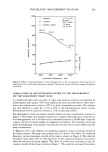
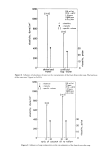
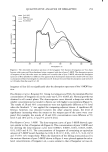
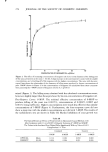
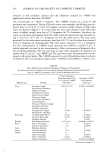
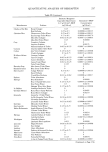
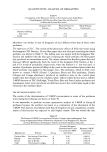
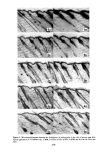
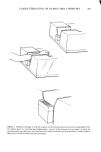
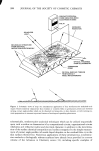
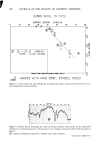
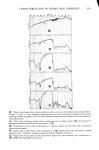
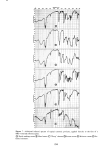
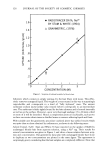
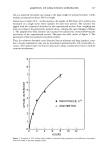
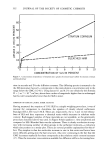
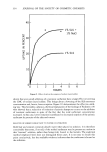
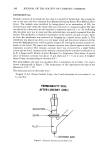
QUANTITATIVE ANALYSIS OF BERGAPTEN 251 perfume applied to filter paper discs and also to silica gel. Yves Saint Laurent (YSL) toilet water (for males) was chosen as an example. Aliquots of 5 /xl were chromatogrammed as before and a similar volume was added to 10 mm Whatman No. ! filter disc and also to TLC plate. A total of ten agar plates were inoculated with Co al- bicans and to each plate a 10 mm disc, silica gel containing bergapten TLC fraction and silica gel containing the whole perfume (not chromatogrammed), was added. Five plates were exposed to UVA and the rest were kept in the dark. The killing zones were measured and the 'results subjected to statistical analysis. In addition to these experi- ments, all perfumes were tested for direct toxicity to the yeast by pipetting 25/xl of each perfume to 10 mm filter paper discs and dried under a stream of warm air from a hair dryer. The discs were added to seeded agar plates which were then grown in the dark. Any inhibition of the yeast growth around the discs was taken as a sign of toxicity. The toxic effects of each perfume were later compared with its phototoxic effects by growing one plate under UVA illumination and a duplicate in the dark. THE SPECTROPHOTOMETRIC TEST The technique used is a modification of the method describe•l by Cieri (6) and later used for the estimation of the 5-MOP content of bergamot oil (2). In this technique, sixteen 25/xl aliquots of each perfume and a similar number of 25/xl aliquots of 1% bergamot oil in ethanol along with 25 /xl of 0.05% pure 5-MOP in ethanol used as reference were chromatogrammed as previously described. The silica gel containing the 5-MOP fractions was scraped from the plates onto clean paper. All 5-MOP frac- tions of bergamot oil were transferred to a glass-stoppered tube and those of the perfume combined in another tube. 5-MOP was then extracted in 10 ml chloroform, centrifuged at 2000 rpm for 5 min and the absorption spectrum of the clear supernate obtained using an SP 8000 recording spectrophotometer (Unicam) with chloroform in the reference cell. The absorption at 310 nm was recorded and the concentration of bergamot oil and 5-MOP in each perfume was calculated as follows: 1. Percentage bergamot oil (v/v) = perfume absorption/bergamot oil absorption where perfume absorption = absorption of supernate containing bergapten TLC frac- tion of perfume, and bergamot oil absorption = absorption of supernate containing bergapten TLC fraction of bergamot oil. 0.27 2. Percentage 5-MOP (w/v) = Percentage bergamot oil x -- 100 RESULTS THE CANDIDA ALBICANS PHOTOTOXICITY TEST TLC Patterns. On TLC, bergamot oil showed five main fluorescent bands (Figure 1). Band 1, 2 and 3 are known as bergamottin, 7-geranoxycoumarin and citropene respec- tively, while band 4, which has a yellowish-green fluorescence, is 5-MOP (2,6). The TLC pattern of perfumes containing bergamot oil was variable and for the sake of sim- plicity these perfumes were divided into two groups. Group A (e.g., YSL toilet water) had five and sometimes six main fluorescent bands similar to those of bergamot oil
Purchased for the exclusive use of nofirst nolast (unknown)
From: SCC Media Library & Resource Center (library.scconline.org)