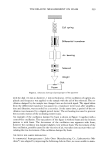
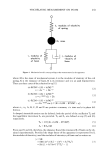
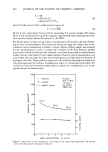
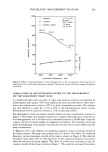
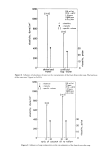
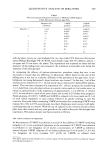
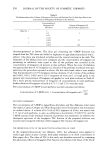
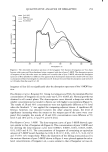
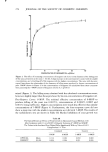
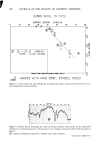
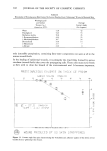
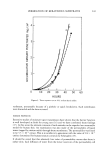
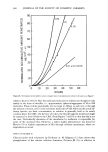
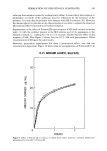
240 JOURNAL OF THE SOCIETY OF COSMETIC CHEMISTS Fr• oscillation Damped oscillation time ( 5 sec. Figure 3. An example of the oscillation damped by foam, with control-free oscillation tain the solution at a constant temperature by the circulation of water at a constant temperature through a spiral glass tube inserted in the solution, we were able to solve this problem. Second, the machine motor's rotational frequency was hardly stabilized because of power insufficiency the motor was replaced by a powerful one. Third, the flow rate of a solution to the foam-generating part of the machine was variable using a tubing pump, a solution at a constant flow rate was injected. A 5% (w/w) toilet soap aqueous solution was foamed by the use of the improved ma- chine. Foam was taken into a measuring vessel that was then quickly transferred to the apparatus. The diameter of each bubble remained about 1001z whereas the specific volume of foams varied much with varying condition of the preparation. Water with a hardness of 70 ppm (as CaCOa) was prepared for use in our present work by dissolving calcium chloride in deionized water. THEORETICAL A mechanical model for the measuring system was assumed, as shown in Figure 4. The equation of motion for the model is given by Mse + Rk + (K + k)x = 0 [1]

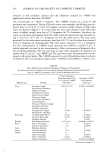
VISCOELASTIC MEASUREMENT ON FOAM 241 k, modulus of elasticity of spring M, mass 3', modulus of I I r/, modulus of elasticity I viscosity of of foam foam Figure 4. Mechanical model corresponding to the measurement by the apparatus where M is the mass of mechanical system, k is the modulus of elasticity of the coil spring, K is the elastance of foam, R is its resistance and x is an axial displacement. There are three cases of the solution for eq [1]. {(K + k)/M)1/5• Ae_•T t + Be_O• t [2] (a) R/2M X • (b) R/2M = X m (c) R/2M {(K + k)/M} e -m/2M (Ct + D) [3] {(K + k)/M} 1//'2 [4] x = Ee -m/2M sin {t •/'(K + k)/M - R2/4M 2 + q} where OZl, oz2, A, B, C, D and E are positive constants, t is time and q is phase dif- ference. A damped sinusoidal motion can be defined both the period of the oscillation Tu and the logarithmic decrement 8T are provided. Td and 8T are defined as eqs [5] and [6], respectively. Td = 2•r/{(K + k)/M- R•/4M =} [5] 8T = RTd/2M [6] From eqs [5] and [6], therefore, the elastance K and the resistance R of foam can be ob- tained experimentally. Provided the shape factor of the apparatus is represented by S, the modulus of elasticity •/and the modulus of viscosity •/of foam can be written as •/=SK = SM {4rr 2 (1/Td 2 - 1/T 2) + 8T2/Td 2} [7] = Sk {(1 + 8v2/4rr 2) T2/Td 2 - 1}
Purchased for the exclusive use of nofirst nolast (unknown)
From: SCC Media Library & Resource Center (library.scconline.org)