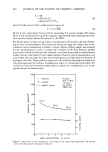
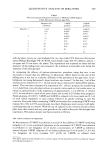
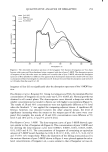
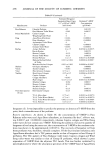
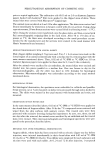
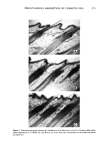
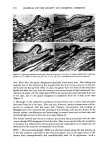
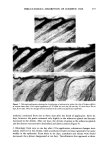
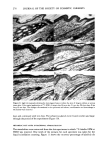
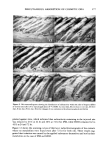
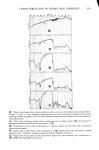
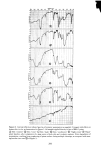
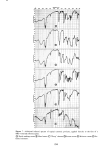
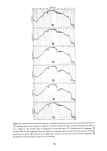
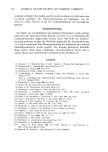
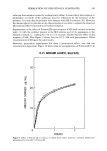
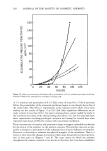
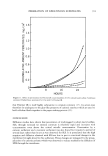
CHARACTERIZATION OF HUMAN SKIN CHEMISTRY 291 •7o (j•) "Blank" prism baseline for an internal reflection plate constructed of the thallium bromide salt, KRS-5, 20 mm x 50 •mm x 2 mm. Absorption bands shown are for trace hydrocarbon cøntaminant from prism polishing and from atmospheric CO2 and H20 unequally sampled between sample .,and reference beams of spectrophotome•er. : {• "Clean" skin of forearm, female subject, resting upon face of"blank" prism of (•). Note absence of absorption bands which would indicate soap residues of (•). (• Forearm skin of same subject, following use of cosmetic cleanser and skin toner rinse, according to instructions of supplier. • Forearm skin of same subject, after preparation as in (•, further treated with "skin mask" cosmetic preparation and "conditioner" preparation, again according to supplier's instructions. (• Forearm skin of same subject, finally treated with "night cream" after "cleansing" and "conditioning" of (• and (•), following supplier's instructions.

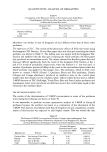
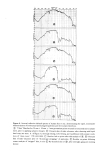
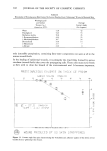
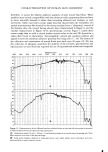
292 JOURNAL OF THE SOCIETY OF COSMETIC CHEMISTS EVALUATION OF COSMETIC EFFICAC7 AND QUALITY Figure 5 presents a series of internal reflection, infrared spectra to illustrate the ease of applying this technique for noninvasive assessment of the results of cosmetics applied to human skin. The individual spectral traces in Figure 5 may be compared with the in- dividual signatures of the cosmetics alone used in each treatment step characterized. At the top of the collection of traces in Figure 5, a spectrum of the residue left by the liquid hand soap used to establish the "clean" skin condition is provided, to demonstrate the band positions where soap residues on the skin might be detected in the infrared spectra. The second trace from the top of Figure 5 provides a "blank" absorption baseline for a typical internal reflection plate made from the translucent salt ICRS-5 (a thallium bromide material), having external dimensions of 50 mmx 20 mm x 2 mm (thick). The only absorption bands seen in this "blank" baseline are for a trace hydrocarbon contaminant which becomes embedded in the prism surface during its optical polishing, and for the atmospheric carbon dioxide and water vapor of the space through which the analytical infrared beam travels. This beam is focused upon and collected from the bevelled prism edges by curved and planar mirrors in the internal reflection accessory that allows these spectra to be recorded. The third trace from the top of Figure 5 is a "clean" skin spectrum obtained by direct analysis of the lower forearm region of a female subject. The forearm was resting, under natural gravita- tional force, on the face of the prism whose "blank" baseline is given in the trace im- mediately above. The major infrared absorption bands shown are clearly those of the skin lipid and protein constituents. No evidence of the fatty-acid-soap absorption bands (as characterized in the top trace of Figure 5) is seen. Inspecting the spectral trace for clean human skin in situ, from left to right, one notes the following infrared absorption bands: at 3300 cm -• for the N-H resonance two sharp peaks centered on 2900 cm -•, correlating with C-H groupings of most organic matter a sharp absorption band between 2350 and 2400 cm -•, for the atmospheric carbon dioxide also sampled by the infrared beam as it reflected from mirror to mirror in the internal reflection ac- cessory a sharp absorption band at about 1740 cm -•, which is diagnostic for the presence of organic esters the Amide I and II absorptions at 1640 and 1540 cm -•, respectively, which are specific indicators of proteins and, at frequencies lower than 1500 cm -•, a group of confirming absorption bands on a generally climbing back- ground, for the primary organic groupings already listed. Just below the in situ characterization of the clean skin of our volunteer is another trace of that same skin area as spectrally characterized immediately following the use of a cosmetic cleansing agent and a skin toner rinse (according to the instructions of the cosmetic supplier). A significant increase in the proportion of hydrocarbon components, most likely from the mineral oil fraction of the skin cleanser preparation, is noted and should be compared with the top trace of the following Figure 6. Except for that evidence of imbibation of aliphatic organic matter, there is no further spectral evidence suggesting dominance of the skin epidermal layers (or masking of these layers) by any residual overcoat of either the cleansing agent or polyol skin toner. Rather, the exceptional increase in absorption strength for the N-H band, and for the Amide I and Amide II bands, of the skin's protein, together with a relatively constant proportion of fatty ester, as compared with untreated skin, illustrates more effective contact of the skin surface with the analyzing prism surface. This improved contact, allowing more efficient analysis of the skin layers and a greater effective "penetration
Purchased for the exclusive use of nofirst nolast (unknown)
From: SCC Media Library & Resource Center (library.scconline.org)