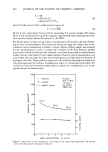
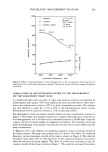
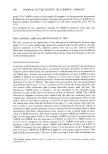
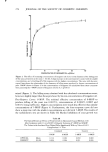
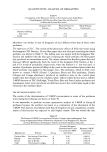
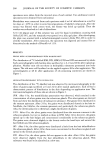
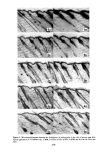
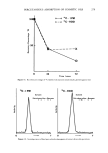
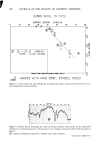
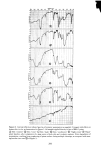
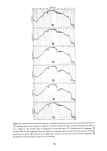
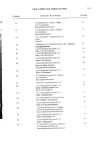
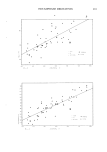
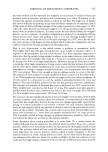
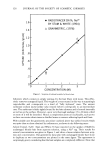
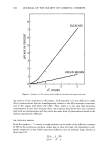
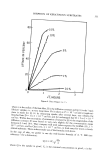
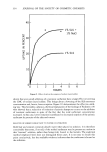
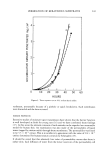
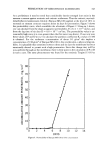
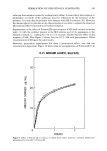
SORPTION OF KERATINOUS SUBSTRATES 331 8O •- 6O 15% 10% 5% 2O 0 0 0.1% 1 2 HOURS Figure 6. Data of Figure 4 vs. •/t where r is the radius of the hair fiber, D is the diffusion constant p4nd librium" uptake, i.e., at very long times. Ifr is taken as 25 x 10-- cm mate is made for Q (o•) by measuring uptake after several days, bleached hair D = 1 to 3 x 10-" cm2/sec and for undamaged hair cm2/sec. Within the uncertainty of estimation of values for Q (•) the diffusion constant D were found to vary only slightly for the concentratioxtheIofrangecloselya(15),wool,magnitudesGriffithforDforesti-"equi-theroughobtainsisa(o=)andoneQ between 0. 1 and 10%. They compare well with values reported by 10-" cm2/sec, and by Chen (16), 4 x 10-" cm2/sec, in both cases related substrate. These authors made use of the formula cited above. In the case of skin, we prefer to use the well known formula of A. V. Hill (see reference 7 for a derivation): where Q is the uptake in g/cm •, Co is the external concentration in g/cm s, t is the

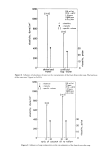
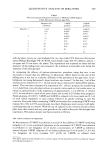
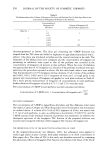
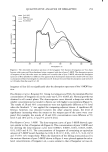
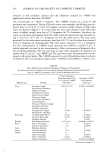
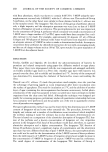
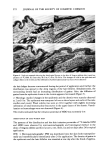
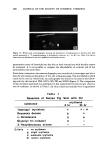
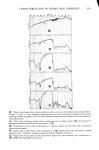
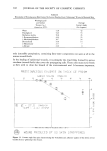
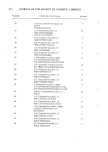
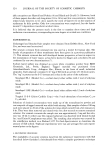
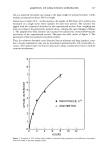
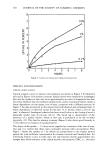
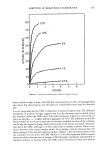
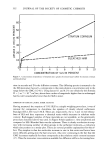
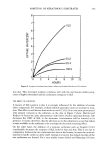
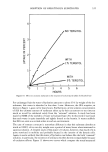
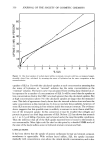
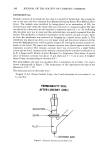
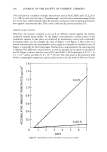
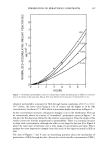
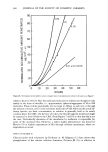
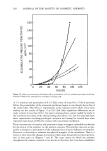
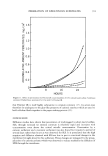
332 JOURNAL OF THE SOCIETY OF COSMETIC CHEMISTS 60- ' • • • •lm, • •'• • • •'-" • BLEACHED HAIR O• I 2 3 4 5 6 7 8 9 10 CONCENTRATION OF SLS IN PERCENT Fiõure 7. Concentration dependence ooe sorption rate: uptake ooe sodium ]auryl suloeate by stratum comeurn and bleached hair _z 40 •- 30 20 10 time in seconds and D is the diffusion constant. The diffusing species is assumed to be the SLS monomer hence Co corresponds to the total solution concentration only in the range below the CMC (0.24%). Using data at 0.1 and 0.2% one obtains by this formula D = 3 to 7 x 10 -9 cm2/sec, about three orders of magnitude higher than in und&maged hair but still considerably lower than for SLS in water. SORPTION OF SODIUM LAURYL ETHER SULFATES Having measured the sorption of 10% SLS by a simple weighing procedure, it was of interest for comparison to determine the uptakes of closely related surfactants: Standapol ES-2, ES-3 and 130-E. These are, respectively, the 2, 3 and 12 tool ethoxy- lates of SLS and they represent a chemical series which increases in ethylene oxide content. Radiotagged samples of these materials are not available, so the gravimetric procedure described above was used. In Figure 8 their uptakes vs. time are plotted and compared to SLS. Bleached hair was the substrate. There is clearly a reduction in sorp- tion with increasing number of ether groups in the surfactant molecule--a reduction which also persists on a molar plot. There are several possible explanations for this ef- fect. The simplest is that the molecules increase in size in this series and hence have more difficulty getting into the hair structure. Also very convincing is the fact that the CMC decreases markedly for these compounds as the ethylene oxide content increases (17). Thus the monomer concentration available for diffusion will be a decreasing func-
Purchased for the exclusive use of nofirst nolast (unknown)
From: SCC Media Library & Resource Center (library.scconline.org)