j. Soc. Cosmet. Chem., 47, 201-211 (July/August 1996) Photochemical alterations in human hair. Part II1: Investigations of internal lipids EDO HOTING, Hans Schwarzkopf GmbH, D-22763 Hamburg, Germany, and MONIKA ZIMMERMANN, Deutsches Wollforschungsinstitut an der RWTH Aachen e.V., D-52062 Aachen, Germany. Accepted for publication October 3, 1996. Synopsis Investigations of the internal lipids of human hair were performed after irradiation with simulated sunlight (global) or specific ranges of UV-B, UV-A, visible light, or IR. A mild extraction method and quantitative determination of internal lipids separated by thin-layer chromatography (TLC) allows the detection of significant differences between the photochemical response of black and blond hair. Using the example of cholesterol and free fatty acids, it could be demonstrated that the visible range of sunlight destroys the internal lipids to a considerably higher extent than exposure to UV-B and UV-A ranges. The photochemical destruction of lipids is largely retarded by the pigment eumelanin. INTRODUCTION The inner or internal lipids (IL) of keratinized fibers, together with globular proteins, form a cell membrane complex (CMC) that connects the keratinous cuticle and cortex cells to a uniform tissue complex. Human hair contains 1.9-5 % (1,2) and wool fibers only 0.7-1.2% IL (3). Despite this low amount, the cell membrane lipids are very important as they make possible a continuous pathway of diffusion into the fiber (4-6). Furthermore, according to recent investigations on human hair, a correlation exists between the amount of IL and the moisture content in the hair (7). A reduction of the amount of lipids by solvent extraction (8) and oxidative damage during chlorine bleaching of wool (9) or during permanent waving of hair (2) favor the diffusion of foreign materials into the fiber (10). It is known that irradiation of human hair with sunlight destroys, via photooxidation, melanin (11-13) as well as protein components (13-16), which destruction is accom- panied by clear alterations of mechanical properties (17-19). However, up to now the photochemically induced modification of the IL has not been investigated. In wool research important indications of the photochemical lability of IL have been published (20,21). The aim of this investigation is to gain basic knowledge about the influence of sunlight 201

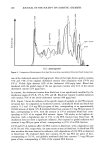
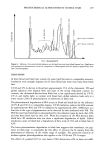
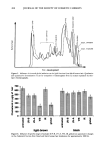
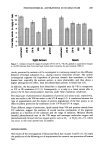
202 JOURNAL OF THE SOCIETY OF COSMETIC CHEMISTS on IL of human hair. To this extent, black and blond human hair were irradiated with simulated sunlight corresponding to the natural sunlight in the Central European latitude during the summer months and with individual parts of the sun spectrum, UV-B, UV-A, visible light, and IR. These experiments were carried out using a special irradiation apparatus, which has been described in detail in the first part of this inves- tigation (12). The non-covalently bound IL were isolated by a mild extraction method under non- oxidizing conditions so as to prevent further reactions of lipids already photochemically oxidized. The lipid extracts were separated by TLC using solvents of different polarity and then charred. Representing all IL, the main fractions--free fatty acids (FFA) and cholesterol--were quantitatively investigated by densitometric scanning of the charred spots. Finally, a photochemical destruction of the IL as a function of the type of irradiation and pigmentation of the hair is discussed. MATERIALS AND METHODS HAIR SAMPLES Untreated black and blond hair was obtained from Herzig Co. as 25-cm-long tresses of European origin. PURIFICATION OF HAIR Hair was extracted for 5 min with dichloromethane and for 30 min with diethyl ether to remove traces of naphthalene. Finally, the hair was washed with a non-ionic deter- gent, rinsed, and stored at ambient humidity. IRRADIATION OF HAIR The hair tresses were irradiated for a period of 6 weeks (1008 h) in individual com- partments with UV-B, UV-A, visible light, IR, or global radiation at RH 70% (12). In each case approximately 10 g of hair were used, the hair was spread parallel and rearranged daily to assure uniform exposure to irradiation. EXTRACTION OF SURFACE LIPIDS In order to remove the external lipids (sebum) and superficial deposits, irradiated hair samples were extracted with n-hexane under non-swelling conditions in a Soxhlet ex- tractor in vacuo according to the method of Schwan et al. (3). EXTRACTION OF INTERNAL LIPIDS Following surface extraction, hair samples were manually cut into ca. 3-mm-long fiber snippets. One gram of this sample was conditioned for 24 h at 20øC and 65% RH, mixed with 50 ml n-hexane/isopropanol/water 6:6:1 (v:v:v) in an Erlenmeyer flask, covered with a layer of nitrogen, protected from light by aluminium foil, and shaken for
Purchased for the exclusive use of nofirst nolast (unknown)
From: SCC Media Library & Resource Center (library.scconline.org)