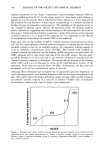
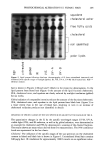
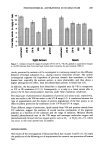
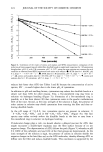
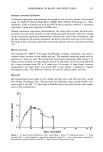
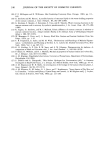
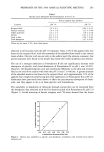
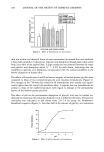
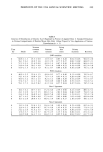
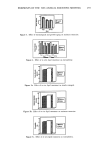
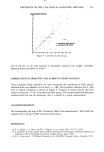
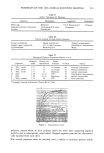
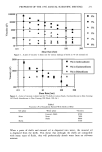
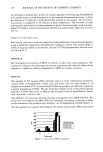
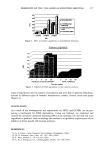
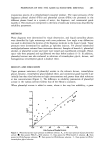
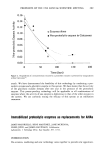
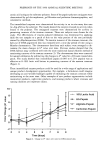
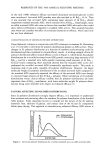
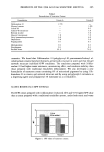
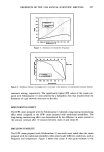
PREPRINTS OF THE 1996 ANNUAL SCIENTIFIC MEETING 259 ACTUAL BODY RATING , o i Figure 4. Correlation of body ratings. 0.25-0.29 g/cc in all cases because of reasonably constant tress weight. Interfiber adhesion forces are shown in Table I. CORRELATION OF OBJECTIVE AND SUBJECTIVE BODY RATINGS Using multiple linear regression we have attempted the correlation of body ratings obtained from two different sets of data, i.e., AE 2 and interfiber adhesion and E• and FAI. A typical correlation is shown in Figure 4. Analysis of variance shows that this model accounts for --61% of the observed body rating. The second correlation also gives similar results but has the advantage that it is based on a single measurement. ACKNOWLEDGMENTS We acknowledge the help of Ms. Hennelore Mark with measurements. This work was supported by a group of TRI Corporate participants. REFERENCES (1) P.S. Hough, J. E. Huey, and W. S. Tolgyesi, J. Soc. Cosine. Chem., 27, 571 (1976). (2) S. Kawabata, R. Postle, and M. Niwa in Objective Specification of Fabric Quality, Mechanical Properties and Performance, (The Textile Machinery Society of Japan, Kyoto, Japan, 1982). (3) M. L. Garcia and L. J. Wolfram, Presented at the 10th IFSCC Congress, Sidney, Australia, 1978.

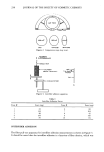
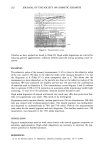
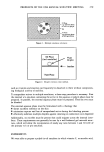
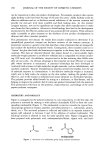
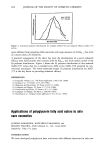
260 JOURNAL OF THE SOCIETY OF COSMETIC CHEMISTS Production of sub-micron pigments by treatment and high solids dispersion DAVID SCHLOSSMAN and GLEN FINEMAN, KOBO Products, Inc., South Plainfield, NJ 07080. INTRODUCTION Titanium dioxide, zinc oxide, and iron oxides are essential ingredients in formulating cosmetics and toiletries. They provide color and may offer other benefits such as UV absorption, skin protection, or antibacterial properties. Pigments are known to give the maximum scattering of light of a particular wavelength, giving the best brightness and hiding power when their particles have diameters equal to half that wavelength. Sub- micron pigments approaching the primary size are produced by treating particles and subsequently dispersing the treated particles in a suitable vehicle (Table I). High solids dispersion of treated pigments produce optimum color and strength, trans- parency, UV absorption, or other activity corresponding with the pigments' primary particle size. Novel finished products and improvements such as consistency, smooth- ness, and product stability can be expected. Finished products houses will also benefit from reduced processing times in a dust-free environment. BACKGROUND Pigments are prone to agglomerate trapping air and surface water between particles. Mechanical grinding such as jet milling or hammer milling may reduce agglomerates, but non-treated pigments are likely to re-agglomerate upon dispersion in a liquid system. In order to produce sub-micron pigments, the particles must be treated. Lipophilic, hydrophobic, lipophobic, or hydrophilic treatments may be employed (Table II). Lipophilic, hydrophobic, and lipophobic treatments similarly form covalent bonds with hydroxyl groups on the surface of pigment particles. The surface-modified particles should be pulverized after treatment to reduce agglomerates created during drying. The pulverized treated pigments are ready to be dispersed in an organic vehicle as high solids. This could not be achieved with untreated pigments, because air voids and water of hydration would impair proper wetting, limiting the solids' percentage. Hydrophilic treatments are required if the dispersion system is aqueous. We have developed a Table I Production of Sub-Micron Pigments 1. Select pigment with small primary particle size 15-50 nanometers 2. Treat pigment: Hydrophobic, Hydrophilic, Lipophobic, Lipophilic 3. Match treatment with suitable vehicle 4. Premix pigment in vehicle 5. Grind high solids dispersion
Purchased for the exclusive use of nofirst nolast (unknown)
From: SCC Media Library & Resource Center (library.scconline.org)