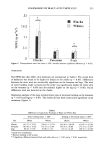
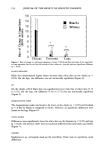
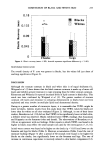
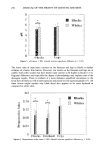
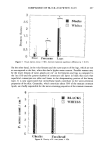
COMPARISON OF BLACK AND WHITE SKIN 239 no significant differences in the density of P. acnes were found between the two races, there appears to be a trend, with black skin showing a higher P. acnes count. This may be due to the increased sebum output in blacks (28). CONCLUSIONS This study found statistically significant differences in TEWL, electrical capacitance, skin pH, and elasticity between black and white skin. The TEWL, continuous capac- itance, and skin pH data support the hypothesis that black skin has a better barrier function than white skin. The capacitance and elasticity data indicate that black facial skin is more hydrated and elastic than white facial skin. Findings from this study may lead to a better understanding of cosmetic requirements for black skin. REFERENCES (1) M. L. Thomson, Relative efficiency of pigment and horny layer thickness in protecting the skin of Europeans and Africans against solar ultraviolet radiation, J. Physiol., 127, 236-246 (1955). (2) D. A. Weigand, C. Haygood, and J. R. Gaylor, Cell layers and density of Negro and Caucasian stratum corneum, J Invest Dermatol., 62, 563-568 (1974). (3) R. P. Rienertson and V. R. Wheatly, Studies on the chemical composition of human epidermal lipids, Jo Invest. Dermatol., 32, 49-59 (1959). (4) E. K. Marshall, V. Lynch, and H. W. Smith, Variations in susceptibility of the skin to dichloro- ethylsulfide, J. Pharmacol. Exp. Ther, 12, 291-301 (1919). (5) D. A. Weigand and M. M. Mershon, The cutaneous irritant reaction to agent o-chlorobenzylidene malononitrile (CS): Quantification and racial influence in human subjects, Edgewood Arsenal Technical Report 4332 (1970). (6) E. Berardesca and H. I. Maibach, Sensitive and ethnic skin: A need for special skin-care agents? Dermatol. Clin., 9, 89-92 (1991). (7) E. Berardesca and H. I. Maibach, Racial differences in sodium lauryl sulfate induced cutaneous reaction: Black and white, Contact Dermatitis, 18, 65-70 (1988). (8) L. C. Johnson and N. L. Corah, Racial differences in skin resistance, Science, 139, 766-777 (1976). (9) C. L. Janes, J. Worland, and J. A. Stern, Skin potential and vasomotor responsiveness of black and white children, Psychophysiology, 13, 523-527 (1976). (10) E. Berardesca, J. Rigal, J. L. Leveque, and H. I. Maibach, In vivo biophysical characterization of skin physiological differences in races, Dermatologica, 182, 89-93 (1991). (11) S. W. Babulak, L. Wo Rhein, D. D. Scala, F. A. Simion, and G. L. Grove, Quantification of erythema in a soap chamber test using the Minolta Chroma (reflectance) meter: Comparison of instrumental results with visual assessments, J. Soc. Cosmet. Chem., 37, 475-479 (1986). (12) R. R. Wickett, V. Nath, R. Tanaka, and S. B. Hoath, Use of continuous electrical capacitance and transepidermal water loss measurements for assessing barrier function in neonatal rat skin, Skin Pharmacol., 8, 179-185 (1995). (13) P. Williamson and A.M. Kligman, A new method for the quantitative investigation of cutaneous bacteria, J. Invest. Dermatol., 45, 498-503 (1986). (14) H. Schatz, A.M. Kligman, S. Manning, and T. Stoudemayer, Quantification of dry (xerotic) skin by image analysis of scales removed by adhesive discs (D-squames), J. Soc. Cosmet. Chem., 44, 53-63 (1993). (15) H. I. Maibach, Racial and skin color differences in skin sensitivity: Implications for skin care prod- ucts, Cosmet. Toiletr., 105, 35-36 (1990). (16) F. Kompaore, J. P. Marty, and Ch. Dupont, In vivo evaluation of the stratum corneum barrier function in blacks, Caucasians and Asians with two noninvasive methods, Skin Pharmacol., 6, 200-207 (1993). (17) W. Montagna and K. Carlisle, The architecture of black and white skin, J. Am. Acad. Dermatol., 24, 929-937 (1991).

240 JOURNAL OF THE SOCIETY OF COSMETIC CHEMISTS (18) (19) (20) (21) (22) (23) (24) (25) (26) (27) (28) (29) P. F. Millington and R. Wilkinson, Skin (Cambridge University Press, Chicago, 1983), pp. 113- 142. G. Imokawa and M. Hattori, A possible function of structural lipids in the water-holding properties of the stratum corneum, J. Invest. Dermatol., 84, 282-284 (1985). G. Imokawa, S. Akasaki, A. Kawamata, S. Yano, and N. Takaishi, Water retaining functions in the stratum corneum and its recovery by synthetic pseudoceramides, J. Soc. Cosmet. Chem., 40, 273-286 (1989). K. Sugino, G. Imokawa, and' H. I. Maibach, Ethnic difference of stratum corneum in relation to stratum corneum function, Annual Scientific Meeting of the American Society of Dermatological Research (Abstr.), 100, 587 (1993). W. Montagna, G. Prota, and J. A. Kenney, Black Skin.' Structure and Function (Academic Press, San , Diego, 1993), pp. 1-12. T. B. Fitzpatrick, G. Szabo, and M. M. Wick, "Biochemistry and Physiology of Melanin Pigmen- tation," in Biochemistry and Physiology of the Skin, A. G. Lowell, Ed. (Oxford University Press, New York, 1983), Vol. 2, pp. 687-712. K. H. Kaidbey, A. P. Poh, R. M. Sayre, and A. M. Kligman, Photoprotection by melanin--A comparison of black and Caucasian skin, J. Am. Acad. Dermatol., 1, 249-260 (1979). P. Eisner, D. Wilhelm, and H. I. Maibach, Mechanical properties of human forearm and vulvar skin, Br. J. Dermatol., 122, 607-614 (1990). A.M. Kligman, Unpublished observations, University of Pennsylvania, Department of Dermatology, Philadelphia, PA (1994). S. Dikstein and A. Zlotogorski, "Skin Surface Hydrogen Ion Concentration (pH)," in Cutaneous Investigation in Health and Disease, J. L. Leveque, Ed. (Marcel Dekker, New York, 1989), pp. 59-78. A.M. Kligman and W. B. Shelly, An investigation of the biology of the human sebaceous gland, J. Invest. Dermatol., 30, 99-125 (1973). A. M. Kligman, R. M. Lavker, G. L. Grove, and T. Stoudemayer, "Some Aspects of Dry Skin and Its Treatment," in Safety and Efficacy of Topical Drugs and Cosmetics, A.M. Kligman and J. J. Leyden, Eds. (Grune & Stratton, New York, 1982), pp. 221-238.
Purchased for the exclusive use of nofirst nolast (unknown)
From: SCC Media Library & Resource Center (library.scconline.org)