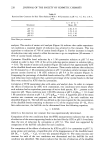
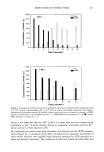
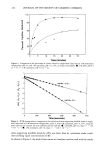
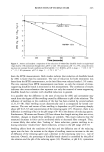
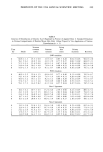
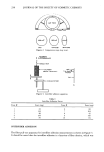
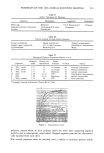
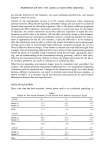
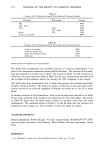
PREPRINTS OF THE 1996 ANNUAL SCIENTIFIC MEETING 265 not provide direction to the evaluator, can cause confusing specifications, and require frequent corrective action. Control of the measurement process is of the utmost importance when measuring pearlized articles. Many factors regarding instrument design and use must be considered beyond those required for absorption pigments. Due to the spatial reflection properties of pearlescent effect pigments, instrument geometry is crucial and must be controlled. In addition, the chosen instrument must have sufficient capability to make the mea- surement in which there is an interest. All too often evaluators choose a color measure- ment method based on instrument availability without considering whether the instru- ment is appropriate for the job. For instance, if specular reflection is to be evaluated, then the instrument must be able to achieve the proper illumination and viewing angle settings and be able to accommodate high reflectance intensities through the use of a filter or effective detector design. If one wishes to evaluate the total reflected light from a sample, then an integrating sphere must be used. Choice of the measurement geometry should be based on controlled visual evaluations using focused light, appropriate light- ing, and an understanding of the illumination/viewing geometry, which is then trans- ferred to the instrumental setup. Failure to choose the proper instrument for the job or an incorrect geometry can result in ambiguous or misleading data. Other factors regarding instrumental design must be considered and controlled. For instance, the optical geometry of goniospectrophotometers is not standardized regarding collimation and the measured area. Changes in the illumination angle, as is often found between different instruments, can result in reversed color trends between samples, as shown in Table I. It is therefore crucial that identical instrumentation be used between laboratories sharing data and specifications. DATA EVALUATION Once color data has been acquired, several points need to be considered regarding its Table I CIELab for Two Samples Measured 20 ø Off Specular With Different Illumination Angles 250/20 ø L* a* b* Sample A 35.1 42.1 - 8.7 Sample B 21.9 45.5 -- 4.1 Delta - 13.2 3.4 4.6 450/20 ø L* a* b* Sample A 38.7 42.2 - 2.9 Sample B 23.9 47.0 - 0.1 Delta - 14.8 4.8 2.9 650/20 ø L* a* b* Sample A 43.7 41.3 6.8 Sample B 26.5 48.0 4.6 Delta - 17.2 6.7 -- 2.2

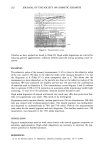
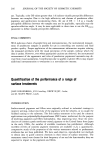
266 JOURNAL OF THE SOCIETY OF COSMETIC CHEMISTS use. Typically, color DE values greater than 1.0 indicate visually perceptible differences between two samples. Due to the high reflectivity and chroma of pearlescent effect pigments and applications incorporating them, the use of DE = 1.0 as a visually perceptible difference between two samples may not be applicable, especially near the specular reflection angle. It may be more applicable in these cases to use the DEc•tc n parameter to define visually perceptible differences. FINAL COMMENTS With judicious choice of sample form and instrumentation, the instrumental measure- ment of pearlescent samples is possible for use in controlling raw material and final product quality. Proper application of the measurement information requires relating the measured attributes with the visual perception of the sample, without which the data is useless. However, even when appropriate cautions are observed, the instrumental measurement of the appearance and color of pearlescent pigmented materials may de- viate from visual assessments. Contributions due to sparkle or glitter effects may require additional instrumentation to evaluation in a non-subjective manner. Quantification of the performance of a range of surface treatments JANE HOLLENBERG, JCH Consulting, DREW SUJET, Cardre, and M. SCOTT PRICE, Cardre. INTRODUCTION Surface-treated pigments and fillers were originally utilized in industrial coatings to improve wetting, reduce reactivity of the pigments with the vehicles, or to couple the finished coating to the substrate. The first surface treatment to be used for cosmetic applications was polymethylhydrogensiloxane (INCI name: methicone) for the purpose of rendering pigments and fillers hydrophobic, thus improving wear. Since the intro- duction of cosmetic-grade methicone-coated pigments to the United States from Japan in the early 1980s, the number of available treatments has proliferated. Although excellent reviews of cosmetic pigment treatments are available (1,2), a quantitative, comparative study of the properties of the various treatments related to performance attributes has not been published. We have used objective, reproducible test methods to obtain data to guide cosmetic chemists in their choice of surface treatment. The treatments tested were chosen for their frequency of use and the functionality they are expected to impart to the pigments and fillers.
Purchased for the exclusive use of nofirst nolast (unknown)
From: SCC Media Library & Resource Center (library.scconline.org)