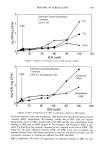
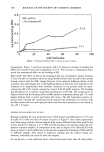
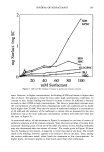
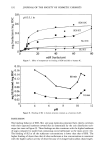
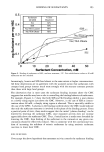
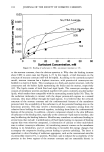
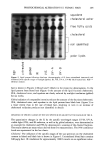
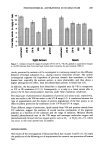
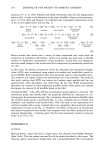
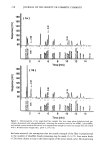
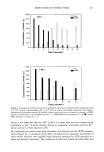
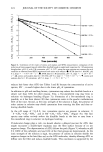
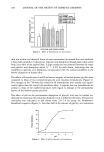
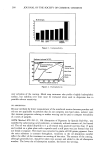
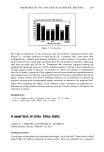
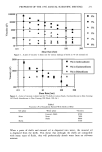
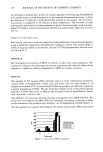
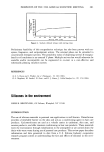
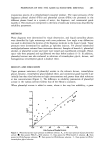
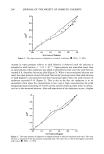
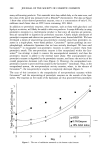
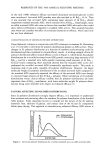
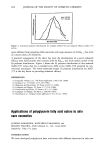
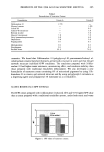
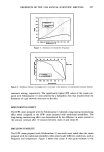
PHOTOCHEMICAL ALTERATIONS IN HUMAN HAIR 209 light-brown black Figure 7. Influence of specific ranges of sunlight (UV-B, UV-A, VIS, 1R, global) on quantitative changes in the FFA fraction from blond and black human hair (irradiation for approximately 1000 h). ciently protected by melanin will be investigated in continuing research on the diffusion behavior of foreign substances (e.g., during cosmetic treatments of hair). The current investigation supports the hypothesis of previous research that eumelanin in black human hair, especially the quinone system, is more photostable, and thus shows a higher photoprotective effect, than the pheomelanin present in blond hair (13). In addition, the hair pigment from blond hair is degraded most by VIS in comparison to UV or IR irradiation (12,13). Consequently, it is only to a lower extent able to protect the IL from photooxidative reactions under these irradiation conditions. The major part of photochemical degradation of proteins and amino acids, respectively, does not reside in the VIS but rather in the UV-B range (12). A correlation between the type of pigmentation and the degree of protein degradation of the hair points to an effective photo protection by eumelanin in the UV-B and UV-A ranges. These different ranges of protection, lipids mainly from VIS and proteins mainly from UV radiation, suggest the existence of several reaction mechanisms of the pigment polymer as a function of the substrate and the range of radiation. Melanin absorbs harmful photochemical rays in the VIS range and scavenges molecular oxygen and photochemically formed reactive oxygen species such as O2- or H20 2 (24-27), which can occur in the total system hair in parallel. CONCLUSIONS The results of the investigations of blond and black hair in parts I and II (12,13) imply the prediction of the following set of requirements for cosmetic sun protection of human hair:

210 JOURNAL OF THE SOCIETY OF COSMETIC CHEMISTS 1. The cuticle of both blond and black hair should be protected from the UV-A and UV-B ranges of sunlight. 2. The cortical proteins in low-pigmented hair should also be protected by UV- absorbing substances. 3. Melanin and lipids in low-pigmented human hair are mainly attacked by VIS. However, according to the current developments in research, a protection of this hair from this range of radiation is only possible by VIS-absorbing, colored substances, which are not acceptable in hair cosmetic preparations. REFERENCES (1) (2) (3) (4) (5) (6) (7) (8) (9) (10) (11) (12) (13) (14) (15) (16) (17) (18) (19) (2O) D. A. Shaw, The extraction, quantification and nature of hair lipid, Int. J. Cosine. Sci., 1, 291-302 (1979). S. Hilterhaus-Bong and H. Zahn, Contribution to the chemistry of human hair: II. Lipid chemical aspects of permanently waved hair, Int. J. Cosmet. Sci., 11(4), 167-174 (1989). A. Schwan, J. Herrling, and H. Zahn, Characterization of internal lipids from wool, Colloid Polym. Sci., 264, 171-175 (1986). J. D. Leeder, J. A. Rippon, F. E. Rothery, and I. W. Stapleton, Use of the transmission electron microscope to study dyeing and diffusion processes, Proc. 7th Int. Wool Text. Res. Conf. Tokyo, 5, 89-99 (1985). J. H. Bradbury, J. D. Leeder, and I. C. Watt, The cell membrane complex of wool, Appl. Polym. Syrup., 18, 227-236 (1971). H. Zahn, Wool is not keratin only, Plenum Lect., 6th Int. Wool Text. Res. Conf. Pretoria, 1 (1980). K. Nishimura, M. Nishino, Y. Inaoka, Y. Kitada, and M. Fukushima, Interrelationship between the hair lipids and the hair moisture, Nippon Koshohin Kagakkaishi, 13(3) 134-139 (1989). M. P. Mansour and L. N. Jones, Morphological changes in wool after solvent extraction and treat- ments in hot aqueous solutions, Text. Res. J., 59, 530-535 (1989). J. Herrling, Analysis of proteins and lipids of the cell membrane complex of dyed and oxidized wool (in German), PhD Thesis, RWTH Aachen (1985). M. L. Tare, Y. K. Kamath, S. B. Ruetsch, and H.-D. Weigmann, Quantification and prevention of hair damage, J. Soc. Cosmet. Chem., 44, 347-371 (1993). K. Jimbow, Y. Miyake, K. Homma, K. Yasuda, Y. Izumi, A. Tsutsumi, and S. Ito, Characterization of melanogenesis and morphogenesis of melanosomes by physicochemical properties of melanin and melanosomes in malignant melanoma, Cancer Res., 44(3), 1128-1134 (1984). E. Hoting, M. Zimmermann, and S. Hilterhaus-Bong, Photochemical alterations in human hair. Part I: Artificial irradiation and investigations of the hair proteins, J. Soc. Cosmet. Chem., 46, 85-99 (1995). E. Hoting, M. Zimmermann, and H. H&ker, Photochemical alterations in human hair Part II: Analysis of melanin, J. Soc. Cosmet. Chem., 46, 181-190 (1995). F. G. Lennox and R. J. Rowlands, Photochemical degradation of keratins, Photochem. Photobid., 9, 359-367 (1969). L. J. Wolfram, "Reactivity of Human Hair, a Review," in Hair Research: Status and Future Aspects, Orfanos, Montagna, and Stfittgen, Eds. (1981), pp. 479-500. C. R. Robbins and M. Bahl, Analysis of hair by electron spectroscopy for chemical analysis, J. Soc. Cosmet. Chem., 35, 379-390 (1984). S. Kanetaka, K. Tomizawa, H. Iyo, and Y. Nakamura, The effect of UV radiation on human hair concerning physical properties and fine structure of protein, Int. Fed. Soc. Cosmet. Chem., Yokohama (1992). R. Beyak, G. S. Kass, and C. F. Meyer, Elasticity and tensile properties of human hair. II. Light radiation effects, J. Soc. Cosine. Chem., 22, 667•578 (1971). A. Deftandre, J. C. Garson, and F. Leroy, Photoaging and photoprotection of natural hair, Congress of the International Federation of Societies of Cosmetic Chemists, New York, October 1990. M. Zimmermann, Internal lipids of wool: Photooxidative induced alterations and their effect on the wool fiber (in German), PhD Thesis, RWTH Aachen (1989).
Purchased for the exclusive use of nofirst nolast (unknown)
From: SCC Media Library & Resource Center (library.scconline.org)