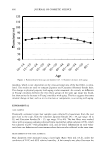
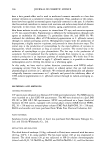
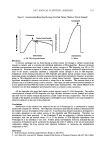
]. Cosmet. Sci., 58, 48S--494 (September/October 2007) A study of the volume and bounce decrease in hair with aging using bending elasticity measurements AKIRA MAMADA and KOICHI NAKAMURA, Kao Corporation, Hair Care Products Research Laboratories, 1-3, Bunka 2, Sumida-ku, Tokyo, 131-8501 Japan. Accepted for publication May 22, 2007. Synopsis Hair diameters and bending stresses were measured for chemically untreated regions of hair close to the scalp, collected from 38 Japanese female (age range: 26 to 51) and 35 Caucasian female (age range: 20 to 40) volunteers. For the bending stress measurements, a new methodology to obtain averaged Young's modulus has been developed in which 50 fibers are measured together to give reproducible data, overcoming the individual differences in each hair fiber. By comparing the resulting data of the fibers collected from the panelists younger than 40 years of age, no significant difference in Young's modulus between Japanese and Caucasian hair was recognized, and the modulus was ca. 10 GPa, regardless of the hair diameter. On the other hand, there existed cases in which fibers showed lower Young's moduli, and these fibers were from senior panelists who were conscious of the decrease in hair volume and bounce with aging. This result indicates that the decrease in volume and bounce in hair with aging is not only caused by a decrease in hair diameter and fewer hairs per square centimeter of scalp but also by some internal change in the hair. INTRODUCTION One of the biggest concerns for the aged female, regardless of nationality, is the decrease in volume and bounce. Thus far the only factors that have been suggested to account for this age-dependent decrease in volume and bounce is a decrease in hair diameter (Figure 1) (1) and a decrease in the number of hair fibers per square centimeter of scalp. The bending stress is thought to be a good physical parameter to represent the hair volume and bounce (2) however, it has not been easy to measure it in a reproducible manner. The methodology reported by W ortmann and Kure (3) needs long and even hair so that it cannot be applied for the purpose of the comparison of many hair fibers from different panelists. Furthermore, the recently increasing trend of hair coloring among women makes it quite difficult to get a sufficient quantity of chemically untreated hair fibers for the measurement. In this context, a new methodology, in which the short, chemically untreated, part of hair (within a few centimeters from the scalp) can be used, was developed, based on the methodology of Sogabe et al. (4), in which a small mass of hair fibers are measured at once. By using the data of bending stress obtained by the new methodology, Young's 48S

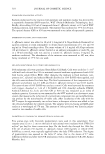
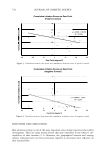
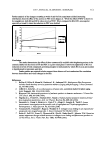
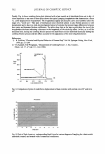
486 JOURNAL OF COSMETIC SCIENCE 120 110 � 100 '""" 90 80 -------■----. • •----•- • ---------------- • 70 ------------------------------------------------------------ 60 50 ---- --- -- ------- -- ----------------- 40 Age Figure 1. Relationship between age and diameter (ref. 1). Diameter decreases with aging. modulus, which is not dependent on the cross-sectional area of the hair fiber, is calcu lated. The results are used to compare Japanese and Caucasian (German) female hairs. The change in physical property with aging is also examined. As a result, no difference in Young's modulus between the two ethnic groups of the same age range was found, but there existed a decrease in Young's modulus with aging. This fact suggests that some internal change in hair, such as in its structure or components, is occurring with aging. EXPERIMENT AL HAIR SAMPLES Chemically untreated virgin hair samples were collected by beauticians from the root part close to the scalp, from the volunteer Japanese females (N = 38, age range: 26 to 51) and Caucasian females (N = 35, age range: 20 to 40). The hair fibers were washed twice with an aqueous sodium polyoxyethylene laurylether sulfate solution (15%), which was adjusted to pH 7 with phosphoric acid, and air-dried. Information on each volun teer's hair care behavior and consciousness about hair was also collected at the same time. MEASUREMENT OF THE HAIR DIAMETER Hair diameters were measured using a laser light (Kato Tech Ltd.) (5,6), under the conditions of 20°C and 65% relative humidity. A hair sample was placed between the
Purchased for the exclusive use of nofirst nolast (unknown)
From: SCC Media Library & Resource Center (library.scconline.org)