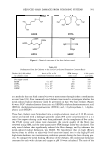
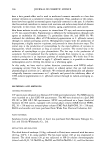
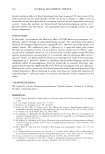
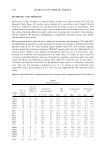
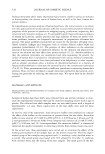
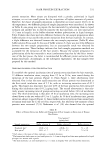
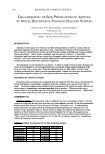
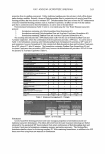
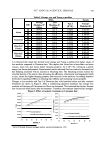
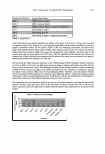
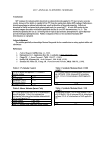
530 JOURNAL OF COSMETIC SCIENCE RESULTS AND DISCUSSION EFFECTS OF EXTRACTION BUFFERS AND WASHING OF THE HAIR SAMPLES ON PROTEIN EXTRACTION In general, the components of extraction buffers in isolating proteins from various tissues play an important role. In particular, because the surface of most hairs, including human head hairs, are lipidized or contaminated with some substances deterrable to isolation of their proteins, the hair materials are generally pretreated before the protein extraction step is performed. This pretreatment step increases the extraction time and thus is time-consuming. Accordingly, we carried out an experiment to examine the effects of the extraction buffers and washing pretreatments on protein extraction using human head hair materials. As shown in Table I, the highest amount of hair protein was extracted in buffer solution A, with a value of 247 .2 ± 3.2 µg/mg of hair. In buffer solution B, a value of 207 .2 ± 5 .2 µg/mg of hair was observed, while the lowest amount of the protein was found in buffer solution C with a value of 8.7 ±0.5 µg/mg of hair. These data suggest that buffer A solution is the most appropriate buffer for the extrac tion of hair protein. Another important thing is that buffer solution C, which is a commercial protein extraction kit used frequently in most tissues, is improper for the isolation of hair protein. This very low amount of protein extraction may be due to the presence of denaturing agents in buffer solution C, which acts as a deterrence in the extraction of hair protein (10-12). However, the difference in protein extraction between buffer solutions A and B may be derived from two factors. One factor is the difference in the concentration of urea (8 M in buffer B and 5 M in buffer A) and another is the presence of thiourea in buffer A solution. In particular, the presence of thiourea in extraction of hair protein at concentrations ranging from 1.2 M to 3 M increases the extraction of hair protein by 50% compared with those of other extraction buffers (10). Table I also shows that there is no significant difference among the washing pretreat ments, indicating that they have no influence on protein extraction from human hair materials. Consequently, the two washing steps employing pretreatments of ethanol and the mixture of ethanol plus chloroform/methanol, which consume over 24 hr, were omitted in the subsequent experiments. EFFECTS OF HAIR SAMPLE PREP ARA TI ON ON PROTEIN EXTRACTION Sample preparation from various tissues is one of the important factors. for efficient Table I Effects of Protein Extraction Buffer and Washing of Hair Samples on Extraction of Human Hair Protein Washing Controla Ethanol EtOH+Chl/MeOH6 Mean Buffer solution A 248.6 ± 4.1 247.0 ± 2.9 246.2 ± 2.6 247.2 ± 3.2c Total protein* (µg/mg hair) Buffer solution B 202.8 ± 6.2 209.9 ± 5.2 209.0 ± 4.2 207.2 ± 5.2c * Each value is the mean of three replicates ± standard deviation. a Control: washing of the hair materials only with distilled water (3 x washings). 6 EtOh, ethanol Chl, chloroform MeOH, methanol. c Mean values calculated in each column of the buffer items. Buffer solution C 9.0 ± 0.4 8.1 ± 0.4 9.1 ± 0.7 8.7 ± OS

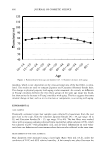
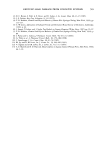
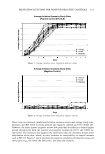
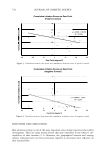
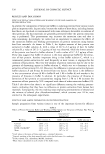
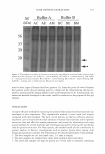
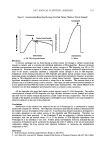
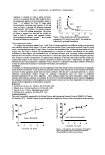
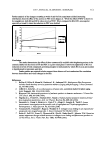
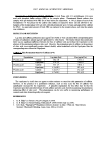
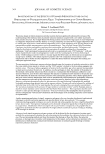
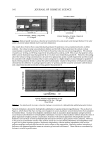
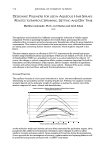
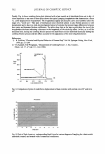
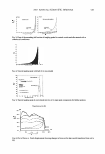
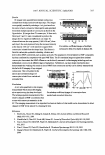
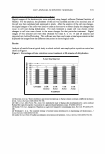
HAIR PROTEIN EXTRACTION 531 protein extraction. Most tissues are disrupted with a grinder, pulverized in liquid nitrogen, or cut into small pieces for the acquisition of higher amounts of protein. However, the choice of sample preparation is dependent on tissue sources (8,10,11). In this experiment, two different groups of sample preparations were introduced. As shown in Table II, one group was to prepare the hair materials by pulverizing them in liquid nitrogen and another was to directly immerse the hair materials, cut into small pieces (1-2 mm in length), in the buffer solutions without pulverization in liquid nitrogen. Table II shows that there was little difference between the two sample preparations when buffer solution A was used for the protein extraction from the hair materials. In contrast, a slight difference was detected between the two sample preparations (Table II) when buffer solution B was used. In the case of buffer solution C, there was also little difference between the two sample preparations, but an unacceptable result was obtained for protein extraction. These findings indicate that both sample preparation methods are acceptable for the extraction of the hair protein. Because the sample preparation by pulverization of the hair materials is more cumbersome than that by the direct immer sion of the hair pieces, the latter is recommended for efficient protein extraction from human head hairs. Accordingly, in the subsequent experiment, the hair samples were prepared by this method. TEMPORAL PROGRESS OF PROTEIN EXTRACTION To establish the optimal incubation time of protein extraction from the hair materials, 12 different incubation times, ranging from 2.5 hr to 50 hr, were tested during the extraction of the hair proteins (Figure 1). From Figure 1, three observations were obtained. One is that the most rapid extraction rate of hair protein was determined at the first initial incubation time of 2. 5 hr, with an increasing extraction rate of 42 .1 µg/hr. This figure also illustrates that over 40% of the hair protein has been extracted during this incubation time (105.2 µg/mg hair). The second observation is that rela tively greater increasing rates of protein extraction occurred before 24 hr of incubation time. The third observation is that after 24 hr of incubation time, the increasing rates slowed down to the rate values of 0.3 to 1.1 µg/hr. At 50 hr of incubation time, protein extraction almost stopped (Figure 1). Some workers extracted proteins from animal hairs or human head hairs for 12 hr or 18 hr, respectively, but relatively low amounts of hair proteins were recovered (7, 11). Nakamura et al. (10) also showed that the optimal Table II Effects of Protein Extraction Buffer and Propagation of Hair Samples on Extraction of Human Hair Protein Sample preparation Powdered haira Hair pieces6 Buffer solution A 252.8 ± 3.3 249.3 ± 1.7 Total protein* (µg/mg hair) Buffer solution B 228.8 ± 3.1 217.1 ± 6.5 * Each value is the mean of three replicates ± standard deviation. Buffer solution C 7.1 ± 1.0 7.9 ± 0.6 a The human hair shafts were cut into small pieces (ca. 1-2 mm in length) and then were pulverized in liquid nitrogen in a mortar with a pestle. 6 The hair materials, cut into small pieces (ca. 1-2 mm in length), were used for protein extraction.
Purchased for the exclusive use of nofirst nolast (unknown)
From: SCC Media Library & Resource Center (library.scconline.org)