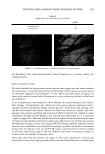
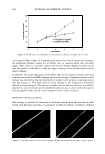
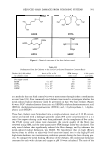
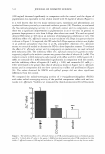
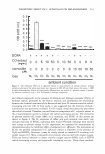
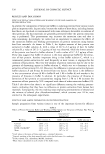
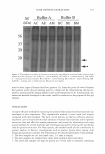
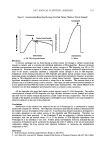
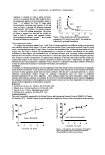
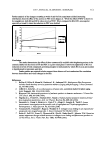
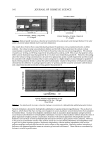
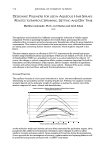
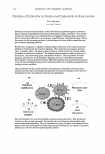
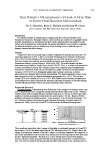
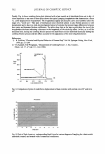
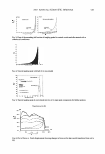
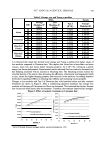
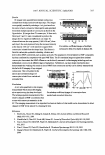
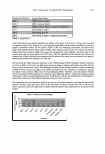
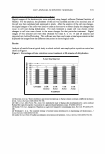
2007 ANNUAL SCIENTIFIC SEMINAR Figure 1 Comp rison of the formula recovery Sample A - before filling, Sample B - after machine filling Recovery test 50 40 30 20 "10 Sh•ar rat. [11•1 I ..... -. ...... Sample A I ---sample B 557 As seen in Figure 1 machine filling significantly impacts the recovery of the formula. The microscopic images of structural changes related to machine filling are shown in Figure 2. Figure 2 Microscopic imag of structural changes induced by filling. Before filling After filling 24 hr Figure 3 illustrates the impact of filling on mascara performance. Figure 3 The sample on the right is freshly filled. Conclusion 78 hr A comparison of the obtained data shows the following: An evaluation of rheomorphological changes under a different filling stress helps to explain changes in mascara performance during industrialization of the product. This technique allows identification of filling sensitive formulas during the product development stage. References : 1. A. Knaebel. R. Skouri, J.P. Munch, and SJ. Candau, Structural and rheological properties of hydrophobically modified alkali-soluble emulsion solutions, J. Polym. Sci. B Polym. Phys., 40, 1985-1994 (2002). 2. H.A. Barnes, Rheology of emulsions, Colloids Surf A Physicochem. Eng. Aspects, 91, 89-95 (1994). 3. F. Lequeux, Emulsion rheology, Curr. Opin Colloid Interface Sci., 3408-411 (1998). 4. T.G Mason, New fundamental concepts in emulsion technology, Curr. Opin. Colloid Interface Sci., 4, 231-238 (1999). 5. CL. Rohn, Analytical polymer technology. Cincinnat� OH, Hanser Publisher (1995). 6. P.van Puyvelde, Y.A. Antonov and P. Moldenaers, A rhea-optical investigation of shear-induced morphological changes in biopolymeric blends, Korea-Australia Rheology J., 3, 115-119 (2002).

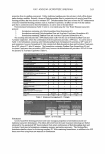
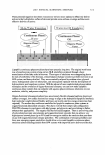
558 JOURNAL OF COSMETIC SCIENCE COMPLEX EFFECT PIGMENTS: TECHNOLOGY IN SUPPORT OF BEAUTY & f ASHION INTRODUCTION Leila S. Song, Ph.D. and Gabriel E. Uzunian BASF Corporation There are new fashion trends and new design influences every year. New materials and formulations are developed to support these new trends and influences. New trend colors no longer match the traditional descriptions such as yellow, red, blue, or green, but instead require more sophisticated visual language, such as sunrise gold, baby pink, sheer indigo, or emerald green, which reflect unique combinations of colors and effects. New color also no longer has only a one-dimensional monotone flat appearance, but rather multi-dimensional, multi-color and changing-color shades with depth. More than merely reflecting light, complex effect pigments actually manipulate light to create a visual impression and can dramatically improve cosmetic and personal care products to meet the beauty and fashion trend. In the past decade the technology to produce a variety of effects has been improved dramatically. The early single-oxide-coated mica pigment has simple structure. As new pigments evolve, their structure becomes much more complex. This has led to a proliferation of new effects: appearances from satiny sheen to metallic luster to sparkling and colors from simple white and iridescent interference to optically variable shifting color. Today's formulators have unlimited options to enhance the aesthetic value and performance of their products. DISCUSSION Typically an effect pigment is based on thin, translucent platelets of low refractive index material, coated with a high refractive index material. Effect pigments are optical filters that reflect and transmit light that falls upon them. The basic laws of optics apply to all effect pigments. The fundamental theory of interference pigments is the principle of light interference and the angular dependence of the reflected or refracted lights. Light striking the surface of pigments is refracted, reflected and scattered by the layers that make up the pigment. A changing play of color is created through interference of the reflected rays of light, with the most intense color seen at specular angle. (1,2) Color effect and coating Colors and effects of pigments can be formed in several different ways as described below: Depending on the coating thickness of high refractive index material, interference colors of gold, red, blue, or green can be generated for the simple structured single-oxide-coated interference pigments. Combining absorption and interference colors can create a variety of single- or dual-color effects. The presence of an absorption pigment, either coated onto the interference pigment or used in conjunction with it, produces intense specular reflection colors that give away to the color of the absorption pigment at non specular angles. There is also a transmission color that combines the effects. (1,2) Adding layers of both low and high refractive index materials onto the mono-layer pigment, the resulting multi-layer coated effect pigment intensifies the color reflectivity. This is because the pigment has more surfaces to reflect, thus there are more chances for the light to be intensified. Further improvement of the multi-layer coatings by applying non-quarter wavelength multi-layered coating technology can result in a complex effect pigment that not only enhances the intensity and chromaticity of the reflected light but also creates goniochromatic color travel effects. (3)
Purchased for the exclusive use of nofirst nolast (unknown)
From: SCC Media Library & Resource Center (library.scconline.org)