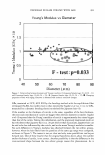
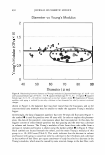
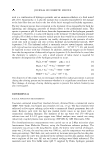
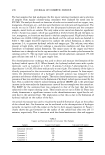
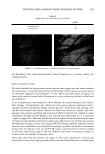
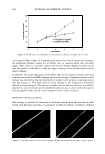
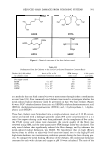
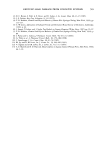
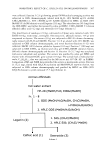
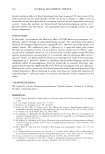
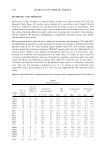
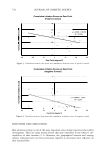
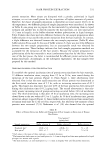
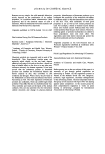
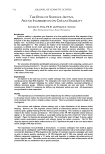
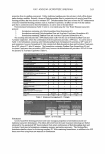
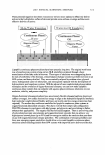
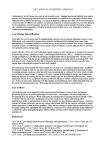
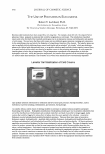
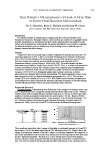
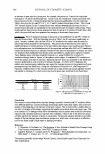
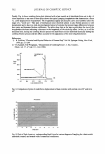
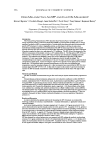
508 Loganin (2) Fr.6 JOURNAL OF COSMETIC SCIENCE Camus officinalis I 50% EtOH extract I HP-20 (MeOH/H2O) Fr.1-5 I ODS (MeOH/H2O) 1. ODS 1. ODS (CH3CN/H2O) (CHJCN/H2O) 2. SiO2 2. ODS (CH3CI/MeOH) (MeOH/H2O) 3.ODS 1. acetylation (CH3CN/H2O) 2. HPLC SiO2 4. HPLC ODS (hexane/EtOAc) (CH3CN/H2O) Morroniside acetate ( 4) 11 Cornuside (5) Scheme 2 1. SiO2 (CH3CN/H2O) 2. ODS (MeOH/H2O) 3. SiO2 (CH3CI/MeOH/H2O) Morroniside acetate was obtained as a colorless crystal (18). The FABMS of morroniside acetate proved the [M+Hr ion at m/z 407, which coincided with the molecular formula C17H 2 6 O 11 . The 1 H-NMR spectrum of morroniside acetate (in CD 3 OD): ol.27 (2H, d, j = 7 .0 Hz), 1.53 (lH, dt, J = 13.5, 3.9 Hz), 1.66 (3H, s), 1.78 (lH, m), 1.19 (lH, m), 3.07 (lH, m), 3.71 (3H, s), 4.14 (lH, dd, J = 2.4, 12.3 Hz), 4.34 (lH, m), 5.00 (lH, m), 5.10 (lH, t,J = 9.7 Hz), 5.23 (lH, t,J = 9.2 Hz), 5.67 (lH, d,J = 8.77 Hz), 6.14 (lH, d, j = 3.2 Hz), 7.43 (lH, s). 13C NMR (CDC13 ): 018.7, 20.5, 20.6, 21.2, 25.9, 30.9, 31.3, 39.1, 51.4, 61.6, 67 .2, 68.4, 71.0, 72.1, 91.2, 94.3, 96.7, 111.1, 152.5, 166.6, 169.2, 169.4, 169.6, 170.1, 170.6. It was thought that this compound without acetylation was morroniside, because it was identified when the isolated compound was morroniside-5-acetate. Caffeic acid (12), loganin (13), sweroside (14,15), and cornuside (11) were identified by comparison with 1 H-, 13C-NMR spectral data. (See Scheme 3 for the chemical structures of these components.) DPPH RADICAL-SCAVENGING ASSAY For this experiment, 0.05 ml of a solution of the compound isolated from the C. officinalis extract was added to 1.95 ml of DPPH (Sigma-Aldrich Co) MeOH solution, 6.0 x 10- 5 M. After the mixture was incubated at room temperature for 30 min, the absorbance at

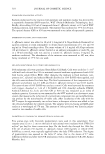
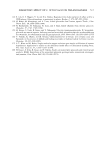
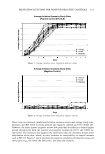
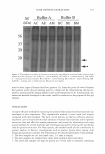
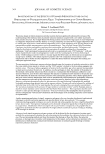
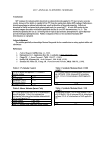
INHIBITORY EFFECT OF C. OFFICINALIS ON MELANOGENESIS 509 0 OH OH caffeic acid ( 1 ) OH HO 0 OGlu loganin (2) OH morroniside acetate ( 4) HO HO 0 OGlu sweroside (3) cornuside (5) Scheme 3 515 nm was monitored. In a similar way, 0.05 ml of solvent (MeOH or water) was added instead of a test sample as a control. The blank was 1.95 ml of MeOH plus 0.05 ml of solvent (MeOH or water). DPPH radical scavenging activity was measured by compari son with the control value. DPPH scavenging rate(%)= [{ABSc -(ABS 5 - ABS B )}/ ABSc] x 100 where ABSc = the absorbance value of the control, ABS5 = the absorbance value of the test sample, and ABSB = the absorbance value of the blank. MEASUREMENT OF CHEMILUMINESCENCE Weak chemiluminescence was observed with compounds from C. officinalis that showed DPPH scavenge activity and EGCG. A half milliliter of cornuside (or caffeic acid) isolated from C. officinalis was mixed with 0.5 ml of 5% (w/w) H2O2 and 0.5 ml of 100 mM KHCO 3 . Using the low-level light detection unit C8801 (Hamamatsu Photonics K.K.), photons from test samples (final cone. 0.05 mM) were measured and integrated for 20 min at room temperature.
Purchased for the exclusive use of nofirst nolast (unknown)
From: SCC Media Library & Resource Center (library.scconline.org)