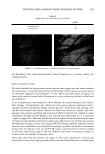
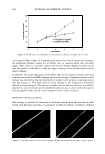
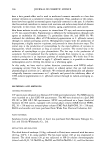
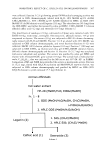
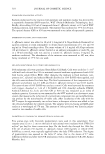
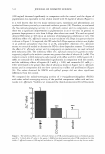
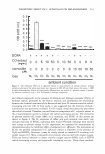
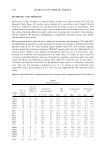
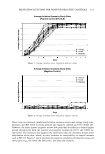
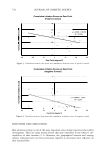
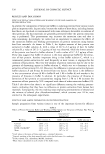
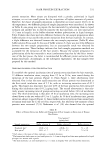
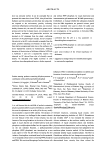
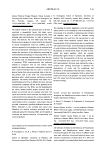
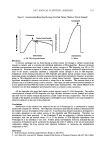
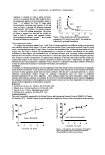
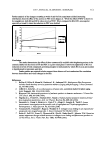
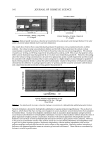
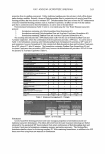
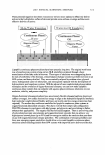
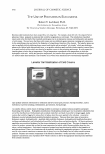
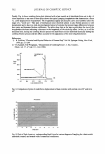
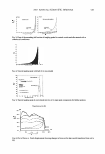
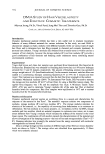
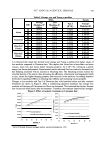
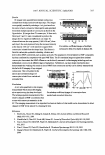
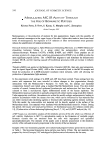
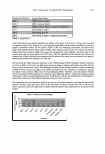
2007 ANNUAL SCIENTIFIC SEMINAR Results IR images were acquired from multiple comeocytes isolated from the third and eleventh tape strips. The images were spatially masked by selecting a 4 x 4 pixel area from the center of each comeocyte. Mean spectra wen: generated from these multiple spectra of comoocytes as shown in the figure below. IR images from 72 comcocytes, 36 from each from layer 3 and 11, were concatenated to produce the images sho\W. Significant differences can clearly be observed between the mean spectra (1180-1430 cm- 1 ) from each layer, the most prominent being the incr� intensity a,r. .... ,.._.. _ _........_ :I 587 • in the band at 1404 cm·1 in the spectrum acquired from Correlation coefficient images of multiple comeocytes isolated from the deeper layer. This feature is comeocytes from two depths in human SC. from the carboxylate symmetric stretching vibration and derives from NMF constituents, such as amino acid salts. The assignment of these features to NMF components has been confirmed by comparison with pure NMF films. The IR correlation images acquired from isolated comeocytes demonstrate that NMF diffen:nccs can be directly measured via this imaging technology and can diffcrc:ntiate comeocytes at different stages of maturation. Furthermore, our most recc:nt ccpcriments have demonstrated that washing skin results in loss of NMF from comeocytes and this can be directly measured and tracked with IR imaging of tape stripped comeocytes. This is illustrated in the spectra and correlation images of comeocytcs isolated form washed and wtwashed skin. Conclusion A new !Cllli-quantitative skin imaging measurement which utilizes IR imaging Ill 1n1..-ofan-,.6---• lllduw.-.dma micro-spectroscopy has been developed. Correlation coefficient imqes of comeocytes from The technique permits measurement of the w■s•ed and unwashed skin sites. relative changes in NMF concentration that occurs with comeocyte maturation in the SC. This imaging measurement of an important biochemical marker of skin health is also demonstrated to detect changes in NMF levels induced by cleansing the skin. Reference 1. Boskey AL, Moore DJ,Amling M, Canalis E, Delany AM Jou ma I of Bone and Mineral Research 18(6):1005-1011, 2003 2. Mc:ndelsohn R, Chen H-C, Rerek ME, Moore DJ. Joumal of Biomedical Optics 8(2): 185-190, 2003 3. Xiao C, Moore DJ, Rerek ME, Flach CR, Mendelsohn R. Journal oflnvutigative Dermatology 114:622- 632, 200S 4. Xiao C, Moore DJ, Flach CR, Mendelsohn R. Vibrational Spectroscopy38:1SI-158, 2005 5. Zhang G, Moore DJ, Mendelsohn R, Flach CR. Journal ofln11estigative Dermatology 126: 1088-1094, 2006

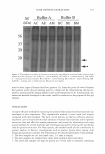
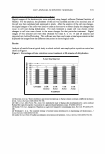
588 JOURNAL OF COSMETIC SCIENCE OZONE AND SKIN: AN 0vERVIEW Giuseppie Valacchi, Ph.D. Center for Comparative Respiratory Biology and Medicine University of California, Davis Davis, CA 95616 The skin, as an interface between the body and the environment, is chronically exposed to stress from both UV radiation and environmental oxidative pollutants such as diesel fuel exhaust, cigarette smoke, halogenated hydrocarbons, heavy metals and 03 (one of the most toxic of these compounds). The skin is protected against oxidative stress by a variety of antioxidants these include enzymatic antioxidants (glutathione peroxidase, superoxide dismutase, catalases) and nonenzymatic low molecular weight antioxidants such as vitamin E isoforms, vitamin C, glutathione (GSH), uric acid and ubiquinol. The distribution of antioxidants in the stratum corneum (SC) follows a gradient with higher concentrations in deeper layers. This may be explained by the fact that SC layers move up in time as a part of the physiological turnover of skin cells and are replaced by freshly differentiated keratinocytes. Therefore, the superficial layer is exposed to chronic oxidative stress for a longer time than the deep layer. Compared with the SC, the surface lipids contain high levels of a- and y tocopherol because of the secretion of vitamin E by sebaceous glands. Eventually, the uppermost layer of the SC will desquamate and the remaining antioxidants and reacted products will be eliminated from the body. It is generally understood that the toxic effects of 03 are mediated through free radical reactions, although 03 is not a radical species per se. They are achieved either directly by the oxidation of biomolecules to give classical radical species (hydroxyl radical) or by driving the radical-dependent production of cytotoxic, nonradical species (aldehydes). Furthermore, the formation of the oxidation products characteristic of damage from free radicals has been shown to be prevented by the addition of the antioxidants vitamin E and C, though the mechanism is not fully understood. The target specificity of 0 3 towards specific compounds together with its physicochemical properties of fairly low aqueous solubility and diffusibility, must be taken into account when a target tissue (lung and skin) is exposed to 03. Within the skin, the SC has been identified as the main target of oxidative damage. As the outer skin barrier, the SC has important functions, limiting transepidermal water loss and posing a mechanical barrier to penetration by exogenous chemicals and pathogens. It comprises a unique two compartment system of structural, non-nucleated cells (corneocytes) embedded in a lipid enriched intercellular matrix, forming stacks of bilayers that are rich in ceramides, cholesterol and free fatty acids. The effects of 03 on cutaneous tissues have recently been evaluated using a murine model (SKHl hairless mice). Skin vitamin E concentration was dramatically reduced after single high dose of 0 3 (10 ppm x 2 h) E. and this was associated with a significant depletion of ascorbate followed by an increase in the lipid peroxidation measured as malondialdehyde (MDA) content. Because its chemical and physic properties, 0 3 does not penetrate through the cells and now it is well accepted the hypothesis that 0 3 mainly reacts within the SC. This hypothesis was supported by further experiments, where hairless mice were exposed to varying levels of 03 for 2 h. Depletion of SC
Purchased for the exclusive use of nofirst nolast (unknown)
From: SCC Media Library & Resource Center (library.scconline.org)