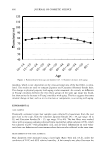
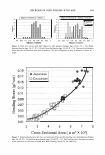
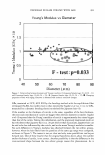
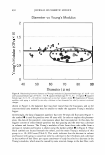
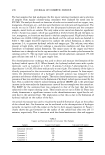
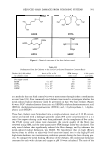
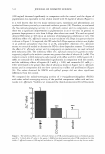
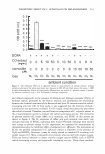
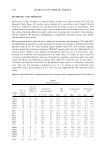
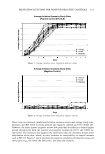
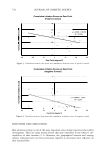
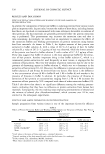
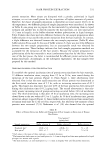
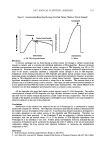
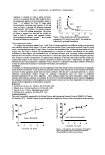
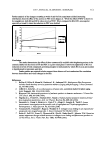
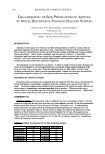
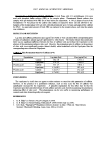
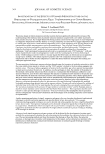
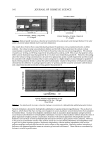
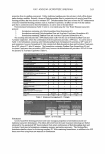
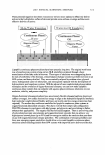
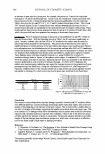
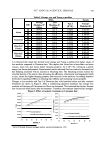
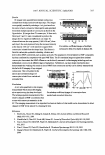
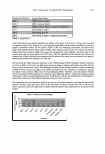
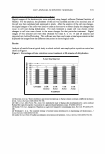
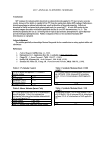
DECREASE IN HAIR VOLUME WITH AGE Japanese females (age: 26-39, N = 21) and Caucasian females (Age: 20-40, N = 35 Japanese females (age: 45-51, N = 17) Japanese females (age: 45-51, N = 9) with hair trouble such as less hair volume Table I Results of Analysis by ANOV A Japanese females (age: 26-39, N = 21) and Caucasian females (age: 20--40, N = 35) 0.33 0.00015 Japanese females (age: 45-51, N = 17) 0.091 493 Japanese females (age: 45-51, N = 9) with hair trouble such as less hair volume Each figure means the significance probability. Japanese females with hair trouble such as less hair volume show significant differences from other Japanese females (age: 26-39) and Caucasian females (age: 20--40). as a change in structure or components. A few reports have referred to the relationship between age and hair shaft properties, such as hair diameter and tensile strength (13- 17, 18). Kususe (18) has reported the same tendency as with these results by using tensile testing, that is, the Young's modulus decreases with aging. Regarding the internal change in hair with aging, changes in the lipid components have been reported (19). It was also reported that the ratio of the lipid originating from the sebum cutaneum increases with aging (20). These internal lipid changes may be the cause of the difference in the Young's modulus. However, further and wider study will be needed to clarify what are the main causes of this difference, because some funda mental changes in the internal structure and/or components of the hair must occur with aging. CONCLUSIONS One of the biggest concerns for the aged female, regardless of nationality, is the decrease in volume and bounce. The bending stress is thought to be a good physical parameter to represent hair volume and bounce however, it has not been easy to measure it in a reproducible manner. In this study, a new methodology, in which a small mass of hair fibers from the chemically untreated part of hair (within a few centimeters from the scalp) could be measured at once, was developed. By using the data of bending stress obtained by the new methodology, Young's modulus, which is not dependent on the cross-sectional area of the hair fiber, was calculated. By comparing the resulting data of the fibers collected from the panelists younger than 40 years old, no significant difference in Young's modulus between Japanese and Caucasian hair was recognized, and the modulus was ca. 10 GPa, regardless of the hair diameter. On the other hand, there existed cases in which fibers showed lower Young's moduli, and these fibers were from senior panelists who were conscious of the decrease in hair

494 JOURNAL OF COSMETIC SCIENCE volume and bounce with aging. This result indicates that the decrease in volume and bounce in hair with aging is not only caused by a decrease in hair diameter and fewer hairs per square centimeter of scalp but also by some internal change in the hair. REFERENCES (1) H. Otsuka et al., J. Soc. Cosmet. Chem. Jpn., 12(3), 192-197 (1988). (2) P. S. Hough,]. Soc. Cosmet. Chem., 27, 571-578 (1976). (3) F. J. Wortmann and N. Kure,]. Soc. Cosmet. Chem., 41, 123-139 (1990). (4) A. Sogabe et al.,]. Soc. Cosmet. Chem. Jpn., 36(3), 207-216 (2002). (5) A. Franbourg,J. Am. Acad. Dermatol., 48 (Suppl. 6), Sl 15-Sl 19 (2003). (6) Japan Patent No. 1991-289942. (7) S. Kawabata et al., Senn'igakaishi, 30, 340-348 (1972). (8a) G. V. Scott and C. R. Robbins,]. Soc. Cosmet. Chem., 29, 469-485 (1978). (86) C.R.Robbins, Chemical and Physical Behavior of Human Hair 2nd ed. (Springer-Verlag, New York, 1988), pp. 239. (8c) J. A. Swift, Int.]. Cosmet. Sci., 21, 227-239 (1999). (9) J. A. Swift, Int.]. Cosmet. Sci., 17, 245-253 (1995). (10) R., Wickett, 2nd Ethnic Hair & Skin Conference, Chicago IL, September 19-21, 2003. (11) M. D. Buhban, Z. Morph. Anthrop. 65(3), 324-328 (1974). (12) L. Rebenfeld et al., J. Soc. Cosmet. Chem., 17, 525-538 (1966). (13) N. Naruse et al., J. Am. Geriatr. Soc., 19, 308-314 (1970). (14) H. C. Friedrich et al., Dermat. Wchnschr, 121, 265-271 (1950). (15) A. Marchionini et al., Dermat. Wchnschr, 99, 1285-1290 (1934). (16) W. Fuhrmann et al., Zwecke Haustarzt, 6, 122-127 (1955). (17) T. Sasaki, Bull. Kyoto Prefect. Univ. Med., 11, 42-62 (1934). (18) S. Kususe, Clin. Dermatol., 5(8), 544-549 (1963). (19) H. Tanamachi et al., The First International Conference on Applied Hair Science, Princeton, NJ, June 9-10, 2004. (20) Y. Masukawa et al., 13th International Hair-Science Symposium, Potsdam, Germany, September 10-12, 2003.
Purchased for the exclusive use of nofirst nolast (unknown)
From: SCC Media Library & Resource Center (library.scconline.org)