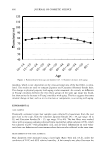
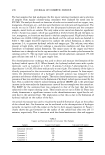
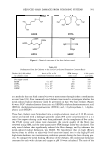
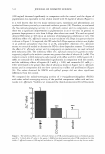
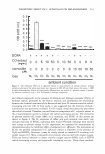
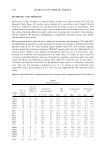
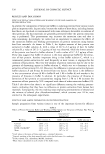
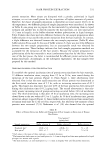
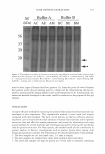
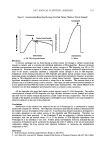
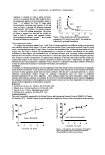
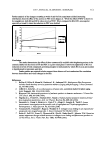
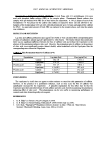
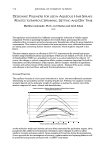
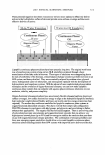
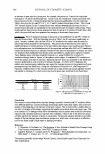
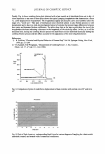
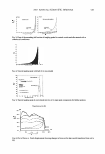
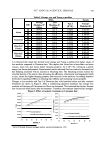
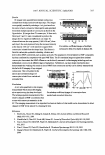
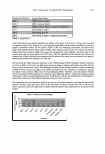
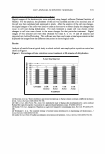
Sample Identification 1 MSH2 ASP 1 Table 1. Sample key. 2007 ANNUAL SCIENTIFIC SEMINAR 591 25µ1 of test material was applied topically to the surface of the tissue. In this study, 1 % Kojic Acid was used as a positive control (25µ1 volume) for a skin lightening agent while tissues treated with PBS was used as a negative (untreated) control. For the positive control in the skin darkening experiments, the tissues were treated with standard MatTek Media (with a-MSH), while negative control tissues were treated with MatTek Media that did not contain a-MSH. Four tissues were prepared for each treatment, with three used for the melanin assay and one tissue used for the MTT assay. After the application of the materials, the tissues were incubated for 14 days. During this incubation period, the tissues were rinsed, new test materials were applied, and the assay medium was changed every other day. We found that the 50ppm liposomal dispersion of the a-MSH analog (MSH3) stimulates melanin production as well as a-MSH. At all levels, the ASP analog decreases melanin synthesis and lightens skin better that the kojic acid used as a positive control. This lightening occurred in tissue samples exposed to a media containing a-MSH. However because the higher levels (ASP2 and ASP3) had low viabilities, it is difficult to separate the impact of the cytotoxic effects from the skin lightening effects. Therefore, only test material with the lowest concentration (ASPl) appears to be inducing a skin lightening effect by reducing the melanin content in the tissues. Thus, biomimetic peptides promise an efficacious route for the modification of melanogenesis, without the cytotoxicity or formulation limitations commonly seen in this area. This compelling discovery introduces peptides into aspects of cosmetic chemistry other than for anti-wrinkle purposes and may open many other doors in the near future. Cosmetic chemists now have a new tool to induce a gradual, natural skin lightening or tanning effect through the topical application of an aqueous-based product. GI :::, Graph 3. Melanin per Tissue Weight I= 15.0 --------------------- r _ 12.0 �---- ' j 9.0 ..,_ ___ _ = I s.o "i 3. 0 1i 0.0 gi ,1:- °' �ca Treatment

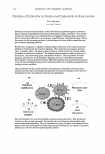
592 JOURNAL OF COSMETIC SCIENCE ALL THAT GLITTERS IS GOLD Gary Agisim, Richard Kenny, Sara Magee, and Bhalchandra Patel Wyeth Consumer Healthcare In today's highly competitive global economy, the cosmetic chemist is constantly searching for innovative strategies. Green chemistry, focusing on quality products whose composition and manufacture are environmentally friendly, resonates powerfully with the modem consumer as exemplified by Walmart's strong commercial success with "green products" representing manufacturing processes with minimal environmental footprint. There is potential to apply catalysis by gold in numerous commercial applications. Several investigators have now demonstrated that heterogenous gold catalysts, when prepared in an appropriate manner, are highly active and selective for a number reactions, often at lower temperatures than existing commercial catalysts. Despite occasional references in the older literature to the ability of gold to catalyze certain reactions, the metal has until recently had the reputation of being one of the least catalytically useful. The recent discovery that some supported gold catalysts can affect the oxidation of carbon monoxide at or below ambient temperature has, however, focused attention on the metal's ability in this respect. For oxidation of carbon monoxide at low temperature, catalysts comprising small ( 5nm) gold particles supported preferably on an oxide of the first transition series, such as titanium dioxide or alpha-ferrous oxide are needed. Deposition-precipitation and co-precipitation are better methods than impregnation for this purpose and provide the desired intimacy of contact between metal and support. High activity may well originate at sites at the gold-support interface, with the support making a vital contribution. Stable activity can result by optimizing aging in solution during preparation, and low calcination temperatures are generally desired. Gold catalysts also have potential for both selective and nonselective oxidation of hydrocarbon, for methanol synthesis by hydrogenation of carbon monoxide or dioxide, or the water-gas shift, and for the reduction of nitric acid by hydrogen, propene, or carbon dioxide. The remarkable catalytic activity behavior shown by gold depends on forming it into very small particles. This is because the massive metal and large particles cannot chemisorb typical reactant molecules to any useful extent this only occurs when adequate number of low-coordination surface atoms are present, ideally on particles so small that they lack full metallic character. The long neglect of gold as a catalyst is chiefly due to the failure to appreciate the necessity of creating particles sufficiently small and, for oxidations, of selecting a helpful support. Other relevant factors may be the likely high mobility of surface atoms on small particles and the electronegative character of gold, both stemming from the relativistic contraction of the s-electron orbitals. Although a great many different methods for preparing supported metal catalysts are reported in the literature, three predominate: 1) Impregnation of a preformed support with a solution of a salt of the metal in question, followed by drying and reduction: this may be accomplished either just by filling the pores of the support with solution or by suspending the support in a larger volume of solution, from which the solvent is then removed. 2) Exchange of protons or other cations associated with the support for cations of the desired element, followed by washing, drying, and reduction. 3) Co-precipitation of hydroxides or similar precursors to both support and metal, followed by drying, calcinations, and reduction
Purchased for the exclusive use of nofirst nolast (unknown)
From: SCC Media Library & Resource Center (library.scconline.org)