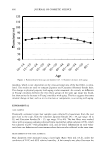
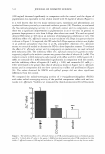
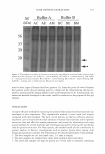
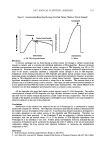
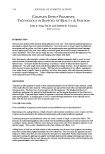
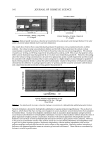
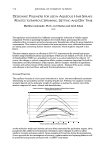
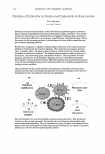
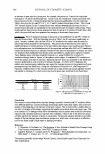
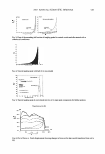
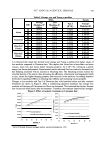
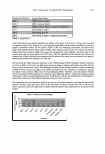
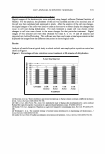
2007 ANNUAL SCIENTIFIC SEMINAR 579 TRUE POROSITY MEASUREMENT OF HAIR: A NEW W"AY 10 STUDY HAIR DAMAGE MECHANISMS Yin Z. Hessefort, Brian T. Holland and Richard W. Cloud Nalco Company, 1601 West Diehl Road, Naperville, Illinois 60563 Introduction The iitemal structure of damaged hair is changed in the hair cortex am medulla by the fonnati.on of mesopores. lbis paper employs a mvel method, gas sorpt:i.on [I], to quantify the true porosity characteristics by detennini.ng total pore volume, adsoiption pore size distributionaDl smface area of damaged hair. Subsequently, the damage mechanisms were studied by comparing the different adsorption pore size distributions of hair resulting from two different types of damage: chemical am photo damage. Methods Virgin brown hair was bleached using a solution coitaining 6% hydrogen peroxide am 1. 7% ammonium hydroxide at 40°C.A QUV Accelerated Weathering Tester (Q-Panel Lab Products) with a 340 UV A bulb emitting at 340 rm maximum was used. The em:rgy dose was 450 J/cm2• Forty hair strmls were :ramomly selected aid their diameters were measured in Fiber Dimensional Analysis System (Mitutoyo, Model LSM 5000). The tensile strength was then detennim:d using a DiaStron Tensile Tester (Model 170/670). The L, a, b values were measured in a Hunter Colorimeter (LabScan XE). Nitrogen soiption was conducted using a Quantacluome Autosolb-1 C instrument. Finely cut hair was added to a sample cell where it was placed under vacmun at 145°C for 0.5 hom. Heating the sample wxler vacuum is :oecessaiy to remove physiso:rbed water that may affect porosity measuremeits. The degas temperature is based on the data collected from DSC in which the dehydration peak appears at ca. 125 °C. The total pore volume (TPV) was collected at PIP O of ca. 0. 995. BJH (Ba.nett Joyner Halenda) adsorpt:i.on pore size distribution was used to detennim the mesopores am small macropores of hair after damage. 5-pt BET (Bnmauer-Emmett-Teller) was used to detennine surlace area (SA). Results and Discussion Chemical Damage: Ullierstaoling how the porosity of hair changes with damage can be a real asset in determining what is causing the damage 3111 what adverse effect it bas on hair. Nitrogen soiption can be used to measure the pore structure of hair up to ca 100 rm, at which water vapor soiption or mei:cmy porosimetry would need to be used for pores 100 nm. Based on ruP AC definition micropores are defined as pores 2 rm, mesopores 2 nm-50 mn am macropores 50 nm. Nitrogen soiption can therefore be used to measure micropores, mesopores am small macropores. Table I shows the SA aid TPV of bleached hair at different bl�aching times. Bleach Tune (min) 0 (Virgin hair) l 5 10 15 20 0.40 1.13 1.17 0.55 0.49 0.58 TPV(cc/g) 0.000689 0.000991 0.001010 0.000785 0.000742 0.000778 •-L,-2�.LLJ:...JJ:!:1:£..:.::��t:r.J:t!II 10 --- Figure 1: Adsorption pore size wstribution of virgin hair (-) and I min bleached hair (--). These results are astonishing after 1 minute of bleaching, a comiderable iu:rease in SA ml TPV has occurred. The SA has nearly tripled 3111 the TPV has i:n:reased by 30%. Figure 1 shows th: change in the mcsopore structure of hair after 1 mimlte of bleaching compared to the virgin hair. It also clearly demonstrates what were o:n:e four distinct pores for the virgin hair are mw three pores for the 1 mirrute bleached hair. The peak at ca. 2 mn is similar in pore size for both samples however, the pore volume associated with that pore has greatly increased for I mimrte bleached hair. The other two pores for the bleached hair are either combimtions of the virgin hair pores or

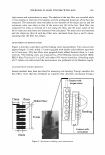
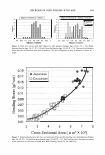
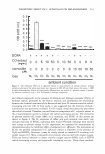
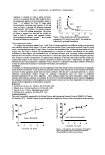
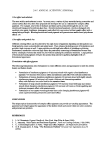
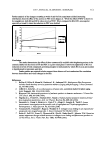
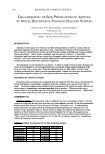
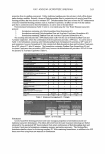
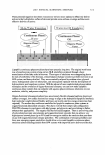
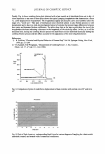
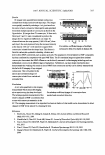
580 JOURNAL OF COSMETIC SCIENCE an increase in pore size for a given pore, for example, the pore at ca. 3 nm for the virgin hair i:n::::reased to 3 .5 mn for the bleached hair. In any event, the overall pore volume associated with the given pores for the 1 miIUite bleached hair has i:n::::reased significantly over the virgin hair. Table I also gives the SA am 1PV of 5, 10, 15 and 20 miIUite bleach times of hair. The SA am 1PV hcrease slightly for the 5 miIUite bleach time am then dramatically decrease for the 10 minute bleach time am are maintained for the most part through 20 mimltes of bleaching. These results imicate that pores are being generated in hair at least up to 5 minutes of bleach time, after which, the pores that have been generated are merging to form much larger pores. UV Damage: The UV irradiation damage of hair gives a much different SA and 1PV (Table II) than the bleached hair. With the bleaching shown in Table I, the SA i:n::::reases significantly at initial 1 mimte, contrary, after the first 200 h of UV irradiation the surface area decreases by almost half of that detected for the virgin hair. This proves that within the first 200 h there is significant fusion of certain portions of the hair follicle that causes a loss in surface area. Figure 2 is an adsorption pore size distribution plot of the virgin hair and hair after 200 h of UV irradiation Unlike the increase in pore size am pore volume for hair that was bleached for 1 miIUite, the 200 h UV irradiated hair maintained four distinct peaks am shifted to smaller pores am pore volumes. These fimings agree with those foum by Reutsch et al. using FESEM [2], in which UV irradiation damage leads to 'fusion' of the surface cuticle edges. At continued UV irradiation to 400 h the surface area starts to hcrease, imicating that new pores are generated or the fused layer has been perforated to some extent to let nitrogen through. At 1200 h of UV irradiation the surface area increases again, imicating o:n::::e again the hcrease in pores or the generation of more openings through the fused layer. Along the conclusions of Reutsch et al., after long-term UV exposure, complete fusion of the cuticular sheath into a rigid, brittle unit occurs alli may become susceptible to cracking [2], which in tum may lead to pores once restricted by the fused layer. UV Exposure (h) 0 (Virgin hair) 200 400 1200 Conclusion Table II 0.40 0.22 0.30 0.34 TPV (cc/g) 0.000689 0.000581 0.000651 0.000729 0.Cll12 :: · .. ,n 0.0010 ••-.. -·\ i OOIJ08 �y: �'. : G. f. •- 0.0000,�, �====i.::..,.;..;...===�, 0 00 Pote Olamtffr {nm) Figure 2: Adsorption pore size distribution of virgin hair (-) and 200h UV exposed hair (- -). Our extensive research has shown that hair damage caused by chemical and UV oxidation follow very different pathways. Chemical damage (bleaching) nearly triples hair surface area in the first minute of bleaching due to the increase of the pore volume. This is followed by a sudden drop in SA after 10 rnimtes of bleaching, suggesting that smaller pores break down into larger ones. This is in contrast to UV damage which shows an immediate loss in surface area in the first 200 hours exposure am a gradual i:n::::rease as exposure time continues, which is due to the fusion of cuticle cell first am then the hcrease of pores or cracks later. The porosity analysis provides a powerful insight of the hair damage from mechanistic perspective, which also can be used as an effective tool for the future study of hair repair or damage prevention Reference 1. Y. Hessefort, B. Hallam et al, "Gas Sorption: A New Method to Identify Hair Damage Using True Porosity measurements" 2006 IFSCC Congress in Osaka 2. Sigrid B. Ruetsch, Y. Karnath, and H. D. Weigmam: "Photodegradation of human hair: An SEM Study". J. Cosmet. Sci., 51. 103 -125 (March/April 2000) The authors gratefully acknowledge Wayne Carlson, Jobiah Sabelko and Cheryl Slabozeski for their contributions.
Purchased for the exclusive use of nofirst nolast (unknown)
From: SCC Media Library & Resource Center (library.scconline.org)