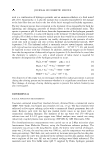
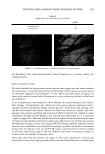
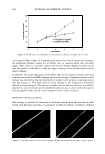
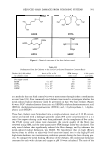
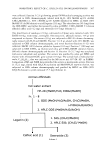
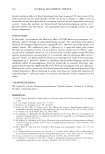
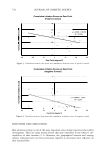
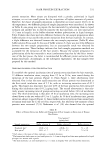
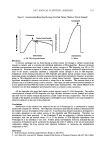
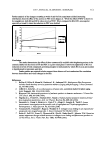
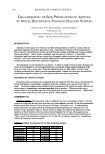
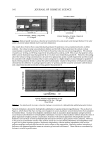
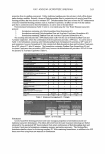
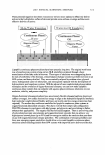
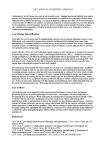
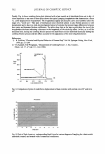
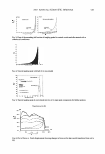
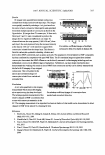
C � C 0 'ii C .. I- ! 2007 ANNUAL SCIENTIFIC SEMINAR Figure 1. Autotensiomat Recording Showing Post-Peak Tailing "Relative Tensile Strength" 72.0 dynet/cm 31.5 dynes/cm f Relative Tensile Strength Chart Divisions a. 5% TEA-ibuprofen/water � C .2 ! • I- ! ::r en t Chart Divisions b. Water Discussion 553 A nonionic surfactant was not found having a surface tension low enough or surface viscosity high enough to compete with or overcome the interfacial dominance of TEA-ibuprofen. However, increased surfactant concentrations were found to reduce the surface viscosity of TEA-ibuprofen (e.g. 5% vs. 1 % ceteareth-20). With the exception of sodium lauroyl lactylate (1 % aqueous solution=50 chart divisions) none of the anionic surfactants exhibited a comparable tensile strength to that of TEA-ibuprofen. Comparison of the chemical structures of TEA-ibuprofen and sodium lauroyl lactylate reveals common propionate groups and adjacent chemical structures having significant electrophilic character an aromatic group in TEA-ibuprofen and an ester group in sodium lauroyl lactylate. Organic structures having significant electrophilic character are known to orient flat at the interface. The electron cloud of an aromatic ring or a carboxyl group is such a structure. Their large size and orientation prevent formation of a close-packed interfacial film that results in the highly elastic interfacial film. This retards diffusion of the emulsifier into the fatty amphiphile and ultimately results in a thinner cream consistency. All the ibuprofen salts tested had similar surface tensions (range 31.5-36.0 dynesh.m). The surface viscosity/tensile strength of TIPA-ibuprofen was high (48 chart divisions), but the Quadrol and sodium salts had very low tensile strength characteristics (2 and 5 chart divisions, respectively). The low tensile strength of the Quadrol and sodium head groups is attributable to steric hindrance in the case of Quadrol or electronic repulsion in the case of the sodium salt. Conclusions Stabilization of the emulsion was improved by the use of Promulgen D, a combination of cetearyl alcohol and ceteareth-20. However, TEA-ibuprofen continued to dominate the surface as demonstrated by the delayed viscosity development of the cream (2). It was found that delayed consistency development is not totally dependent on the surface activity of the emulsifier and TEA-ibuprofen. Therefore, two mechanisms have been proposed: I) the Promulgen D may be undergoing a delayed hydration in accordance with the gel network theory (1) or 2) the kinetics of TEA-ibuprofen replacement with Promulgen D at the interface is very slow. Further process development work has indicated that the consistency development can be accelerated by changing the order of addition of the oil and water phase components, adding the drug solution after emulsion formation, or increasing the emulsification temperature to 95°C. References 1. G.M. Eccelston, Cosmetics and Toiletries, 92 (2), 21-28 (1911). 2. L.E. Pena, B.L. Lee and J.F. Stearns, Journal of the Society of Cosmetic Chemists, 44, 337-345, (1993).

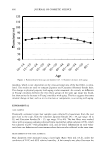
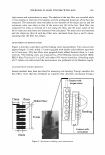
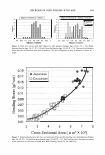
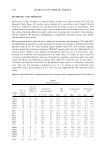
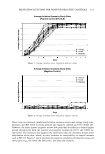
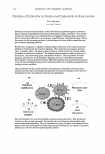
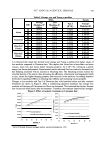
554 JOURNAL OF COSMETIC SCIENCE OP TIMIZATION OF SURFACTANT CONCENT RATIONIN TOPICAL MICROEMULSION FORMULATIONS Introduction Jessica S. Yuan, Alice Yip and Edgar J. Acosta Department of Chemical Engineering and Applied Chemistry University of Toronto Microemulsions have been considered as potential delivery vehicles because of their high solubilization capacity for hydrophilic and lipohilic active ingredients, their thennodynamic stability, transparency, and their self emulsifying properties. Microemulsions are systems which contain water and/or oil nano-domains coexisting in thennodynamic equilibrium due to the presence of a surfactant film adsorbed at the oil/water interface. The applications of microemulsions in cosmetic and phannaceutical fonnulas have been limited due to the relatively high concentration of surfactants (up to 80 wt.%) and cosurfactants (such as medium chain alcohols), required to formulate these systems. Such high concentrations of excipients increase the cost of the formulation and increase the chances of triggering allergic reactions. Lecithin microemulsions are especially desirable in cosmetic and pharmaceutical applications because lecithin is a naturally-occurring nontoxic surfactant. Furthennore, alcohol-free lecithin microemulsions have been formulated with food-grade linker molecules using total (lecithin+ linker) concentrations as low as 20 wt. % 111• Link.er molecules are amphiphiles that segregate near the oil/water interface, close to the surfactant molecules 121• Moreover, the link.er-based lecithin microemulsion systems have proven to be effective vehicles for topical delivery, featuring high skin absorption and permeation ofthe active ingredient, and minimal cytotoxicity 131• The objective of this study is to optimize the surfactant concentration on the vehicle and to investigate the relation between lecithin concentration and delivery performance (skin absorption/permeation) of the active ingredient. The result could lead to the more cost-effective formulations and lower side effects in human. In this work, the linker-based systems consist of soybean-extracted lecithin as surfactant, a mixture of sodium octanoate and octanoic acid as hydrophilic link.er, sorbitan monooleate as lipophilic linker and isopropyl myristate (1PM) as oil phase. To this end, the in vitro absorption/permeation of lidocaine (a poorly water-soluble ingredient used in acne treatment) through pig skin was evaluated as a function of lecithin concentration. Experimental Preparation and selection of linker-based microemulsion Linker microemulsions were formulated using different lecithin concentrations (from 0.4% to 4.0% at intervals of 0.4%). The sorbitan monooleate to lecithin weight ratio was kept constant at 3:1 for all systems. The octanoic acid to lecithin weight ratio was kept constant at 1: I. For a given lecithin concentration, sodium octanoate scans were conducted by varying the sodium octanoate concentration at constant temperature (22°C) and electrol)1e concentration (0.9% w/w NaCl). For in vitro penneation studies, six samples of Type II microemulsions and another six samples of Type I microemulsions (corresponding to each lecithin concentration) were selected. In vitro permeation studies Cadaver pig ears were purchased from the local market and frozen overnight. Thin skin tissue (600µm thickness) was dermatomed off the dorsal side of the ears. In vitro penneation studies were performed according to the standard percutaneous absorption protocol supplied by MatTek Corporation (Ashland, MA, USA). Briefly, the skin piece was placed in a MatTek Penneation Device (MPD), with the epidermis facing up. The microemulsion formulation (0.4 ml) was applied in the donor compartment. The receptor compartment was filled with 5 ml of PBS (0.0IM phosphate, 0.137M NaCl, pH 7.4). At predetermined time, the receiver solution was withdrawn completely and immediately replaced by fresh PBS solution. At 5.5 h, the experiment was terminated. Results and discussion Phase behaviour of linker-based microemulsions The phase behaviour of the linker microemulsions was obtained by scanning the concentration of sodium octanoate, from 0.5% to 7% at intervals of 0.5%. In this manner, the following phase transition occurred in all series with increasing sodium octanoate concentrations: Winsor Type II (water-swollen reverse micelles) - Winsor Type III or IV (bicontinuous phase) - Winsor Type I (oil-swollen micelles). This phase behaviour is similar to the one observed in our previous study 131• Figure 1 presents the "phase map" of the linker microemulsions where the boundaries between the different Winsor types of microemulsion phases are plotted in terms of the lecithin concentration (y-axis) and the sodium octanoate-to-lecithin ratio (x-axis). As the surfactant concentration increases from the A to J series, more sodium
Purchased for the exclusive use of nofirst nolast (unknown)
From: SCC Media Library & Resource Center (library.scconline.org)