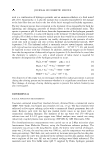
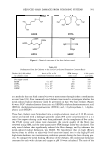
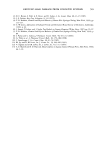
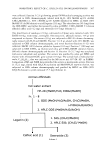
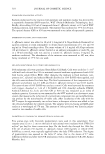
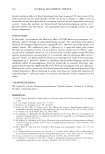
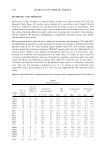
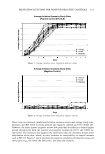
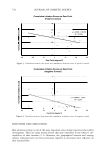
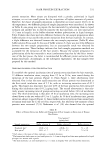
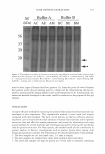
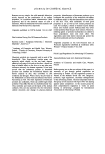
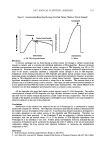
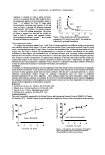
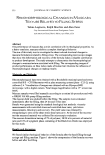
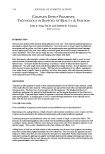
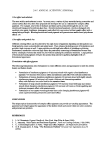
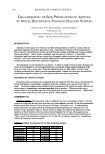
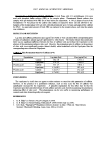
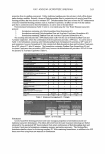
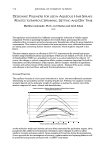
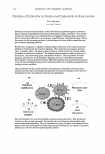
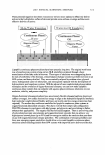
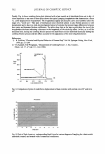
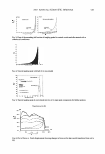
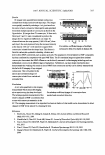
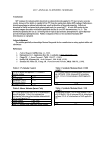
2007 ANNUAL SCIENTIFIC SEMINAR 565 The rheological evaluation and molecular interpretation of microgel thickening systems are assisted by scaling theories that have been developed to explain the role of hydrophobic 'multistickers'on the formation of gel networks by polyelectrolytes.17 We have adopted a similar rheological approach to gain insight into microgel sizes and to assess the level of interaction between the microgels. We have applied these theories in our investigation of polyelectrolyte and hydrophobically-modified polyelectrolyte thickeners, as well as networks formed by polymer-particle interaction and polymer-surfactant interaction. We have generated plots of reduced specific viscosity against polymer concentration for microgel thickeners and hydrophobically-modified microgel thickeners. We gain insight into the molecular behavior by measuring the following values depicted in Figure 1: • The intrinsic viscosity, [11], is a measure of the hydrodynamic volume of the polymer microgel in solution. It's dimensions we usually given as deciliters occupied per gram of polymer. • The critical overlap concentration, C*, which is the lowest concentration that provides sufficient polymer volume to cause overlay of the polymer molecules. For polyelectrolytes at this concentration, overlap can occur without entanglement. On the other hand, hydrophobically modified hydrophilic polymer molecules can form network structures below the 'volume-filling' concentration. 4 Viscosify Regimes for H ydrophobically -Modified Polyelectrolytes 2 4 erTlX)rary' ne1!M 'fhe polyelec:1rolyte shield each other = 'E ntmglerremand hydrophobic association Figure 1: A schematic representation of the specific reduced viscosity against polymer concentration, showing the molecular rheological characteristics of the different concentration regimes. Results and discussion -1.5 -1 -05 Log of Conmntration (g.tl.) Intrinsic Viscosity ~ 1 0dUg (1 l[ri]~0.1) C*~ 0.14g/dl 0.5 : .§ 0 � -1.5 -1 -0.5 LcgclCcncentradcin( g.tl] Intrinsic Viscosity ~ 2dl/g (1 /[ri]~0.5) C*~ 0.5g/dl 0.5 Figure 2: Reduced specific viscosity as a function of concentration for a poly (acrylic acid) microgel thickener A in water and in o.8 percent sodium chloride at pH 7 and room temperature.

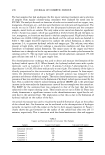
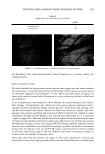
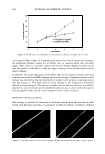
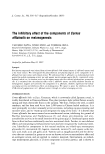
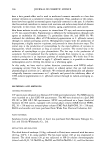
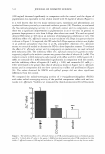
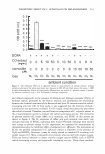
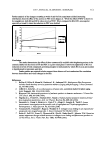
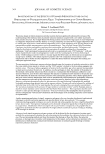
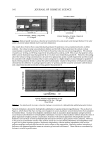
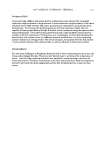
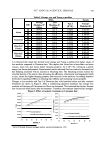
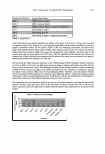
566 JOURNAL OF COSMETIC SCIENCE Intrinsic Viscosity ~ 25dUg (1 /[ri]~0.04) C*~ 0.04g/dl Corbopol900(pll�7)0J!l!,NaCI Intrinsic Viscosity~ 2.5dUg (1/[T\]~0.4) C*~ 0.4g/dl Figure 3: Reduced specific viscosity as a function of concentration for a poly (acrylic acid) microgel thickener Bin water and in o.8 percent sodium chloride at pH 7 and room temperature. Our results show that for these cross-linked polyacrylates the polymers exist as isolated molecules in dilute solution. The critical overlap concentration is distinct and for both of these polymers the critical overlap concentration is essentially identical to the Einstein theoretical value for non-interacting spheres. The intrinsic viscosities are 10 dl/ g and 25 dl/ g respectively for poly(acrylic acids) A and B. This means that polymer A has either a lower molecular mass than polymer B, or it is more cross-linked than polymer B. However, the scaling above the critical overlap concentration is 40 and 13 for poly(acrylic acids) A and B respectively and this would be consistent with a higher modulus (that would correspond to a higher degree of cross-linking) for polymer A. Each of these polymers shrinks to about the same hydrodynamic volume in the presence of 0.8 percent sodium chloride but the difference in scaling exponents above C* persists, and this would be consistent with the shear and compression moduli of polymer a being greater than polymer B. Logof� Ce Intrinsic Viscosity =[ri]=0.5Antilog of -0.3) C*= 0.3(Antilog of -0.5) Ce~ 1-25 g/dl 1 /[ri]=1 /0.5=2 Figure 4: The reduced specific viscosity as a function of polymer concentration for a hydrophobically modified polyacrylate thickener. Network formation is favored by hydrophobic substitution of a polyacrylate microgel thickener. This is shown in Figure 4, which shows that chain overlap and entanglement occurs at polymer concentrations below that calculated by Einstein theory. Increase in hydrophobic substitution leads to associative phase-separation and gel syneresis occurs beyond a threshold level of hydrophobic substitution. Increase in chain backbone stiffness delays the onset of phase-separation to higher polymer concentration. Polymers with random placement of hydrophobes and stiff backbones are less likely to form hydrophobically-associated networks in pure polymer-water solutions. However, in the presence of surfactant micelles many of these trends are reversed blocky substitution of hydrophobes tends to give rise to phase-separated polymer/ surfactant compositions, whereas random substitution tends to favor polymer-surfactant networks that traverse the entire volume of the composition. Similarly, random interaction of polymers with dispersed particles causes an extensive gel network to be formed. These effects are exacerbated by increase in micelle or particle sizes.
Purchased for the exclusive use of nofirst nolast (unknown)
From: SCC Media Library & Resource Center (library.scconline.org)