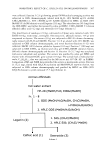
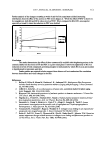
2007 ANNUAL SCIENTIFIC SEMINAR 571 Setting and Hold In general, high stiffness and strong hold in styling aids can be achieved by using high molecular weight polymers or high amounts of lower molecular weight polymers. Both these solutions lead to high viscosity and coarse spray pattern, especially in aqueous hair spray formulations. To overcome this problem polymers with low molecular weight, that are capable of forming rigid films with high E·moduli, are the preferred design for aqueous hair spray formulations. It was shown that polymers bearing a rigid backbone have properties suitable to fit this requirement. Furthermore, our investigation revealed that changing the functionality of a polymer chain, by different chemical modifications, can have surprising positive influence on setting results. The key in forming a strong bond with the hair surface is to have both, cohesion of the polymer film, as well as adhesion to the keratin surface. Drying behavior The two main challenges in finishing a hairstyle with a water-containing hair spray are curl droop and prolonged dry time. There are only limited ways to accelerate the evaporation of water. One is by the reduction of droplet size, another by using azeotropic mixtures of water and acetone. Therefore, within given rules other techniques have been investigated to prevent curly hairstyles from sagging and provide fast-drying properties to aqueous hair sprays.

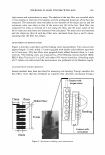
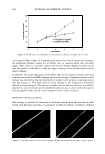
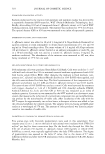
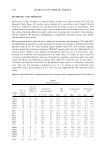
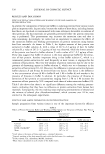
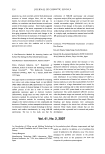
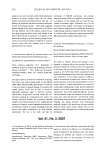
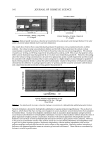
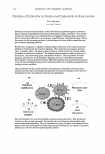
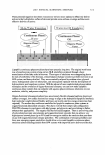
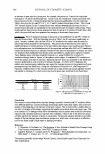
572 JOURNAL OF COSMETIC SCIENCE GENERAL OVERVIEW OF SILOXANE CHEMISTRY IN EMULSIONS Eric Abrutyn Kao Brands Company Emulsions in the personal care industry in the United States are primarily aqueous-continuous phase emulsions using traditional monomeric and polymeric organic emulsifiers. Over the past 20 years, the industry has slowly embraced the use of lipophilic-continuous phase emulsions to deliver actives more effectively (e.g., Sunscreen, Liquid Make-up, and Antiperspirants). One of the reasons for this increasing popularity is the development of more effective emulsifiers and more consumer appealing aesthetics. Whether they are aqueous or lipophilic continuous phase emulsions, all will required some key attributes to be functional and consumer appealing. They need to have an aqueous, and most likely, a lipophilic phase. The aqueous phase provides a conduit for delivery of water soluble humectants to enhance skin hydration. The lipophilic phase provides a conduit for delivery of moisturizers, skin conditioning agents, and aesthetic modifiers. They all probably will need fragrance, preservatives, and miscellaneous functional actives for multi-functional benefits. Where aqueous-continuous phase emulsions differ from lipophilic-continuous phase emulsions is in how the two incompatible phases will be stabilized (surface active modifying ingredients) and rheology/viscosity modifiers. This presentation will focus on the chemistry and application of lipophilic-continuous phase emulsions and how they are formulated and processed in emulsions. Examples will be shown to demonstrate how they are employed in personal care applications. i. aq ... i / � oil Polymeric stabilization aq. r � � ... :··· • on In rfi ci comple1 aq. Monomolecular film aq. oU Solid d.sor tion Why do formulators shy away from lipophilic-continuous phase emulsions? Why are they not used more in the personal care arena? For one, they have a list of perceived issues that on the surface make them unappealing. They are considered too greasy (oil phase is first thing felt when applied to the skin), too expensive to make (high oil phase contribution), too expensive to process, and they are not known for their high temperature stability.
Purchased for the exclusive use of nofirst nolast (unknown)
From: SCC Media Library & Resource Center (library.scconline.org)