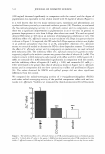
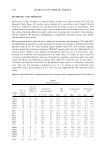
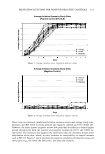
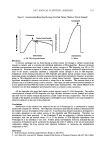
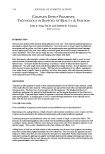
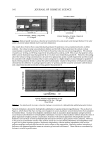
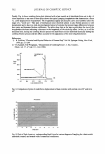
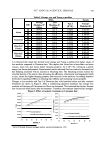
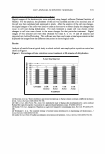
560 JOURNAL OF COSMETIC SCIENCE SKIN TRYPTOPHAN AND CROSSED-LINKED COLLAGEN LEVELS ARE SIGNJFICA TLY REDUCED BY 4-HYDROXYCJNNAMIC ACID Nava Dayan, Ph.D. Lipo Chemicals, Inc. Introduction Exposure of the skin to ultraviolet (UV) radiation can induce changes in the intensity of different native fluorophors, both at the epidennis and dermis levels. These variations allow tracking changes related to chronological aging and photo aging, as well as to differentiate between healthy and disordered skin ( 1 ). Using spectrofluorometric instrumc11tation one can distinguish between a 295nm band that originates from the amino acid tryptophan (TP) in the epidermis, and a 340nm band that corresponds with levels of pepsin --digestible cross-linked collagen (PDC) in the dermis. It was demonstrated that while TP levels may be elevated due to exposure to UVB radiation (photo-aging), PDC levels will increase with time due to chronological aging. In this study we followed changes in levels of TP and PDC in Asian skin, over a period of 8 weeks, following an application of an emulsion containing either hydroxycinnamic acid (HCA), magnesium ascorbyl phosphate (MAP) or hydroquinone (HQ). Methodology A panel of nine female subjects of Asian decent applied an emulsion containing one of the above active compounds on the foreann twice daily for 8 weeks. Measurements of baseline, 2, 4, 6 and 8 weeks, were taken using Spex SkinSkan® spectroflurometer (Jobin Yvon, Edison, NJ). This instrument is a highly sensitive fiber-optic spectrofluorometer designed for a non-invasive in vivo measurement on skin. The excitation spectrum with a peak maximum at 295nm has been correlated with the levels ofTP and the 340nm peak was correlated with the PDC. Data was calculated by subtracting the peak height value of the untreated site from the value of the treated site. Results and disevssion The mechanism by which ultraviolet radiation ages the skin and its relation to chronological aging is known to involve the generation of reactive oxygen species (ROS's) that can be neulr.llized by anti oxidants. One of the methodologies to follow biochemical alterations in the skin that result from photo exposure and chronological aging is the measurement of skin auto fluorescence (2). Selected molecules in the skin will absorb light al one wavelength and emit it at a higher wavelength. Tryptophan, which has auto fluorescence, is an important precursor for melanin biosynthesis, as well as other pigment intermediates in the skin (J, 4, 5). Cross-linked collagen is elevated in mature skin and is related to chronological aging (6). It was also shown that topical application of anti-oxidants, such as green tea extract and vitamins E and C c:an block the generation of fluorescent molecules in the skin, and this obstruction was correlated with the delay of skin aging related to changes in collagen (7). The results plotted in figure I include variations in TP levels in response to treatment. While al week two there is no significant difference in reduction in TP levels between the three actives, by week 4, MAP and HQ are shown to decrease TP levels significantly more then HCA. This trend, however, is reversed at weeks 6 and 8, when HCA surpasses both MAP and HQ to create a major reduction in the TP peak. 1,0,,, .,,,.. !!I ..... . 5 - � '°"' � 2 ... ... Woolr2 ...... . ... , ll,,

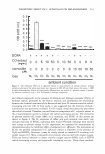
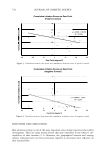
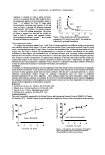
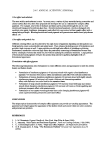
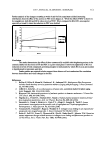
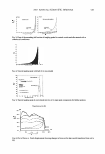
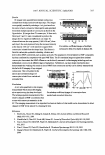
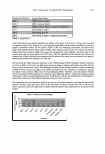
2007 ANNUAL SCIENTIFIC SEMINAR 561 Further analysis of the changes occurring at weeks 6 and 8 of the experiment yielded interesting information about the effect of the actives on PDC levels (figure 2). While the effect of MAP is shown to be insignificant, both HQ and HCA reduce levels of PDC. When compared to HQ, HCA was superior especially at week 8, where the reduction in PDC was doubled. Weeks Conclusion ,,,,-:-,••••,HCA _...,_MAP ---HQ This study demonstrates the effect of three commercially available skin-brightening actives in the cosmetic market on skin levels of TP and PDC in a pilot Asian panel. It shows the superiority of HCA in reduction in levels of both compounds, providing insights to mechanisms by which HCA as an anti-oxidant is hypothesized to rejuvenate aged skin. Further studies are required to better support these data as well as to understand the correlation between these effects and visual changes in the skin. References I. Kollias N, Gillies R, Moran M., Kochevar I.E., Anderson R.R., Endogenous Skin fluorescence includes bands that may serve as quantitive markers of aging and photoaging J. invest Dermatol. 11, 776-780 (1998). 2. Leffel D.J., Stetz M.L. In vivo fluorescence of human skin- a potential marker for photo aging. Arch. Dermatol. 124, 1514-1518 (1988). 3. Blagovea P.M. Aminoacids-precursors of melanin synthesis in hamster melanoma. J. Cancer Res. Clin. Oneal. 108, 366-368 (1984). 4. Hegedus Z.L., Frank H.A. Altschule M.D., Nayak u Human plasma /ipofuscin melanins formed from tryptophan metabolites. Arch. Int. Physiol. Biochim. 94, 339-348 (1986). 5. Smaniotto A., Comai S., Bertazzo A., Costa C.V., Allegri G., Seraglia R., Traldi P. A mass spectrometric investigation on the possible role of tryptophan and 7-hydroxytryptophan in melanogenesis. J. Mass Specrom. 41, 921-930 (2006). 6. Yamanuchi M., Prisayanh P., Haque Z. Woodley D.T. Collagen cross-linking in sun exposed and unexposed sites of aged human skin. J. Invest. Dermatol 97, 938-941 (1991). 7. Rutter K., Sell D.R., Fraser N., Obrenovich M., Zito M., Starke-Reed P., Monnier V.M Green tea extract suppresses the age related increase in collagen cross-linking and fluorescent products in C578U6 mice. Intl. J. Vitam. Nutr. Res. 73(6), 453-460 (2003).
Purchased for the exclusive use of nofirst nolast (unknown)
From: SCC Media Library & Resource Center (library.scconline.org)