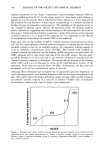
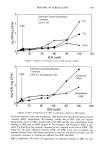
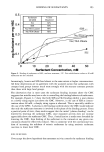
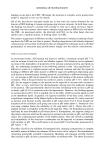
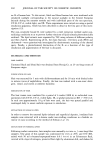
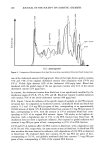
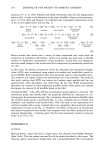
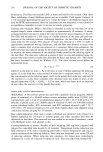
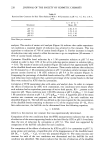
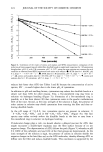
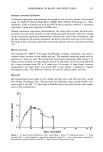
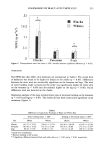
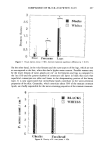
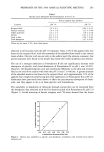
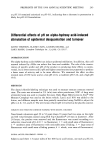
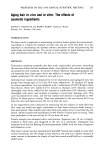
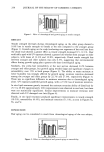
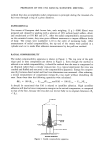
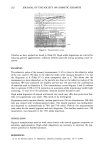
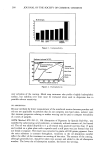
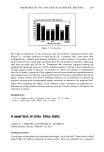
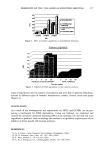
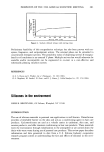
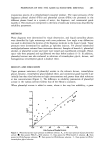
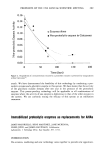
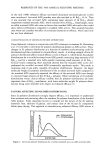
186 JOURNAL OF THE SOCIETY OF COSMETIC CHEMISTS studied extensively (15-18). Figure 1 represents a typical binding isotherm of SDS to a water-soluble protein (9,17). In the initial region (a), there exists some binding to specific sites on the protein. This is followed by either a plateau or a slow rising part of the isotherm (b) and beyond it a third region corresponding to a massive increase in binding because of cooperative interactions (c). The unfolding of the protein occurs in the cooperative binding region. Beyond the saturation point, the binding isotherm shows a plateau (d), suggesting that further binding of the surfactant does not occur on the protein. Under saturation binding conditions, i gram of the protein can be expected to bind as much as 1.5 to 2 grams of the surfactant (7). It is important to note that all of this behavior occurs below the normal CMC of the surfactant. Some data exist on the binding of SDS to stratum corneum and keratinous proteins (19-28). The main difference between surfactant binding to a soluble protein versus an insoluble protein is that for an insoluble protein, the cooperative binding appears to occur at surfactant concentrations above the CMC. The limited work available on stratum corneum also indicates that the binding of SDS continues to increase above the CMC, although with a slope lower than that in the pre-CMC region. This was inter- preted by Faucher et al. (23) to be due to the restricted diffusion of micelles into the stratum corneum compared to monomers. The reasons for the increase in the binding above CMC itself was not discussed in terms of the thermodynamic activity of the monomer, which does not increase above the CMC. Furthermore, the data does not adequately cover the low concentration region in this case. Although alkyl isethionate-type surfactants are of considerable practical importance in mild cleansing products, their binding behavior to skin has not been investigated in the past. This paper reports the results of binding studies of soaps, SDS, and SLI to human and porcine stratum corneum as a function of relevant variables such as surfactant concentration, solution pH, time of contact, and temperature. (d) log ([el) Figure 1. Schematic plot of the number of bound ligands per protein molecule (n) as a function of the logarithm of the free ligand concentration (c). Region a, specific binding region b, non-cooperative binding region c, cooperative binding, region d, saturation. Reproduced from M.N. Jones, Biochem. J., 151, 109-114 (1975).

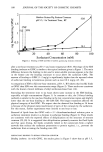
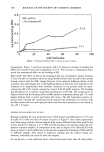
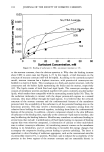
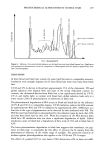
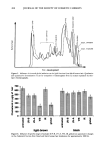
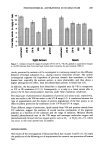
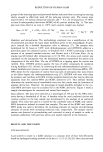
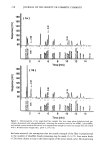
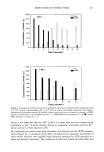
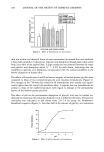
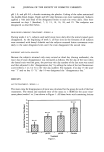
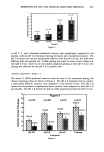
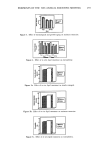
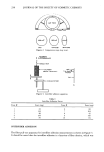
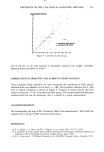
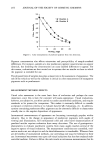
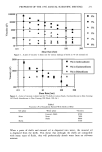
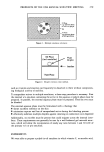
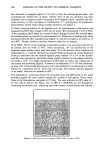
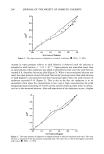
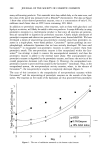
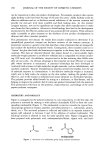
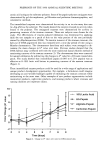
BINDING OF SURFACTANTS 187 EXPERIMENTAL MATERIALS The materials used in these binding experiments were •4C-labeled SDS and SLI, ob- tained from Unilever Research, Colworth Laboratory. Potassium hydrogen phthalate and potassium dihydrogen phosphate were from Aldrich Chemicals Co. Sodium borate, TEA (triethanolamine), and sodium hydroxide used for buffer preparations were pur- chased from Fisher Scientific Corp. Hairless guinea pig skin was obtained from Charles River Laboratories (Wilmington, MA), and the stratum corneum was isolated from it by a trypsin separation procedure. Human stratum corneum was also obtained by trypsin separation from excised cadaver skin obtained from the International Institute for the Advancement of Science. METHODS Adsorption procedure. The procedure used to evaluate surfactant binding to guinea pig and human stratum corneum required that three 8-mm punches of SC be placed in 25.4-mm (1-in) square Teflon screens. These screens were placed in treatment solutions containing a combination of •4C-labeled (1 }xCi/ml) and nonlabeled surfactant, ranging in total concentration from 1 mM to 100 mM. Before the addition of the SC sample to the treatment solution, 50 }xl of the treatment solution was removed to provide initial radioactivity values. After the selected treatment time (for example, one hour), the screens were rinsed by moving them back and forth five times in a dish of distilled water. This was to essentially wash off the excess bulk solution that would have been associated with the corneum. Since the objective of the work was to determine the thermodynamic binding of the surfactant to the corneum, excessive rinsing was not done to avoid desorption. The screens were then blotted and dried with desiccation overnight. The weight of each individual SC sample was recorded using a Perkin-Elmer AD4 Autobalance, and the sample was placed into scintillation vials containing 0.5 ml of distilled water. Scintiverse BD (Fisher Scientific) was added to each vial, and the radioactivity of the stratum corneum samples was determined using the Beckman Scin- tillation Counter. The amount of surfactant bound to the SC was calculated over the final weight of SC. This was particularly important since in certain systems a weight loss was observed upon surfactant treatment due to the extraction of corneocytes and other surfactant-soluble components. For experiments with soaps, it was necessary to buffer the Na oleate and Na laurate solutions with 0.4 M TEA. The pH of the system was around 9.5. Stratum corneum samples for delipidized experiments were prepared by treating the Teflon screens containing the 8-mm punches with a 2:1 chloroform/methanol solution for one hour and drying with nitrogen. RESULTS SURFACTANT BINDING TO GUINEA PIG STRATUM CORNEUM The initial experiments of SDS and SLI binding were done on hairless guinea pig stratum corneum (GPSC). Figure 2 shows the binding isotherm of SDS and SLI to GPSC
Purchased for the exclusive use of nofirst nolast (unknown)
From: SCC Media Library & Resource Center (library.scconline.org)