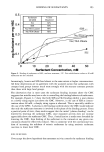
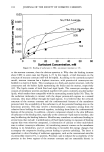
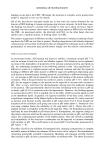
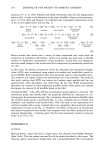
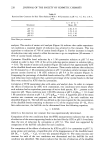
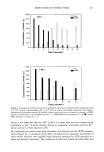
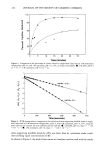
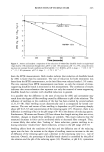
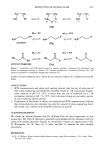
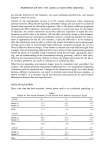
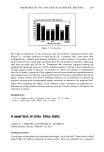
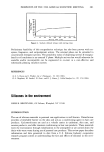
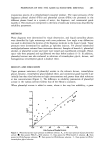
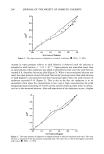
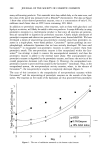
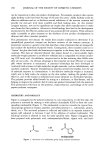
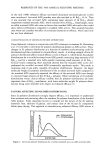
REDUCTION OF HUMAN HAIR 225 pKa• = 8.6 (7a) cysteamine (7b) H3N S- + pKa2 = 10.75 S- '- u •,•• S- O pKal = 3.7 O pKal = 10.4 HS'.PLOH _ -- HS'./LO_ _ ammonium thioglycolate (7C) _ Figure 7. Cysteamine and ATG species present in aqueous solutions: cysteamine five-membered ring formed via hydrogen bonding in solution (7a), chemical equilibria for cysteamine solutions (7b), and chemical equilibria for ammonium thioglycolate solutions (7c). results of stress-relaxation data, which do not present evidence of a delayed reaction for ATG. CONCLUSIONS 1. SFTK measurements and amino acid analysis indicate that the rate of reduction of both stress-supporting and whole-fiber disulfide bonds by 1 M ammonium thiogly- colate solution at pH 9.4, 23øC, is faster than the rate of reduction by a 1 M cysteamine solution at pH 7.6, 23øC, both solutions having an equivalent percent of active-reducing species present. 2. Comparison of the results of amino acid analysis and SFTK measurements indicate that stress-relaxation data represent not only the removal of stress-supporting disul- fide bonds, but correlate with disulfide reduction in general. ACKNOWLEDGMENTS We thank Dr. Robert Hammer and Dr. William Daly for their suggestions on this manuscript. Mr. Patrick Hanavan is gratefully acknowledged for his assistance with the amino acid analysis procedure. Finally, we would like to express our appreciation to Dr. D. Weigmann, Dr. M. Tate, Dr. L. Salce, and Mr. A. Savaides for their valuable discussions. REFERENCES (1) R. R. Wickett, Kinetic studies of hair reduction using a single fiber technique, J. Soc. Cosmet. Chem., 34, 301-316 (1983).

226 JOURNAL OF THE SOCIETY OF COSMETIC CHEMISTS (6) (7) (8) (9) (10) (11) (12) (13) (14) (15) (2) R. R. Wickett and B. G. Barman, Factors affecting the kinetics of disulfide bond reduction in hair, J. Soc. Cosmet. Chem., 36, 75-86 (1985). (3) R. R. Wickett, Disulfide bond reduction in permanent waving., Cosmet. Toiletr., 106, 37-47 (1991). (4) S. Hilterhaus-Bong and H. Zahn, Contributions to the chemistry of human hair. III. Protein chemical aspects of permanent waving treatments, Int. J. Cosmet. Sci, 11, 221-231 (1989). (5) C. R. Robbins, Chemical and Physical Behavior of Human Hair, 2nd ed. (Springer-Verlag, New York, 1988), pp. 1-98. C. Zviak, The Science of Hair Care, 2nd ed. (Marcel Dekker, New York, 1986), pp. 183-209. D. W. Cannell and L. E. Carothers, Permanent waving--Utilization of the post-yield slope as a formulation parameter, J. Soc. Cosmet. Chem., 29, 685-701 (1978). R. Reed, M. Den Beste, and F. L. Humoiler, Permanent waving of hair--The cold process, J. Soc. Cosmet. Chem., 1, 109-121 (1948). J. B. Wilkinson and R. J. Moore, Harry's Cosmeticology, 7th ed. (Chemical Publishing Company, 1982), pp. 555-575. A. Sch6berl and H. Gr•ifje, Ober Disulfid-Austauschreaktionen bei nieder- und hochmolekularen Verbindungen, Fette Seifen Anstrich., 60, 1057 (1958). P. Bor• and J. C. Arnaud, Actualites Dermopharm., 6, 75 (1974). S. S Sandhu and C. R. Robbins, A sensitive fluorescence technique using dansyl chloride to assess hair damage, J. Soc. Cosmet. Chem., 40, 287-296 (1989). C. R Robbins and C. Kelley, Amino acid analysis of cosmetically altered hair, J. Soc. Cosmet. Chem., 20, 555-564 (1969). J. G. Gumprecht, K. Patel, and R. P. Bono, Effectiveness of reduction and oxidation in acid and alkaline permanent waving, J. Soc. Cosmet. Chem., 28, 717-732 (1977). J. Chao, A. E. Newsom, I. M. Wainwright, and R. M. Mathews, Comparison of effects of some reactive chemicals on the proteins of whole hair, cuticle, and cortex, J. Soc. Cosmet. Chem., 30, 401-413 (1979). (16) H. Zahn, S. Hilterhaus, and A. Strubmann, Bleaching and permanent waving aspects of hair research, J. Soc. Cosmet. Chem., 37, 159-175 (1986). (17) S. Hilterhaus-Bong and H. Zahn, Contributions to the chemistry of human hair. III. Protein chemical aspects of permanent waving treatments, Int. J. Cosmet. Sci., 11 221-231 (1989). (18) S. Hilterhaus-Bong and H. Zahn, Contributions to the chemistry of human hair. II. Lipid chemical aspects of permanently waved hair, Int. J. Cosmet. Sci., 11, 167-174 (1989). (19) S. D. Gershon, M. A. Goldberg, and M. M. Rieger, Cosmetics.' Science and Technology, 2nd ed. (John Wiley & Sons, New York, 1972), Vol. 2, pp. 167-250. (20) S. Hilterhaus-Bong and H. Zahn, Contributions to the chemistry of human hair. I. Analyses of cystine, cysteine, and cystine oxides in untreated human hair, Int. J. Cosmet. Sci., 9, 101-110 (1987). (21) C. E. Reese and H. Eyring, Mechanical properties and structure of hair, Text. Resh. J., 20, 743-753 (1950). (22) D. Weigmann, L. Rebenfeld, and C. Dansizer, The role of sulfhydryl groups on the mechanism of permanent setting of wool, Cirtel (Paris), 319-328 (1965). (23) D. Weigmann, L. Rebenfeld, and C. Dansizer, Kinetics and temperature dependence of the chemical stress relaxation of wool fibers, Text. Resh. J., 36, 535-542 (1966). (24) D. Weigmann and L. Rebenfeld, The Chemistry of Sulfides (Interscience Publishers, 1968), pp. 185- 203 (25) D. Weigmann and L. Rebenfeld, The reduction of wool with dithiothreitol, Text. Resh. J., 36, 202-203 (1966). (26) M. Manuszak, E. Borish, and R. R. Wickett, The kinetics of disulfide bond reduction in hair by ammonium thioglycolate and dithiodiglycolic acid, J. Soc. Cosmet. Chem. 47, 49-58 (1996). (27) M. Manuszak, A study of the effects of reduction by cysteamine and ammonium thioglycolate on the physical and chemical properties of human hair, Master's thesis, University of Cincinnati, 1993. (28) D. Weigmann, Reduction of disulfide bonds in keratin with 1,4-Dithiothreitol. I. Kinetic investi- gation, J. Polym. Sci., 6, 2237-2253 (1968). (29) M. S. Robinson and B. J. Rigby, Thiol differences along keratin fibers: Stress/strain and stress- relaxation behavior as a function of temperature and extension, Text. Resh. J., 55, 597-600 (1985). (30) R. Beyak, C. F. Meyer, and G. S. Kass, Elasticity and tensile properties of human hair,J. Soc. Cosmet. Chem., 20, 615-626 (1969).
Purchased for the exclusive use of nofirst nolast (unknown)
From: SCC Media Library & Resource Center (library.scconline.org)