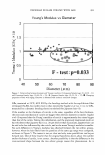
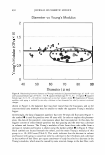
494 JOURNAL OF COSMETIC SCIENCE volume and bounce with aging. This result indicates that the decrease in volume and bounce in hair with aging is not only caused by a decrease in hair diameter and fewer hairs per square centimeter of scalp but also by some internal change in the hair. REFERENCES (1) H. Otsuka et al., J. Soc. Cosmet. Chem. Jpn., 12(3), 192-197 (1988). (2) P. S. Hough,]. Soc. Cosmet. Chem., 27, 571-578 (1976). (3) F. J. Wortmann and N. Kure,]. Soc. Cosmet. Chem., 41, 123-139 (1990). (4) A. Sogabe et al.,]. Soc. Cosmet. Chem. Jpn., 36(3), 207-216 (2002). (5) A. Franbourg,J. Am. Acad. Dermatol., 48 (Suppl. 6), Sl 15-Sl 19 (2003). (6) Japan Patent No. 1991-289942. (7) S. Kawabata et al., Senn'igakaishi, 30, 340-348 (1972). (8a) G. V. Scott and C. R. Robbins,]. Soc. Cosmet. Chem., 29, 469-485 (1978). (86) C.R.Robbins, Chemical and Physical Behavior of Human Hair 2nd ed. (Springer-Verlag, New York, 1988), pp. 239. (8c) J. A. Swift, Int.]. Cosmet. Sci., 21, 227-239 (1999). (9) J. A. Swift, Int.]. Cosmet. Sci., 17, 245-253 (1995). (10) R., Wickett, 2nd Ethnic Hair & Skin Conference, Chicago IL, September 19-21, 2003. (11) M. D. Buhban, Z. Morph. Anthrop. 65(3), 324-328 (1974). (12) L. Rebenfeld et al., J. Soc. Cosmet. Chem., 17, 525-538 (1966). (13) N. Naruse et al., J. Am. Geriatr. Soc., 19, 308-314 (1970). (14) H. C. Friedrich et al., Dermat. Wchnschr, 121, 265-271 (1950). (15) A. Marchionini et al., Dermat. Wchnschr, 99, 1285-1290 (1934). (16) W. Fuhrmann et al., Zwecke Haustarzt, 6, 122-127 (1955). (17) T. Sasaki, Bull. Kyoto Prefect. Univ. Med., 11, 42-62 (1934). (18) S. Kususe, Clin. Dermatol., 5(8), 544-549 (1963). (19) H. Tanamachi et al., The First International Conference on Applied Hair Science, Princeton, NJ, June 9-10, 2004. (20) Y. Masukawa et al., 13th International Hair-Science Symposium, Potsdam, Germany, September 10-12, 2003.

J. Cosmet. Sci., 58, 495-503 (September/October 2007) Hair coloring systems delivering color with reduced fiber damage JENNIFER M. MARSH, JANINE FLOOD, DIRK DOMASCHKO, and NIRANJAN RAMJI, The Procter & Gamble Company, Whitehall Lane, Surrey, UK, TW20 9NW U.M.M.), The Procter & Gamble Company, 11810 East Miami River Road, Cincinnati, OH, 45252 U.F., D.D.), and The Procter & Gamble Company, 8700 Mason Montgomery Road, Mason, OH 45040 (N.R.). Accepted for publication May 22, 2007. Data presented at the Annual Scientific Meeting of the Society of Cosmetic Chemists, New York, December 2006. Synopsis The possible metal-induced formation of free radical species such as the hydroxyl radical (HO*) during the use of permanent hair coloring products has been demonstrated. These highly reactive species are formed from the reaction of hydrogen peroxide with redox metals such as copper, which are thought to be absorbed by the hair from the from-the-tap wash water. Formation of such radical species has been shown to lead to measurable keratin fiber damage. The incorporation of chelants such as N,N' -ethylenediamine disuccinic acid (EDDS) has been demonstrated to prevent this metal-induced radical formation and thus significantly reduce the fiber damage. This chelant is highly effective due to its ability to specifically bind low levels of copper in the presence of relatively high levels of calcium, as is found in hair. INTRODUCTION The use of permanent hair colorants is widespread and allows consumers to either change their natural hair color and/or cover gray. However, there are trade-offs that the con sumer has to make if she or he is using these products on a regular basis. One of the main trade-offs is the fiber damage that is sometimes seen after multiple use (1). This can lead to the consumer's experiencing poor hair feel, an increased incidence of split ends, and generally hair that loses some of its healthy appearance and shine. Thus developing hair coloring systems that allow the consumer to color on a more regular basis and yet maintain hair quality is highly desirable. There are two key chemical processes that take place during the coloring process that contribute to final color. The first is the oxidation of the melanin pigment and previ ously deposited dyes that lightens the underlying hair color, and the second is the oxidation of the dye precursors to form the colored chromophores (2,3). For both processes the oxidant is essential, and in the majority of retail hair colorants the oxidant 495
Purchased for the exclusive use of nofirst nolast (unknown)
From: SCC Media Library & Resource Center (library.scconline.org)