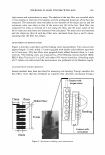
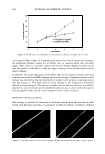
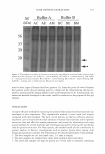
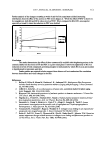
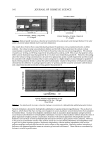
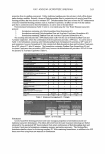
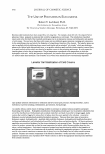
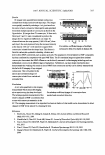
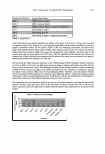
502 JOURNAL OF COSMETIC SCIENCE Figure 5. Gas formation after 10 minutes. Left: no EDDS. Right: with EDDS. conditional formation constant of copper vs that for calcium will give a strong indication of how specific the chelant is to binding copper in the presence of calcium. This is very important in hair because there is a hundred-fold or greater excess of calcium on the hair vs copper (6000-10,000 ppm Ca vs 60-100 ppm Cu). Table III summarizes the FT-IR cysteic acid values, the SEM damage index, and the Cu/Ca conditional formation con stant ratio for the four chelants. If the Cu/Ca ratios for the four chelants are compared, EDDS has a very significant advantage in terms of its specificity for binding to copper in the presence of an excess of calcium. This may drive its superiority in preventing the metal-induced radical damage. To directly investigate the role of the chelant on the radical chemistry, an optical microscope was used to compare the gas production from a formulation containing no EDDS chelant (0.1 % EDT A) to one containing EDDS ( 1 % level). The colorant was added to the hair at a 4 g/g dose, and then the gas formation was imaged 10 minutes after application. Figure 5 compares the formulations with and without EDDS and clearly demonstrates the ability of EDDS to reduce the gas formation significantly. CONCLUSIONS The hair of a regular colorant consumer will likely absorb low levels of copper ions (60-200 ppm) from tap water in addition to water hardness ions such as calcium and magnesium. On coloring, the presence of the copper ions can generate the highly reactive hydroxyl radical species that can cause significant damage to the keratin fiber. This fiber damage is measurable as an increase in surface cysteic acid and can be visually observed as a decrease in cuticle quality in the SEM. The addition of a chelant to a hair colorant such as N,N-ethylenediamine disuccinic acid (EDDS) can significantly reduce the formation of the hydroxyl radical by complexing with the copper in the hair. It has been demonstrated that the choice of chelant is crucial. In particular, the chelant must have a high selectivity for complexing to copper, especially relative to other metals that are commonly found in hair such as calcium. REFERENCES (1) M. L. Tate, Y. K. Karnath, S. B. Ruetsch, and H. D. Weigman,]. Soc. Cosmet. Chem., 44, 347-372 (1993).

REDUCED HAIR DAMAGE FROM COLORING SYSTEMS 503 (2) K. C. Brown, S. Pohl, A. E. Kezer, and D. Cohen,]. Soc. Cosmet. Chem. 36, 31-37 (1985). (3) J. F. Corbett, Rev. Prog. Coloration, 4, 3-6 (1973). (4) C.R. Robbins, Chemical and Physical Behavior of Human Hair (Springer-Verlag, New York, 1994), pp. 133-137. (5) C. W. Jones, Applications of Hydrogen Peroxide and Derivatives (Royal Society of Chemistry, Cambridge, 1999), p. 44. (6) J. Fossey, D. Lefort, and J. Sorba, Free Radicals in Organic Chemistry (Wiley, Paris, 1997) pp. 93-97. (7) C.R.Robbins, Chemical and Physical Behavior of Human Hair (Springer-Verlag, New York, 1994), p. 84. (8) I. Pareja and C. Codina,j. Pharmacol. Toxicol. Meth., 44, 507-512 (2000). (9) G. Yildiz et al.,]. Pharmacol. Toxicol. Meth., 39, 179-184 (1998). (10) J. Strassburger,J. Soc. Cosmet. Chem., 36, 61-74 (1985). (11) M. Joy and D. M. Lewis, Int.]. Cosmet. Sci., 13, 249-261 (1991). (12) V. Signori and D. M. Lewis, Int.]. Cosmet. Sci., 19, 1-13 (1997). (13) A. E. Martell and R. D. Hancock, Metal Complexes in Aqueous Solution (Plenum Press, New York, 1996), pp. 1-14.
Purchased for the exclusive use of nofirst nolast (unknown)
From: SCC Media Library & Resource Center (library.scconline.org)