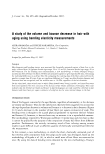
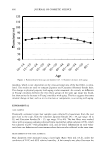
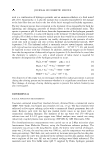
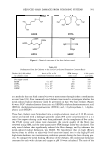
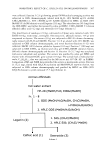
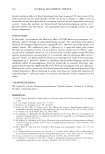
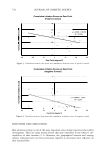
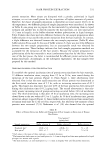
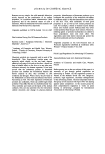
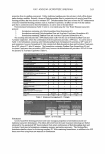
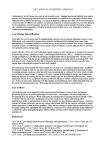
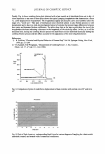
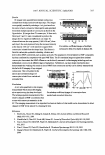
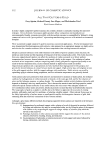
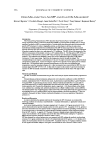
486 JOURNAL OF COSMETIC SCIENCE 120 110 � 100 '""" 90 80 -------■----. • •----•- • ---------------- • 70 ------------------------------------------------------------ 60 50 ---- --- -- ------- -- ----------------- 40 Age Figure 1. Relationship between age and diameter (ref. 1). Diameter decreases with aging. modulus, which is not dependent on the cross-sectional area of the hair fiber, is calcu lated. The results are used to compare Japanese and Caucasian (German) female hairs. The change in physical property with aging is also examined. As a result, no difference in Young's modulus between the two ethnic groups of the same age range was found, but there existed a decrease in Young's modulus with aging. This fact suggests that some internal change in hair, such as in its structure or components, is occurring with aging. EXPERIMENT AL HAIR SAMPLES Chemically untreated virgin hair samples were collected by beauticians from the root part close to the scalp, from the volunteer Japanese females (N = 38, age range: 26 to 51) and Caucasian females (N = 35, age range: 20 to 40). The hair fibers were washed twice with an aqueous sodium polyoxyethylene laurylether sulfate solution (15%), which was adjusted to pH 7 with phosphoric acid, and air-dried. Information on each volun teer's hair care behavior and consciousness about hair was also collected at the same time. MEASUREMENT OF THE HAIR DIAMETER Hair diameters were measured using a laser light (Kato Tech Ltd.) (5,6), under the conditions of 20°C and 65% relative humidity. A hair sample was placed between the

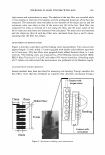
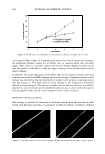
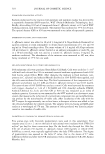
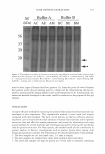
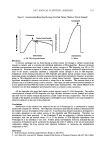
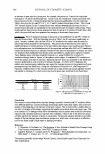
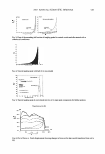
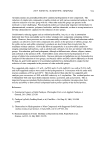
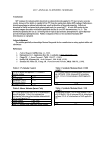
DECREASE IN HAIR VOLUME WITH AGE 487 light source and a photodetector array. The shadow of the hair fiber was recorded while it was rotating at intervals of 30 degrees, and the orthogonal projection of the hair was measured. The maximum value was taken as the diameter of the major axis (a) and the minimum value was taken as that of the minor axis (b) of the hair. Each fiber was measured five times at intervals of 5 mm along the fiber, and the mean values of the hair's major axis and minor axis diameters were calculated. The mean cross-sectional area and the ellipticity (b/a) of each hair fiber were calculated from these a and b values, assuming that the fiber was elliptic. MEASUREMENT OF BENDING STRESS Figure 2 describes a specimen used for bending stress measurements. Two cross-section papers (length: 51 mm width: 15 mm) equipped with double-sided adhesive tape were set 10 mm apart. Fifty hair fibers were perpendicularly affixed between them, at 1-mm intervals. The bending stress was measured by a Pure Bending testing machine (KES FB2-S: Kato Tech Ltd.) (7) at 20°C and under 65% relative humidity. A bending angle of 2.5 radians was selected and the measurement was performed in the Hookean region. CALCULATION OF YOUNG'S MODULUS Several methods have been described for measuring the bending Young's modulus for hair fibers. Scott (8a) has developed an equation that describes calculating Young's Connect with torque sensor 15mm 15mm - - - � - � 10mm , / 50 Hair Fibers /2 1/ ,� 5 1mm '� Figure 2. Specimen for bending stress measurement. Connect with servomotor
Purchased for the exclusive use of nofirst nolast (unknown)
From: SCC Media Library & Resource Center (library.scconline.org)