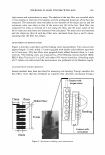
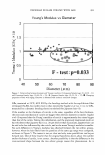
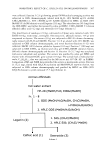
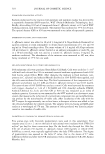
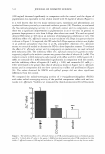
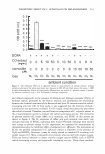
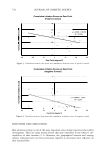
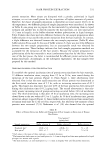
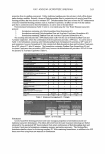
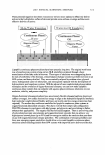
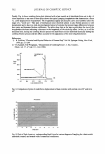
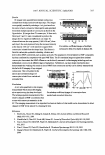
488 JOURNAL OF COSMETIC SCIENCE modulus by the hanging hair fiber method, but this value has not been corrected for hair fiber ellipticity. Swift (8c,9) reported a noteworthy theory about bending stress, considering the cross sectional shape of the hair fiber. He suggested that the bending stress was affected by a force directed along the hair's minor axis then, in the second moment of inertia I, the minor axis should be emphasized. We adopted his theory and the Young's modulus was calculated from the measured bending stress data. When the obtained bending stress is expressed as M, curvature as 1/p (where p is the curvature radius), Young's modulus as E, and the second moment of inertia as I, equation 1 is written: M/(1/p) = E X I (1) Assuming that the hair is bent at the minor axis, I is expressed by equation 2: I= 1rab3/64 (2) From the above-mentioned a and b values for each of 50 fibers, a mean value of the second moment of inertia, I a v' was calculated and used in this experiment instead of I. The relationship between M and 1/p is obtainable from the experiment as a linear correlation. Thus, the mean Young's modulus was obtained from the tile and Iav• by using equation 3: E = M/(l/p)/50 I a v (3) RESULTS AND DISCUSSIONS HAIR DIAMETER The frequency distributions of the major and minor axis values of the Japanese female and Caucasian female hairs used for the bending stress measurement are shown in Figure 3. The frequency distribution of hair ellipticity is summarized in Figure 4. In compari son with Caucasian hair, the average Japanese hair is ca. 20 µm larger in both the major and minor axis diameters. The ellipticity ratio (b/a) for Japanese hair is also larger by 0 .15. These results show that Japanese hair is thicker and more round than Caucasian Maximm Diameter (a)-Japanese- 14 ,------------------, 12 ------------------------- 4 --------------------- 65 70 75 80 85 90 95 JOO 105 ll0 115 120 125 130 Diameter( JJ m) Mimwm Diameter (b )-Japanese- 16 ,-- - -----------------, 14 ----------- 12 g'ID g 8 [ 6 � 2 0 ................................................ u.......,.�.......,_____,_���_.___.___........____, 65 70 75 80 85 90 95 100 105 110 115 120 125 130 Diameter(JJ m) Figure 3. Hair diameter from Japanese females (age: 26-51, N = 52). (a) Maximum diameter from Japanese females (age: 26-51, N = 52). (b) Minimum diameter from Japanese females (age: 26-51, N = 52). Figure of hair cross section is oval (not circular). Hair diameter from Japanese females is 70-80 µm.

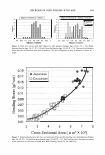
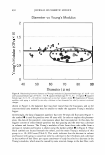
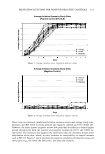
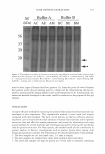
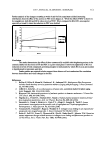
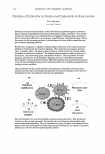
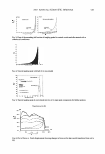
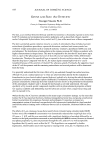
DECREASE IN HAIR VOLUME WITH AGE 489 I Ellipticity of Diameter (a)- Japanese - I 12 ,--___!:============------, 10 ----------------------- - --------------------- 2 --------------------- 0.6 0.65 0.7 0.75 0.8 0.85 0.9 0.95 Ellipticity of Diameter 14 EllipticityofDiameter (b)- Japanese vs. Caucasian - I 12 ------------ --------------------- ■ Japanese ________ D Caucasian 2 0 L-L.......JL.......JIIJ.a.lJIUi.RliallJJJRJIUJ.JRJJal 0.6 0.65 0.7 0.75 0.8 0.85 0.9 0.95 Ellipticity of Diameter Figure 4. Hair cross section and fiber ellipticity. Left: Japanese females (age: 26-51, N = 52). Right: Japanese females (age: 26-51, N = 52) and Caucasian females (age: 20--40, N = 35). The ovality of diameter shows narrower distribution than that of diameter. The level of Japanese ovality of diameter is about 0.1 s larger. 0.19 _,,,,-..,. 0.17 0.15 co 0.13 00 00 0.11 0.09 co 0.07 •""'"'4 0.05 co 0.03 0.01 2 - -- --- - - - - -- -- - ---- - - - - - ----- - - ---------- --♦- -♦ ♦ Japanese D Caucasian 3 4 5 6 7 Cross Sectional Area ( µ m2 x 103) 8 Figure 5. Relationship between the cross-sectional area of hair and the bending stress from Japanese females (age: 26-39, N = 21) and Caucasian females (age: 20--40, N = 35). The bending stress decreases according to the reduction in the cross-sectional area. Both bending stresses fit the same line.
Purchased for the exclusive use of nofirst nolast (unknown)
From: SCC Media Library & Resource Center (library.scconline.org)