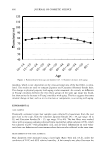
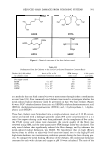
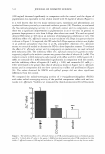
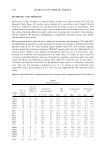
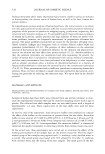
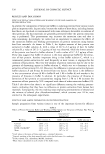
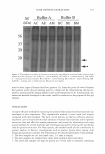
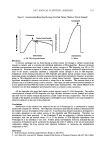
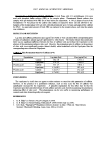
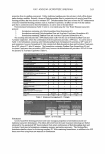
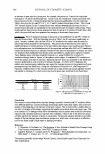
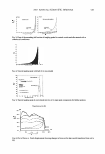
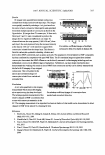
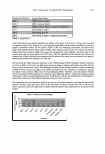
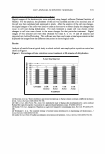
580 JOURNAL OF COSMETIC SCIENCE an increase in pore size for a given pore, for example, the pore at ca. 3 nm for the virgin hair i:n::::reased to 3 .5 mn for the bleached hair. In any event, the overall pore volume associated with the given pores for the 1 miIUite bleached hair has i:n::::reased significantly over the virgin hair. Table I also gives the SA am 1PV of 5, 10, 15 and 20 miIUite bleach times of hair. The SA am 1PV hcrease slightly for the 5 miIUite bleach time am then dramatically decrease for the 10 minute bleach time am are maintained for the most part through 20 mimltes of bleaching. These results imicate that pores are being generated in hair at least up to 5 minutes of bleach time, after which, the pores that have been generated are merging to form much larger pores. UV Damage: The UV irradiation damage of hair gives a much different SA and 1PV (Table II) than the bleached hair. With the bleaching shown in Table I, the SA i:n::::reases significantly at initial 1 mimte, contrary, after the first 200 h of UV irradiation the surface area decreases by almost half of that detected for the virgin hair. This proves that within the first 200 h there is significant fusion of certain portions of the hair follicle that causes a loss in surface area. Figure 2 is an adsorption pore size distribution plot of the virgin hair and hair after 200 h of UV irradiation Unlike the increase in pore size am pore volume for hair that was bleached for 1 miIUite, the 200 h UV irradiated hair maintained four distinct peaks am shifted to smaller pores am pore volumes. These fimings agree with those foum by Reutsch et al. using FESEM [2], in which UV irradiation damage leads to 'fusion' of the surface cuticle edges. At continued UV irradiation to 400 h the surface area starts to hcrease, imicating that new pores are generated or the fused layer has been perforated to some extent to let nitrogen through. At 1200 h of UV irradiation the surface area increases again, imicating o:n::::e again the hcrease in pores or the generation of more openings through the fused layer. Along the conclusions of Reutsch et al., after long-term UV exposure, complete fusion of the cuticular sheath into a rigid, brittle unit occurs alli may become susceptible to cracking [2], which in tum may lead to pores once restricted by the fused layer. UV Exposure (h) 0 (Virgin hair) 200 400 1200 Conclusion Table II 0.40 0.22 0.30 0.34 TPV (cc/g) 0.000689 0.000581 0.000651 0.000729 0.Cll12 :: · .. ,n 0.0010 ••-.. -·\ i OOIJ08 �y: �'. : G. f. •- 0.0000,�, �====i.::..,.;..;...===�, 0 00 Pote Olamtffr {nm) Figure 2: Adsorption pore size distribution of virgin hair (-) and 200h UV exposed hair (- -). Our extensive research has shown that hair damage caused by chemical and UV oxidation follow very different pathways. Chemical damage (bleaching) nearly triples hair surface area in the first minute of bleaching due to the increase of the pore volume. This is followed by a sudden drop in SA after 10 rnimtes of bleaching, suggesting that smaller pores break down into larger ones. This is in contrast to UV damage which shows an immediate loss in surface area in the first 200 hours exposure am a gradual i:n::::rease as exposure time continues, which is due to the fusion of cuticle cell first am then the hcrease of pores or cracks later. The porosity analysis provides a powerful insight of the hair damage from mechanistic perspective, which also can be used as an effective tool for the future study of hair repair or damage prevention Reference 1. Y. Hessefort, B. Hallam et al, "Gas Sorption: A New Method to Identify Hair Damage Using True Porosity measurements" 2006 IFSCC Congress in Osaka 2. Sigrid B. Ruetsch, Y. Karnath, and H. D. Weigmam: "Photodegradation of human hair: An SEM Study". J. Cosmet. Sci., 51. 103 -125 (March/April 2000) The authors gratefully acknowledge Wayne Carlson, Jobiah Sabelko and Cheryl Slabozeski for their contributions.

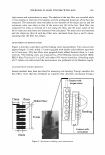
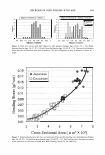
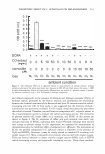
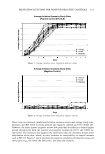
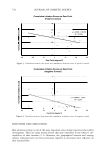
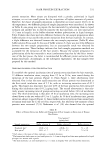
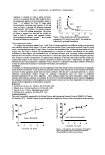
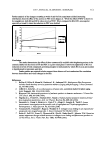
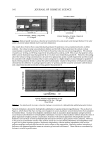
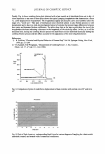
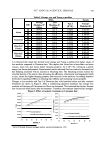
2007 ANNUAL SCIENTIFIC SEMINAR 581 AN ANALYSIS OF THE WET-DRY TRANSITION COMBING FORCES OF HAIR AND TANGLING PEAK FORCE ASYMMETRY Manuel Gamez-Garcia, Ph.D. Ciba Specialty Chemicals Polymer Effect Research 540 White Plains Road, Tarrytown, NY 10591 USA Abstract A study has been made of the different adhesive and friction processes involved in the transition of combing forces from wet to dry in virgin and bleached hair. The analysis shows that the wet and dry tangling peaks can be separated into two main components, namely: one asymmetric and the other symmetric with respect to the maximum force value. For various degrees of tangling the ratio between the areas of these two peak components appears to be constant for a particular hair treatment. Furthermore, the analysis shows that both peak components contain important information about variations in adhesion, friction, and number of tangled fibers. The experiments also show that the irregularities frequently observed in the plateau and tangling peak forces of wet and dry hair are due to a stick•slip mechanism that arises from decreasing differences between the static and dynamic friction coefficients as the hair dries. Amonton's law of friction via a modified Capstan equation are considered when analyzing the effect of cuticle sheath visco•elasticity on the observed differences between the static and dynamic friction coefficients of the drying hair surface. Discussion and Analysis It is well agreed within the hair care community that the main difficulty in interpreting force combing measurements is related to the inherent reproducibility error of the various combing trials. In fact, it is perhaps this issue that has hindered researchers from unlocking the large amount of potential information that may be extracted from combing force experiments. It is certain that once this issue is solved the challenge will focus on dissecting the different friction contributions to the total force/comb displacement arising from the static and dynamic friction forces between comb and hair, and between the hair fibers themselves. Substantial progress has already been made in the past and it has been proposed that the total combing force stems from the various force contributions arising from the comb to hair friction forces, hair to hair friction forces, and fiber to fiber adhesion forces (1·2). However, so far no efforts have been made to quantify the contributions from comb to hair friction, hair to hair adhesion, and hair to hair friction by separate. Also, there is lack of information about the changing nature of the friction processes as the hair transitions from wet to dry. Finally, even though when it is known that that most polymers do not follow Amonton's Law of friction and that the hair is a biopolymer with bulk and surface visco•elastic characteristics no analysis has been made to verify the validity of this assertion for hair. This paper presents an analysis of various key experimental results that may help to elucidate some of these issues. Fig. 1 shows, for instance, that cutting the tip of a hair swatch at an angle of 45° eliminates almost completely the force tangling peak observed under dry conditions. This experiment together with the observation that there is always a tangling peak no matter how short or long we cut the hair tress, shows that the main contribution to the tangling peak stems not from increases in the fiber friction coefficient at the swatch tip, as it is commonly assumed, but rather to a hair fiber Capstan effect related to an increase in the contact angle between fibers. Fig. 2, on the other hand, shows a plot of the tangling peak area values v .s. peak heights obtained for various degrees of tangling. Line (A) represents the plot for the untreated hair swatch, while line (B) the plot for the same swatch after treatment with a commercial conditioner. Fig. 3a and 3b show half plots of the tangling peaks for the same untreated and treated swatches, while Fig. 4 and 5 show the partitioning analysis of a single peak into two area sections and into two peak components, respectively. Incidentally, it was fond that the ratio between the values of the two area sections was almost constant for all hair runs and only dependent on the type of hair treatment. The experiments described in Figs. 2 to 5 show that certain physical parameters related to hair comb and hair to hair friction remain constant during the combing process regardless of the degree of tangling introduced intentionally during combing. This observation is as expected as the only process susceptible of influencing the friction coefficients is the type of hair treatment and not the degree of tangling. Higher degrees of tangling will have, thus, the effect of increasing the contact angle and the contact area between, both, fiber and comb and between fiber and fiber.
Purchased for the exclusive use of nofirst nolast (unknown)
From: SCC Media Library & Resource Center (library.scconline.org)