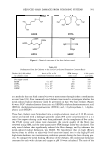
584 JOURNAL OF COSMETIC SCIENCE OMA STUDY OF HAIR VISCOELASTICITY AND EFFECTS OF COSMETIC TREATMENTS Miyoun Jeong, Ph.D., Vimal Patel, Jung-Mei Tien and Timothy Gao, Ph.D. Croda, Inc., 300-A Columbus Circle, Edison, NJ 08837 USA Introduction Dynamic mechanical analyzer (OMA) has been a very useful tool to evaluate viscoelastic behavior of many different materials for various industries. In this study, we used DMA to characterize changes in elastic modulus with different humidity levels on various types of single hair fibers and to determine how hair fibers respond to chemical and cosmetic treatments. In personal care industry, Young's modulus (E) obtained from a tensile tester is widely used as a measure of hair elasticity, however the storage modulus (E') and loss modulus (E") provide a good combination of hair elasticity and damping under continuous stress, simulating natural environmental conditions. Experimental Virgin dark brown and Asian hair samples were purchased from International Hair Importers & Products Inc. Bleached hair was obtained by bleaching dark brown hair in 6.0% active hydrogen peroxide for 15 and 30 minutes, respectively. The amount of bleaching solution was calculated using a weight ratio of 1 :25 (hair/bleach solution). For the cosmetic treatment, each hair fiber was soaked in a conditioning shampoo containing Quaternium 91 at 37°C for 2 minutes and then rinsed. This treatment was repeated twice and then the hair fiber dried overnight at the ambient. A Dynamic Mechanical Analyzer (Q800, TA Instruments New Castle, DE) was used to measure the storage and loss modulus (E' & E") of hair fibers by using a film/fiber tension clamp. The applied force frequency was 1 Hz and the amplitude was 15µm. A Miniature Tensile Tester (MTT -670) was used to determine Young's modulus (E) of the same hair fiber at identical humidity levels for comparison. Hair fiber samples were equilibrated at 30°C and a constant humidity level for 30 minutes before both tests. Results and discussion Dynamic mechanical analyzer applies an oscillating force to a sample and characterizes the response of the material to that force 1 . The materials' response consists two components of modulus, storage modulus (E') and loss modulus (E"). The storage modulus indicates the elasticity of the material, i.e., the capability of recovering from deformation or its resistance to deformation. The loss modulus is its viscous property, i.e., its tendency to flow. In DMA, storage modulus and loss modulus, which are material responses to continuous sine waves, are to some extent different from Young's modulus which indicates the stiffness of the material in the initial linear region. The combination of both moduli expands the characterization of the material and allows investigation of the damping property - the ratio of loss and storage modulus (Tan 8 = E" / E'). Damping indicates how promptly the material loses the energy associated with molecular rearrangements and internal friction 1 . Data on average storage and loss modulus of different types of hair fibers at various humidity levels are shown in Table I. The average value was calculated from approximately 15 fibers which were randomly selected.

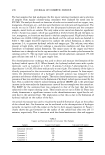
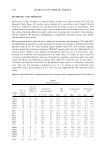
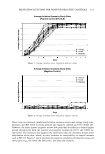
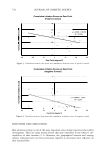
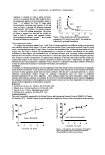
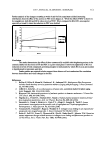
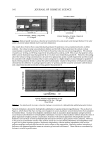
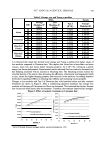
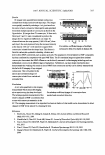
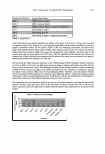
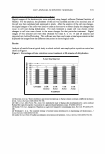
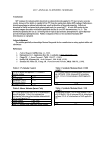
2007 ANNUAL SCIENTIFIC SEMINAR 585 a e . T bl I S torage, oss an dY d I oung s mo u us DMA Tensile Storage Loss Tanp Young's RH Modulus, E" Modulus, E' (E"/E') Modulus (E) (MPa) (MPa) 40 4978.3 121.3 0.0243 6.6E+09 Asian 60 4454.7 137.8 0.0310 5.4E+09 80 3676.7 143.0 0.0388 4.7E+09 40 5239.6 108.6 0.0207 l.IE+IO Caucasian 60 4792.0 129.2 0.0272 8.7E+09 80 4150.2 138.6 0.0336 7.6E+09 Bleached 40 5808.4 115.4 0.0198 8.3E+09 60 5208.1 141.9 0.0271 7.5E+09 15mins 80 4331.6 160.1 0.0372 7.0E+09 Bleached 40 5781.7 127.9 0.0223 8.8E+09 60 5107.1 151.0 0.0297 9.IE+09 30mins 80 4130.7 155.7 0.0378 8.4E+09 It is observed that Asian hair showed lower storage and Young's modulus but higher values of loss modulus compared to Caucasian hair. This implies that Asian hair is less elastic and more viscous. Asian hair also shows higher damping property, tan 8 (E" / E'), indicating a greater energy lost during deformation. Experimental results indicated that hair elasticity decreased and hair damping increased with an increase in bleaching time. The bleaching process reduces the crosslink density of the matrix, thus decreasing the efficiency of molecular rearrangements which, in turn, causes the higher damping property and reduction in the elasticity. Increasing humidity levels shows significant effects on reducing hair stiffness and increasing viscous property. Changes in loss modulus and Tan o of Caucasian hair with humidity before and after cosmetic treatments are shown in Figure I. After a conditioning shampoo treatment, the average loss modulus and damping of Caucasian hair fibers are decreased. This indicated that the hair became less viscous and more elastic after the treatment. Therefore, the treatment improved hair strength. 0.0400 0.0350 0.0300 0.0250 0.0200 0.0150 0.0100 0.0050 0.0000 30 Figure I. Effect of cosmetic treatment on Caucasian hair · ·········································•··••·············........................, 160.0 ,.. .............................................................................................. , --Caucasian-untreated N � N Caucasian-treated wth Incroquat 1266 40 50 60 Hmidity,% 70 80 90 .. - j 80.0 60.0 40.0 20.0 0.0 30 40 • • • Caucasian-treated with Incroquat 1266 50 60 Humidity,% 70 80 90 1 Kevin P. Menard, Dynamic mechanic analysis: a practical introduction, 1999.
Purchased for the exclusive use of nofirst nolast (unknown)
From: SCC Media Library & Resource Center (library.scconline.org)