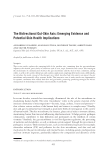
581
J. Cosmet. Sci., 75.6, 581–597 (November/December 2024)
*Address all correspondence to Manon Gault, manon.gault@basf.com
Presented at the SCC77th annual scientific meeting &showcase, NY December 11–13, 2023.
First-Time Use of a Droplet-Based Microfluidic Method to
Highlight Specificities of Microbiota Communities From
Sensitive Skin
MANON GAULT, SABRINA LEOTY-OKOMBI, DELPHINE RIVAL AND
VALÉRIE ANDRÉ
BASF Beauty Care Solutions, Lyon, France (M.G., S.L., D.R., V.A.)
Accepted for publication November 26, 2024.
Synopsis
The skin microbiome plays a crucial role in skin health, yet research focusing on the microbiome of sensitive
skin (SS) remains limited. There is a notable absence of a clinical bacterial collection to evaluate the harmful
potential of these bacteria or to assist in selecting suitable cosmetic products. To fill this research gap, we
conducted a comprehensive bacterial analysis using 16S rRNA sequencing and droplet-based microfluidics
to extract and cultivate clinical bacterial isolates from individuals with and without SS, specifically on facial
skin. Our results revealed a decreased abundance of Staphylococci, particularly Staphylococcus epidermidis,
in SS, coupled with an increase in Cutibacterium acnes and Corynebacteria. Additionally, we identified shifts
in the relative proportions of various bacterial species. We isolated hundreds of strains, ultimately selecting
31 representative strains for ingredient testing. Notably, certain strains of Cutibacterium acnes from SS
patients were linked to reduced keratinocyte viability and heightened interleukin-8 production, indicating
potential virulence.
INTRODUCTION
Up to 70% of women and 60% of men report having sensitive skin (SS).1 SS syndrome is
a complex clinical phenomenon defined by the self-reported presence of different sensory
perceptions, including tightness, stinging, burning, tingling, pain, and pruritus, even
though objectively measurable signs of irritation are not always present. Although the
skin microbiome is considered important to skin health, the relationship between the skin
microbiome and skin sensitivity has received little attention.
The skin serves as a barrier between the body’s internal physiology and the external
environment, which means that the skin microbiota is continually exposed to external
factors such as UV rays and pollution, both of which can modify its composition.2-4
J. Cosmet. Sci., 75.6, 581–597 (November/December 2024)
*Address all correspondence to Manon Gault, manon.gault@basf.com
Presented at the SCC77th annual scientific meeting &showcase, NY December 11–13, 2023.
First-Time Use of a Droplet-Based Microfluidic Method to
Highlight Specificities of Microbiota Communities From
Sensitive Skin
MANON GAULT, SABRINA LEOTY-OKOMBI, DELPHINE RIVAL AND
VALÉRIE ANDRÉ
BASF Beauty Care Solutions, Lyon, France (M.G., S.L., D.R., V.A.)
Accepted for publication November 26, 2024.
Synopsis
The skin microbiome plays a crucial role in skin health, yet research focusing on the microbiome of sensitive
skin (SS) remains limited. There is a notable absence of a clinical bacterial collection to evaluate the harmful
potential of these bacteria or to assist in selecting suitable cosmetic products. To fill this research gap, we
conducted a comprehensive bacterial analysis using 16S rRNA sequencing and droplet-based microfluidics
to extract and cultivate clinical bacterial isolates from individuals with and without SS, specifically on facial
skin. Our results revealed a decreased abundance of Staphylococci, particularly Staphylococcus epidermidis,
in SS, coupled with an increase in Cutibacterium acnes and Corynebacteria. Additionally, we identified shifts
in the relative proportions of various bacterial species. We isolated hundreds of strains, ultimately selecting
31 representative strains for ingredient testing. Notably, certain strains of Cutibacterium acnes from SS
patients were linked to reduced keratinocyte viability and heightened interleukin-8 production, indicating
potential virulence.
INTRODUCTION
Up to 70% of women and 60% of men report having sensitive skin (SS).1 SS syndrome is
a complex clinical phenomenon defined by the self-reported presence of different sensory
perceptions, including tightness, stinging, burning, tingling, pain, and pruritus, even
though objectively measurable signs of irritation are not always present. Although the
skin microbiome is considered important to skin health, the relationship between the skin
microbiome and skin sensitivity has received little attention.
The skin serves as a barrier between the body’s internal physiology and the external
environment, which means that the skin microbiota is continually exposed to external
factors such as UV rays and pollution, both of which can modify its composition.2-4