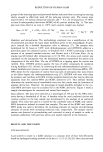
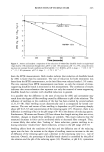
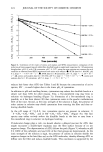
284 JOURNAL OF THE SOCIETY OF COSMETIC CHEMISTS Effects testing on sediment- and soil-dwelling organisms indicate no adverse effects at concentrations actually found in these environmental compartments. REFERENCES (1) Silicones Environmental Health and Safety Council (SEHSC), unpublished report, Environmental Entry Volumes and Fate Predictions for Organosilicon Compounds, April 7, 1995. (2) EPA RM1 Administrative Record, Final RM1 Aquatic Risk Characterization for Octamethylcyclotetra- siloxane (OMCTS), September 1994. (3) 59FR 50639, October 5, 1994. (4) Fendinger et al., Environmental Occurrence of Polydimethylsiloxnes (PDMS), Society of Environmental Toxicology and Chemistry (SETAC) presentation, November 1996. (5) Xu et al., The Degradation of a Polydimethylsiloxane Catalyzed by Different Clay Materials, SETAC presentation, November 1996. (6) SEHSC, unpublished report, Hydrolysis of PDMS on Sediment, July 1996. (7) Sabourn et al., Investigation of the Biodegradation of Dimethylsilanediol on Soils, SETAC presentation, November 1996. (8) Putt et al., Effects of Sediment-Bound Polydimethylsiloxane (PDMS ) to Aquatic Invertebrates, SETAC pre- sentation, November 1996. (9) Garvey et al., Effects of Polydimethylsiloxane (PDMS) to Soil-Dwelling Organisms, SETAC presentation, November 1996. Vapor pressure of a fragrance in a system of laureth-4 and water STIG E. FRIBERG, TIAN HUANG, LIN FEI, and SAMUAL A. VONA, Clarkson University, Potsdam, NY •3699, and PATRICIA AIKENS, ICI Surfactants, Wilmington, DE 19850. INTRODUCTION The behavior of a fragrance in the presence of a colloidal solution is of particular interest in view of the fact that many alcohol-based products are being replaced with aqueous miceliar systems. The vapor pressure of a volatile material is an estimation of its chemical potential in that environment: P• = p•o + RTlnp/pø = p•o + RTlna where • is the chemical potential with vapor pressure p and •o is the chemical potential in the standard state giving a vapor pressure equal to pO. The investigations of fragrance vapor pressure presented here include the entire system of water, nonionic surfactant, and fragrance. The vapor pressure of the fragrance in the different association structures provides information about the molecular interactions with water and surfactant and enables the evaluation of the fragrance vapor pressure as a function of time during the

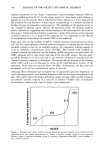
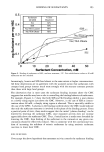
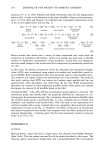
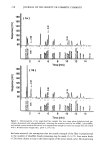
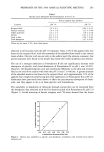
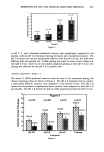
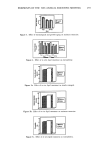
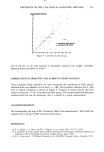
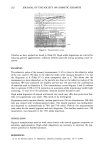
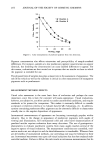
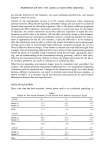
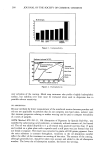
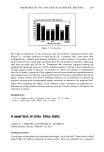
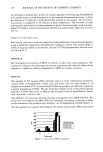
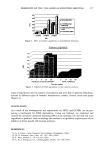
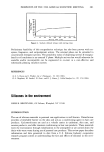
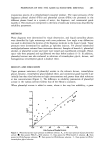
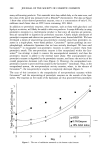
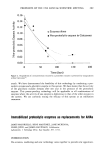
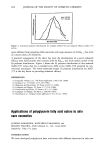
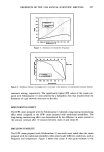
PREPRINTS OF THE 1996 ANNUAL SCIENTIFIC MEETING 285 evaporation process of a colloidal-based consumer product. The vapor pressures of the fragrances phenyl alcohol (PEA) and phenethyl acetate (PEAc) are presented in the different phases found in a system of water, the fragrance, and commercial grade laureth-4. The results are interpreted in the form of molecular interactions described by solubility parameters. METHODS Phase diagrams were determined by visual observation, and liquid crystalline phases were identified by light microscopy with cross polarizers. Low angle x-ray diffraction was used to determine the location of the fragrance molecule in the liquid crystal. Vapor pressures were determined by capillary gc (splitless injector, 5% phenyl substituted methylpolysiloxane column flame ionization detector). Samples of laureth-4, phenethyl alcohol, or phenethyl acetate and water were mixed and equilibrated overnight. Head- space vials were prepared and equilibrated two days before analysis (1-3). In addition, phenethyl acetate was also evaluated in solutions of tetraethylene glycol, decane, and homogeneous tetraethylene glycol n-dodecyl ether. RESULTS AND DISCUSSION Vapor pressure variations of phenethyl acetate in the solvents decane, tetraethylene glycol, benzene, tetraethylene glycol dodecyl ether, and commercial grade laureth-4 are initially less than ideal solutions at high concentrations and greater than ideal solutions at low concentrations (Figure 1). The difference in solubility parameters of phenethyl acetate in the various solvents follows that of the Henry's constants. When phenethyl acetate is added to water, where it has very low solubility, a great !.0- 0.8 0.6 0.2, Y Y ooo x •....- o o.o- 0.8 1.o. Figure 1. Phenethyl acetate vapor pressure in different solvents. Po, is the vapor pressure of pure phenethyl acetate. ', Data points PEAc/Cx2/EO) solution. C), Data points for PEAc/laureth 4 solution. ', Data points for PEAc/benzene solution. •', Data points for •EAc/decane solution. x, Data points for PEAc/ tetraethylene glycol solution.
Purchased for the exclusive use of nofirst nolast (unknown)
From: SCC Media Library & Resource Center (library.scconline.org)