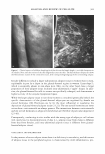
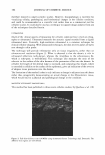
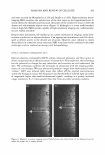
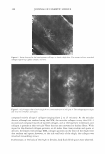
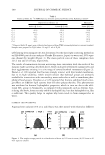
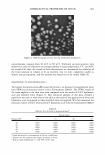
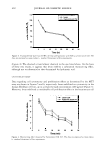
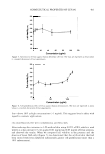
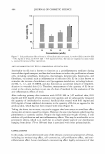
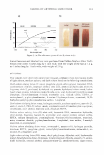
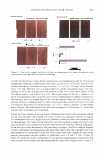
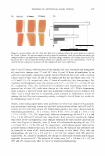
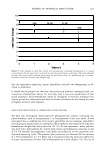
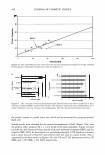
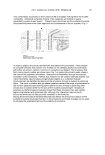
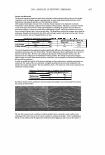
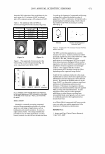
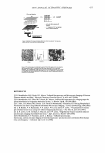
ANALYSIS AND REVIEW OF CELLULITE 389 Resolution in average-BM! women was still permissible with resolution of blood flow and individual collagen fibers. In females with greater than average BMI at all sites, collagen was stretched (resembling striae), and many dark fluid-filled spaces were ob served at all sites compared to those in females with average BMI. Resolution in greater-than-average-BM! women was not permissible, with loss of resolution of blood flow and individual collagen fibers. The observed dark fluid-filled spaces index-matched to water. Another observation particular to female skin was the presence of so-called "puncture" zones surrounded by blood flow (Figure 6). The collagen appeared very dense and "stretched" in one direction and the epidermis very thin, with little resolution of the basal cell layer. Although the observations appeared as actual "holes," they are not considered at this stage of investigation to be actual adipose tissue puncturing the dermis, but the indentations as seen by Querleux et al. (10) and subsequently identified as tightly packed dermal papillae (9). However, neither is it ruled out that these observed dark spaces in the image could be where adipose had protruded, since histo pathological studies by Pierard et al. had observed fat "herniation" (8), which was also seen in MRI studies (9). Since the dark fluid-filled spaces index match to water, they are currently under further investigation (62). In the cellulite condition there are numerous reports of increased glycosaminoglycans (GAGs), components of the ground substance that fill the spaces between collagen fibers and collagen bundles. GAGs trap bulk (tetrahedron) water, which is unable to bind to proteins, resulting in rigidity and instability of the collagen fibers-also seen in striae distensae. If the collagen as observed in cellulite is stretched, more spaces appear, giving rise to an increase in the potential for more bulk water, which could be observed as dark spaces that are not blood vessels. If there are abnormally increased amounts of reticular collagen (thinner), they are then suspect to rupture. Increased amounts of reticular collagen could be examined to see if in cellulite-prone females there is an abnormality in active fibroblasts. Active growth fibroblasts also cause an increase in GAGs. Although this work is still in its initial stages, further investigations are continuing to Figure 6. (a,b) Indentations into the dermal-epidermal layers. The arrows indicate actual blood flow within the capillaries.

390 JOURNAL OF COSMETIC SCIENCE rule out the influence of long-term sun exposure as compared to actinic damage (62). However, the limitation of this technique, as with other image analysis systems, is in obtaining clear resolution beyond the upper portion of the dermal papillae. CONTACT THERMOGRAPHY Contact thermography (CT) can measure alterations or variations in skin temperature, and thus any skin disorder affecting directly or indirectly the microcirculation of the skin becomes a candidate for thermal evaluation. Consideration of the application of CT to cellulite should be given. In a compressed subcutis, as seen in cellulite and visualized by several of the image techniques described in this paper, the microvasculature is pressed against the papillary dermis. The amount of heat generated could be compared to that observed in non-cellulite skin. CONCLUSIONS Dimpling of the skin of the peripheral regions of the female body, commonly called cellulite, is presumed wrongly to be an abnormality of adipose tissues rather than normal reality. Reality dictates that cellulite is a condition reflected in differences in adipose biochemistry and connective tissue structure in the female gluteal-femoral adipose tis sue. At this stage of current understanding of the condition, it is concluded that "visual cellulite" is a consequence of the inability of collagen at the papillary dermis to contain adipose protrusion through a "thin" dermis, which is not observed in males. From current image analysis techniques, it is suggested that dimpling of the skin is associated with enlarged fat lobules surrounded by thin and focally loose connective tissue strands. Furthermore, the "striae" observed in these studies may result from excessive tension arising from the continuous and progressive vertically orientated stretch in the adipose tissue. Due to the limitations of each technique, there is no one method at present that can be used to evaluate cellulite. Furthermore, current formulations do not penetrate suffi ciently into the adipose tissue to cause an effect. However, strengthening a "thin" dermis would be a step in the right direction. Although cellulite appears incurable, the subject itself needs a clearer understanding, a consistent approach, coherency to prevent misinterpretation and misunderstanding in both the scientific and popular literature, formulations that "deliver," correlation of data, good clinical development of methods, and management and understanding of the psychological and social aspects of the condition. Only then can the unmet need of managing the expectations of the consumer and of the regulatory and advertising au thorities be achieved. ACKNOWLEDGMENTS The authors thank Professor Gerald Pierard for permission to use the photographs m Figure 1, and Lucid Inc. for performing the confocal microscopy analyses.
Purchased for the exclusive use of nofirst nolast (unknown)
From: SCC Media Library & Resource Center (library.scconline.org)