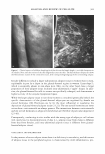
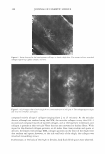
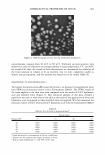
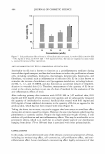
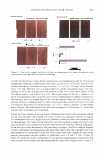
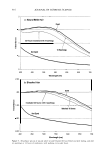
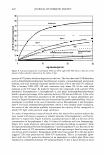
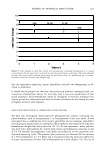
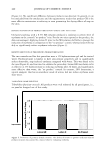
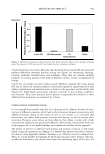
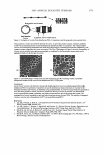
414 JOURNAL OF COSMETIC SCIENCE and cyclopentasiloxane (Si-Tee™ GF 3092), 10% phenyl trimethicone (Si-Tee™ PTM 20), 3% amodimethicone (Si-Tee™ AM 652), 0.1 % cyclopentasiloxane (Si Tec™ CM 040), 29% tocopheryl acetate, 0.1 % SD-40 Alcohol, 55%. RESULTS AND DISCUSSION COLOR FADING BY SHAMPOOING VS IRRADIATION AND SHAMPOOING It is commonly observed that shampooing and solar exposure of dyed hair leads to a noticeable color loss, even for hair treated with permanent hair dyes. This effect is dependent upon the hair color shade and, consequently, the composition of the dyeing system employed in a hair-color formulation (12). The most pronounced fading effects are typically observed for red shades such as light auburn, medium auburn, and dark auburn. Traditional compositions of such hair dyes are based on 4-amino-2-hydroxy toluene, 1-naphtol, or 2-methyl-1-naphthol as red shade couplers (12,13). More vivid red colors can be obtained by using pyrazole derivatives such as 1-hydroxyethyl-4,5- diamino pyrazole sulfate, which act as primary intermediates (12). Other novel inter mediates, such as phenyl methyl pyrazolone and 6-hydroxyindole, can serve as couplers (14,15). In order to compare the color changes from shampooing and exposure to sunlight, we analyzed the samples of three types of hair, which included natural white, dark brown, and bleached hair, all dyed with a dark auburn shade of a commercially available hair color based on non-pyrazole technology (I). One set of samples was shampooed ten times without exposure to sunlight, in which case the hair samples were allowed to dry between each shampooing. Another set of samples was exposed to 32 hours of irradiation and shampooed after every eight hours of exposure. Figure 4 shows the total color change in terms of dB values for hair after the completion of treatments. It is evident that the color variation depends on the type of hair. Washing alone produced the same extent of color change, with dB values of 1.7-1.8 in bleached and white hair. There was less color variation in shampooed dark brown hair subjected to shampooing alone. In contrast to this, dyed white hair underwent very significant color fading (dB = 8.1) as a result of light exposure and shampooing. Most likely, this can be ascribed to the limited pho tostability of the hair-color chromophores and the lack of the photoprotective effect of a natural pigment such as melanin. Additionally, white hair (Piedmont hair) is lightened as a result of irradiation, which might be a contributing factor to the observed large photofading effect. Photo-irradiation/shampooing of bleached hair resulted in a smaller color loss. It is possible that such a result is the consequence of two reactions occurring in bleached hair. First is the fading of the artificial hair color and second is the darkening of background hair as a result of the recondensation of residual melanin products that remain in hair after bleaching. Such a phenomenon was observed and reported for photo-irradiated bleached hair (16). In contrast to this, highly pigmented brown hair showed only small color variation, with a dB value of about 1, after 32 hours of irradiation and four shampooings. Further details of color changes are given in Figures 5a and 56, which show the absor bance spectra of natural white and bleached hair before and after dyeing. The figures also

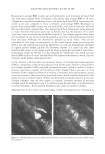
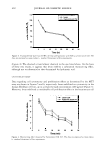
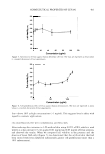
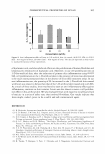
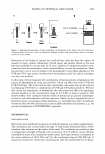
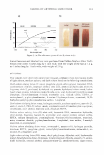
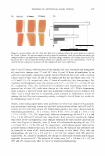
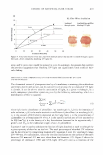
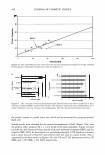
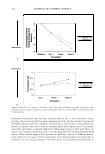
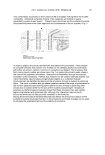
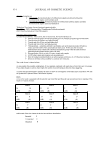
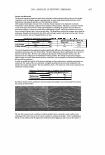
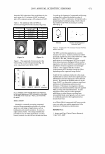
Natural white hair Bleached hair FADING OF ARTIFICIAL HMR COlOR dE = 1.8 8.] dE = L7 4.5 Dark brown hair -p dE = O J , . •- -� I•- ... -1 415 u Vi,gm·e • . Color loss for �amples dyed dar · r d after ten shampooings or 32 hours of irradiation, with ,.,:ashing after every eight hours of exposure (irradiation). include the absorbance curves of hair subjected to ten shampooings and to 3 2 hours of irradiation/sl ampooing combination treatments. Dyed natural white and bleached hair exhibir- maximum ab or ance of approxi, atdy l.5-L6 near 500 nm, \vhich declines above 5 50 nm. · leachcc hair is characterize by greater : bs rbance above 600 nm, lea ling to che d rker app·arance of the s-u11ples tr ated wit.h a hair color. Based on the ab orbance �pecrra it is e id 11t that oly n smt 11 pero.:ntage of rhe dye is rel o cd .1 a result of sham po ing alon , fi r b th rypes of hair. Combimtion crcatmenrs (irradiati 1 / shampooing) lead m a greater los of col r for the nau ral whice and bleached h· ir. ] n contrast to this, as demonstrated by resulc not shown here, dyed dark hro\l n h. ir had a maximum absorbance of approxim rely 1.6, with a smaller decrease in abs rhance above 600 nm. The absorbance of the dark brown sampl s at 700 11m \Va!'. -1, with little change � frer shampooing or irradiation. Figure 6a shows images of natural white (Piedmont) hair dyed with a medium auburn dye (II, non-pyrazole) and exposed to 16 and 32 hours of irradiation. One set of samples was shampooed after every eight hour of irradiation, while the other \\as irradiated with no shampooing. All tresses h, d sections that \Vere not exposed to light, and their color loss is thought to e related to elevated temperature and humidity during irradiation. As in tile experimen described in the preceding paragraph, dyed hair samples expos d to both irradiation and shampooing lost noticeably more colo than samples that were only irradiarecl or slnmpooed (Figure 6b). The a erage total color changes for areas of the samples shampo eel but nor expo eel rn irradiation :vere 1.1 and l.5 after 16 and 32 hours of irradiation, which corresponc s to two and four shampooings, respectivdy. For areas exposed to irradiation but not shampooed the ·oral color changes were 3.3 and 7.5
Purchased for the exclusive use of nofirst nolast (unknown)
From: SCC Media Library & Resource Center (library.scconline.org)