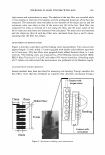
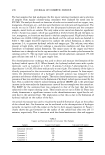
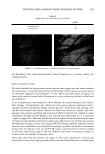
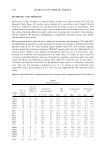
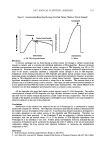
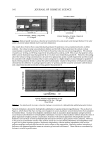
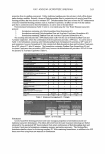
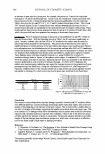
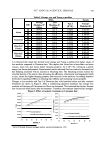
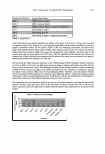
498 JOURNAL OF COSMETIC SCIENCE The hair samples that had undergone the five repeat coloring treatments and a selection of samples from regular colorant-using consumers were analyzed for metal ions by ICP-MS. The analysis focused on detection of redox active metals such as copper, iron, manganese, chromium, etc., and also water hardness ions (calcium and magnesium). The results set out in Table I show that for the lab-prepared substrate and the consumer samples, metal levels are similar. The only redox active metal ion found at significant levels ( 5 ppm) was copper, which was quantified at levels between 66 and 240 ppm no iron, manganese, or chromium was found in the hair samples tested. High levels of water hardness ions (4,000-8,000 ppm) were also found, and the calcium levels are detailed in Table I. The copper would be expected to catalyze the radical formation, as shown in equations 2--4, to generate hydroxyl radicals and oxygen gas. The calcium, even when present at high levels, will not undergo a one-electron oxidation and thus will not contribute to hydroxyl radical formation. The major source of the copper and water hardness ions is thought to be the tap water that is used for the wash cycles between the coloring cycles (7). The tap water used to prepare the lab substrates contained 275-300 ppm calcium ions and 0.1-0.2 ppm copper ions. The chemiluminescence technique was used to detect and measure the formation of the hydroxyl radical species (8,9). When formed, the hydroxyl radicals react with a probe molecule such as luminol or L-O12 (8-amino-5-chloro-7-phenylpyrido [3 ,4- d}pyridazine-l ,4-(2H,3H) dione sodium salt) to emit light. The intensity of the light is directly proportional to the concentration of hydroxyl radicals present. In these experi ments the chemiluminesence of a hydrogen peroxide solution was measured in the presence and absence of the hair sample. The excess chemiluminescence signal seen in the presence of hair was attributed to the formation of hydroxyl radical species caused by the hair. This is called the relative radical forming potential (RRFP) and is the percentage increase in the area under the luminescence curve of the test sample over the control set. The RRFP for the untreated hair was compared to that of the hair that had been subjected to five repeat coloring cycles. These results are set out in Table II. These data clearly demonstrate a significant increase in the chemiluminescence signal for the col ored hair vs the untreated hair. The implication is that this is due to the formation of hydroxyl radicals on the surface of the hair. An optical microscope was used to visualize the possible formation of gas on the surface of the colored hair. Gas formation can be attributed to the decomposition of hydrogen peroxide via reaction with the copper on the hair to form oxygen (equation 4). Figure 1 clearly shows the gas formation on the surface of the colored hair after two and 3 5 minutes, respectively. This is consistent with the chemiluminescence data and supports Table I Copper and Calcium Levels in Consumer Hair Samples Sample Copper level (ppm) Calcium level (ppm) Laboratory substrate 120 8750 Consumer 1 140 5300 Consumer 2 100 6000 Consumer 3 66 3900 Consumer 4 67 8100 Consumer 5 240 6200

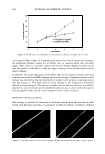
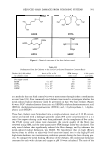
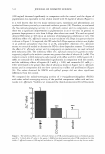
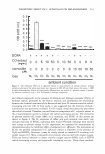
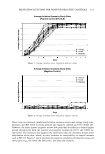
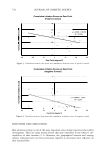
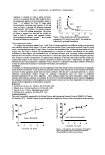
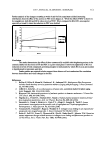
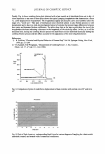
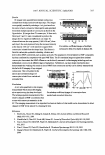
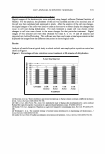
REDUCED HAIR DAMAGE FROM COLORING SYSTEMS 499 Table II RRFP Results for Untreated vs Colored Hair Untreated hair Colored hair RRFP 0 89 Figure 1. Gas formation after 2 minutes (left) and 3 5 minutes (right). the hypothesis that redox metal-initiated radical formation is occurring during the coloring process. RADICAL DAMAGE TO HAIR The data described in the previous section indicate that copper ions and water hardness ions are present in consumer hair and that similar levels of these metals can also be found on substrates prepared in the laboratory. It was shown that these levels of copper can cause redox metal-activated radical formation to occur, producing hydroxyl radicals and gas generation. A set of experiments was designed to show whether this radical formation can lead to fiber damage. Untreated hair was subjected to five repeat coloring treatments with a commercial level 3 permanent blonde colorant product. In-between each coloring cycle the hair was washed with water, wherein the flow rate, metal ion content, and tem perature were closely controlled and monitored. Half of the hair was washed in water containing 150 ppm of water hardness ions (calcium and magnesium in a 3: 1 ratio) and 1 ppm of copper ions. The other half of the hair was washed in water containing the same 150 ppm of water hardness ions but no copper ions. After each cycle the hair was assessed for formation of surface cysteic acid using an FT-IR (Fourier transform infrared) method that has been established to be suitable for studying the effects of oxidative treatments on hair (10-12). Figure 2 sets out the FT-IR cysteic acid measures for the hair washed in tap water containing copper vs the hair washed in tap water containing no copper as a function of the number of washing cycles. These data show that the presence of copper in the water significantly increases the formation of cysteic acid, implying that metal-induced radical chemistry is taking place
Purchased for the exclusive use of nofirst nolast (unknown)
From: SCC Media Library & Resource Center (library.scconline.org)