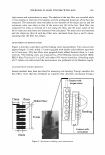
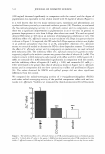
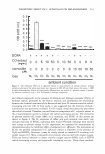
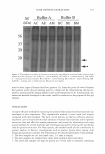
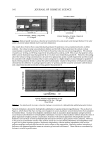
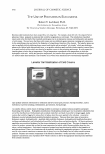
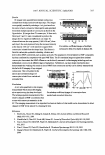
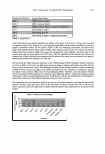
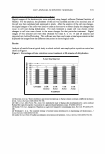
56 37 29 20 M (kDa) HAIR PROTEIN EXTRACTION 533 Buffer A Buffer B AC AE AM BC BE BM Figure 2. Electrophoretic profiles of the protein extracted in two different extraction buffer solutions from human head hair materials. AC: buffer A + control washing. AE: buffer A + ethanol washing. AM: buffer A + washing with a mixed solution. BC: buffer B + control washing. BE: buffer B + ethanol washing. BM: buffer B + washing with a mixed solution. M: protein size marker. may be other types of human head hair proteins (3). From the point of view of human hair protein study, this gel analysis may be a useful tool for characterizing the electro phoretic protein profiles among different sources of human hairs ( 4,9). Consequently, the extraction method developed in this study could be conducive to the purpose of this gel analysis. CONCLUSIONS A simple efficient method for extracting the protein from human head hair materials was developed in this experiment. This reproducible method is more rapid and simpler compared with other methods. The most crucial features are that (a) sufficient amounts of protein can be obtained from small amounts of human hair materials and (b) protein extraction time and effort for sample preparation can be saved by eliminating such steps as pretreatment by several washings and centrifugations and by reducing the incubation time for protein extraction. For these reasons, this method could also be contributive to protein analysis in forensic investigations such as protein typing when testing with human hair proteins is needed. The following are the detailed procedures of this method: 1. The hair samples are cut into small sizes, 1-2 mm in length. 2. The hair samples are washed three times with distilled water and dried. 3. The dried hair samples (20 mg) are placed in a 50-ml tube or container containing

534 JOURNAL OF COSMETIC SCIENCE 5 ml of a buffer solution consisting of 25 mM Tris-HCl (pH 8.5), 2.6 M thiourea, 5 M urea, and 5 % 2-mercaptoethanol. 4. The tube or container is incubated at 50°C for 24 hr. 5. The mixture is filtered through three layers of nylon mesh (200-mesh size). 6. The contents of the protein are measured spectrophotometrically, or SDS-PAGE analysis is performed by concentrating the protein as described in Materials and Meth ods. ACKNOWLEDGMENTS J.-A. Chun and W.-H. Lee were partially supported by BK21 Programs. REFERENCES (1) L. Langbein, M.A.Rogers,H.Wintert,S. Praetzelt, U. Beckhaust, H. R. Rackwitz, and]. Schweizert, The catalog of human hair keratins. I. Expression of the nine type I members in the hair follicle,]. Biol. Chem., 274(28), 19874-19884 (1999). (2) L. Langbein, M. A. Rogers, H. Wintert, S. Praetzelt, and J. Schweizert, The catalog of human hair keratins. II. Expression of the six type II members in the hair follicle and the combined catalog of human type I and II keratins,]. Biol. Chem., 276(37), 35123-35132 (2001). (3) Y. J. Lee, R. H. Rice, and Y. M. Lee, Proteome analysis of human hair shaft, Mol. Cell. Proteomics, 5, 789-800 (2006). (4) S. P. Goyal and V. Sahajpal, Wildlife forensic cell: Activities and development of a novel approach for identifying species from hair using keratin protein profiles, XVI Annual Research Seminar, Wildlife Institute of India (abstract) (2002). (5) T. Inoue, I. Sasaki, M. Yamaguchi, and K. Kizawa, Elution of S100A3 from hair fiber: New model for hair damage emphasizing the loss of S 100A3 from cuticle,]. Cosmet. Sci., 51, 15-2 5 (2000). (6) J. Gray, The world of hair, The P&G Hair Care Research Center an online reference, pp. 4-150 (1997). (7) M. Gerhard, Electrophoretic variability in human head hair: Polyacrylamide gel electrophoresis of hair proteins in the presence of sodium dodecyl sulfate and urea, Electrophoresis, 8, 153-157 (1987). (8) M. Gerhard and M. Hermes, Electrophoretic variability in human hair: Comparative sodium dodecyl sulfate-polyacrylamide gel electrophoresis of body and head hair proteins, Electrophoresis, 8, 490--492 (1987). (9) Y. Shimomura, N. Aoki, J. Schweizer, L. Langbein, M. A. Rogers, H. Winters, and M. Ito, Polymor phisms in the human high sulfur hair keratin-associated protein I, KAPl, gene family,]. Biol. Chem., 277(47), 45493--45501 (2002). (10) A. M. Nakamura, K. Arimoto, K. Takeuchi, and K. Fujii, A rapid extraction procedure of human hair proteins and identification of phosphorylated species, Biol. Pharm., Bull., 25(5), 569-572 (2002). (11) K. Yamaguchi, A. Yamaguchi, T. Kusunoki, A. Kohda, and Y. Konishi, Preparation of stable aqueous solution of keratins, and physicochemical and biodegradational properties of films,]. Biomed. Mater. Res., 31, 439--444 (1996). (12) P. Steinert, R. D. Zackroff, M. Ynardi-Whitman, and R. D. Goldman, Isolation and characterization of intermediate filaments, Methods Cell. Biol., 24, 399-419 (1982). (13) M. M. Bradford, A rapid and sensitive method for the quantification of microgram quantities of protein utilizing the principle of protein-dye binding, Anal. Biochem., 72, 248-254 (1979).
Purchased for the exclusive use of nofirst nolast (unknown)
From: SCC Media Library & Resource Center (library.scconline.org)